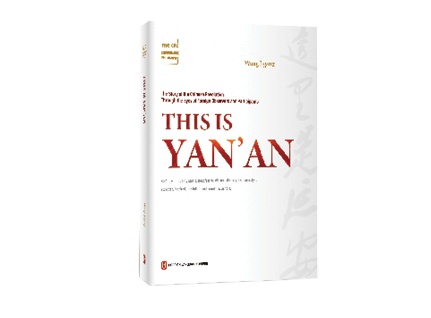
Book: This is Yan’an: The Story of the Chinese Revolution Through the Eyes of Foreign Observers and Participants
Author: Wang Jigang
Published by Foreign Languages Press
For much of the 1930s and 1940s, the outside world had little real access to Yan’an, the seat of the Communist Party of China (CPC) Central Committee, or to the Shaanxi-Gansu-Ningxia Border Region under its leadership. Rumors, misinformation, and deliberate news blockade obscured the reality on the ground. The dominant narrative promoted by the Kuomintang portrayed the Communists as little more than “Red bandits” isolated in barren hills. The truth, however, was far more complex: Yan’an was a functioning revolutionary base with its own systems of governance, whose leaders were determined to communicate their cause to the outside world.
The recently released English edition of the book, This is Yan’an: The Story of the Chinese Revolution Through the Eyes of Foreign Observers and Participants, draws on diaries, dispatches, and memoirs by those who actually made the trek into the Loess Plateau. Among them were Edgar Snow, Agnes Smedley, Helen Foster Snow, Israel Epstein, Anna Louise Strong, and later members of the U.S. Army Observer Group (also known as the “Dixie Mission”). Through their firsthand accounts, the book reconstructs the CPC’s efforts to engage foreign audiences during the Yan’an years and sheds light on one of the earliest large-scale international communication campaigns undertaken by the CPC.
The story begins in the summer of 1936, when Soong Ching Ling received a request from the Party, asking her to recommend a foreign journalist willing to travel to northern Shaanxi. Edgar Snow took up the invitation. On July 13, 1936, he arrived in Bao’an, then the temporary headquarters of the CPC Central Committee. Over the course of many evenings in cave dwellings lit by oil lamps, Mao Zedong spoke with Snow at length about the origins of the Red Army, the development of the revolutionary base areas, and the Party’s vision of a united front against Japanese aggression. The conversations were wide-ranging and inspiring. Four months later, Snow left with many filled notebooks and rolls of film. In October 1937, Red Star Over China was published in London, selling more than 100,000 copies within weeks, cracking the Kuomintang’s information censorship. The now-iconic photograph of Mao wearing a cap emblazoned with a red star soon circulated around the world.
Snow’s visit was not an isolated case. In February 1937, the American journalist Agnes Smedley arrived in Yan’an. That September, the British journalist James Bertram also came at the Party’s invitation. Bertram stayed for about a month, conducting a series of interviews with Mao. These conversations were later published in Jiefang Weekly under the title “Mao Zedong’s Conversation with James Bertram.” “Bertram noticed that Mao was highly attentive to details, insisting that every sentence Bertram wrote during their talks be translated back into Chinese so that he could check his own statements.” Clearly, Mao did not regard the conversation with Bertram as merely an exchange between two individuals; instead, he hoped that through Bertram’s pen, the voice of the Party and its positions on the War of Chinese People’s Resistance Against Japanese Aggression could be conveyed accurately and promptly to the outside world. This, Mao surmised, would win broader understanding and support for China’s anti-fascist struggle.
Throughout the Yan’an period, the CPC maintained a remarkably open approach toward foreign visitors. They were generally allowed to conduct interviews freely, inspect local conditions firsthand, and speak directly with leaders, soldiers, and ordinary residents.
In 1944, Yan’an received two major delegations. In May, the Sino-Foreign Reporters’ Group to Northwest, composed of 21 Chinese and foreign journalists, arrived in the revolutionary base area. Among the foreign correspondents were Gunther Stein of Associated Press, Israel Epstein of The New York Times, Harrison Forman of London Times, Maurice Votaw of Reuters, Father Cormac Shanahan of Catholic Monthly, and N. Prozenko of TASS News Agency. They were permitted to move freely and talk to leaders, workers, students, peasants, and even children at the nursery. When challenged by Kuomintang accusations that the Eighth Route Army was “wandering without fighting,” Votaw offered eyewitness rebuttal: “I saw the battle.” His dispatch from northwest Shanxi documented irrefutable proof, fresh battlefield photos hours after engagement, wounded communist troops, and piles of seized Japanese provisions: matches, cigarettes, canned goods, and even soda pop. Two months later, the “Dixie Mission” arrived in Yan’an in two groups. They examined the CPC base areas centered in Yan’an, the Eighth Route Army’s intelligence networks against the Japanese, and the re-education of Japanese prisoners of war, and submitted detailed reports to the U.S. military and the State Department that were taken seriously by U.S. decision makers.
Equally noteworthy were the channels the Party created to overcome the censorship. In March 1941, the Publicity Department of the CPC Central Committee launched the Report from China, the first foreign-language publication published by the CPC in revolutionary bases. It was mimeographed in English, French, and Russian, carried by underground courier lines to Chongqing, and then distributed to foreign journalists and institutions. On September 1, 1944, Xinhua officially launched its English-language radio broadcasts founded by the CPC. British scholar Michael Lindsay also took part in the technical preparations for the English broadcasts while in Yan’an.
Drawing on extensive original documents, the book weaves together these historical threads to present a core fact: the CPC regarded external communication as a strategic undertaking requiring organization, discipline, and institutional support. It established specialized agencies, such as the Publicity Department of the CPC Central Committee, the Foreign Affairs Group of the CPC Central Committee, the International Publicity Committee under the Publicity Department of the CPC Central Committee, the Foreign Affairs Group of the Southern Bureau of the CPC Central Committee, and the Overseas Work Corps, and launched multiple media outlets (news agencies, newspapers, broadcasting, and foreign-language publications) to tell the world the truth, following the frequently stressed principle “seeking truth from facts” by Mao Zedong. The Party’s confidence and openness left a deep impression on foreign journalists.
For readers today, the book’s value may lie less in offering a set of communication techniques that can be directly copied, but more of a demonstration of a pragmatic attitude when facing isolation and misunderstanding. When information barriers are high and competing narratives dominate public discourse, openness, firsthand observation, and factual documentation can carry greater persuasive power than polished publicity alone. Conditions in Yan’an were extraordinarily harsh, there were no modern printing facilities, no professional communication teams, not even a reliable electricity supply, yet the CPC still succeeded in making its voice heard internationally and in reshaping how many outsiders understood the Chinese revolution.
For readers seeking to understand how the CPC evolved from a remote revolutionary movement in northwest China into a governing force with global influence, and how it successfully communicated with the outside world across different historical periods, this book offers a distinctive and well-documented window into a formative chapter of modern Chinese history.
WU JIAMING, PhD in Law, is a faculty member of Shanghai International Studies University. With an academic background in international politics, she has long been engaged in research on international relations.