Lessons from China help improve agricultural practices in Malawi, strengthening South-South cooperation and advancing local development.
A dry wind sweeps across Lake Malawi, carrying fine dust from the red earth. The air feels warm and dense. On this red soil, hybrid maize, a new variety blending Chinese germplasm with local Malawian seeds, is thriving. Its green leaves sway in the wind, a testament to its strong adaptation to local conditions. Every time I look at this field, I feel a profound sense of emotion. This might seem like an unusual reaction to a field of corn, but it becomes understandable when you know the impact it has on the lives of local people. What grows here is not just grain, but Malawi’s hope for a future free from poverty. It also reflects the importance of collaboration among Global South countries in pursuit of shared development.
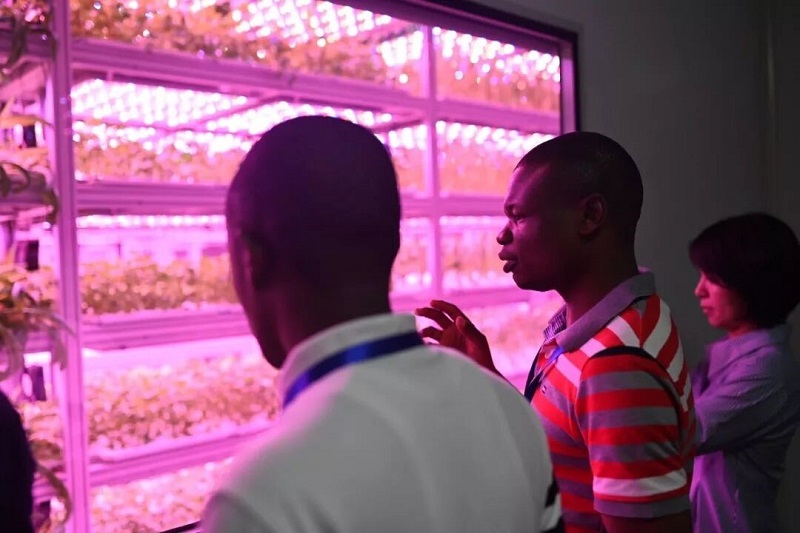
Donasius Pathera visits a Chinese enterprise with classmates from Peking University’s Institute of South-South Cooperation and Development.
In Malawi’s economic landscape, the legacies of colonialism remain deeply embedded. Since gaining independence in 1964, the country has experimented with multiple development pathways, from an agriculture-dependent model under authoritarian rule to Western-led market reforms and an international aid-dependent trajectory. Yet, none have overcome the structural constraints of a monocrop economy.
Forced into a tobacco monoculture during colonial times, the country still struggles to diversify its domestic production, leaving it economically vulnerable and reliant on food imports.
The establishment of diplomatic relations between China and Malawi in 2007 opened new possibilities. As an economist long concerned with my nation’s progress, I began to follow China’s economic trajectory and international cooperation projects. I learned about its historic achievement of lifting hundreds of millions out of poverty and observed Chinese cooperation projects take root across Africa. This sparked an idea: perhaps Malawi doesn’t need to rely on off-the-shelf models from Western textbooks. Perhaps China’s development experience could offer a new blueprint for progress.
I then made a life-changing decision to pursue doctoral studies at the Institute of South–South Cooperation and Development (ISSCAD) at Peking University in Beijing, China. At the time, many of my peers were following established paths, applying Western development models directly to African countries. But I was convinced that development cannot simply be imported; it must be grounded in local conditions. My conviction deepened in 2020 when Malawi officially joined the Belt and Road Initiative (BRI). The synergy between the Forum on China–Africa Cooperation and the BRI has since contributed to measurable improvements in Malawi’s infrastructure, agricultural and electricity supply, reinforcing the path I had chosen.
Reframing Development
At ISSCAD, I met peers from across the Global South. Despite our diverse backgrounds, we shared a core conviction that there is no one-size-fits-all model for development, and progress cannot be achieved through simple replication.
Instead, it depends on precisely aligning global knowledge with local realities. This was the first and most profound lesson ISSCAD taught me. It taught us to believe in our national capacity and development potential.
Through my studies, I came to understand that the frameworks of Western development economics are not universally applicable. Developing countries should not be viewed as passive recipients of external ideas, but as active contributors to knowledge production, drawing on their own experiences and participating in the construction of alternative development paradigms. This perspective, grounded in a strong sense of self-identity, was one of the most valuable outcomes of my training.
Field visits across China provided a practical dimension to this theoretical understanding. From agricultural research institutions and rural cooperatives to industrial parks, I saw how state capacity, institutional coordination, and long-term strategic planning combine to produce results. China’s development experience should be understood not as a transferable model, but as an empirical reference that proves the feasibility of alternative development pathways grounded in domestic priorities and long-term planning.
This insight allowed me to move beyond conventional frameworks and critically reassess Malawi’s agricultural challenges: structural fragmentation, vulnerability to external shocks, and poor market integration. These conditions have contributed to persistent food insecurity and limited rural transformation.
With these issues in mind, I studied China’s agricultural cooperatives and its model of industrial poverty alleviation, particularly how it organizes dispersed smallholders into streamlined production and marketing chains, using an approach that is guided by the government, driven by the market, and centered on farmer participation.
A field visit to an agricultural base in Hubei Province provided a concrete example. The area had long relied on smallholder farming, with limited market access and low prices for the agricultural products. Subsequently, the government helped establish cooperatives, providing improved seeds, technical training, and market access in a coordinated manner. Farmers contributed land or labor as equity and received a proportionate share of profits. In just a few years, an integrated value chain encompassing production, processing, and distribution was established, leading to higher product value and increased farmer incomes. Such models, I believed, may offer viable pathways for addressing structural constraints in Malawi’s agricultural sector, particularly in relation to market access, productivity, and rural livelihoods.
I later led a Malawian expert team on a study visit to China, with a focus on cutting-edge agricultural technologies. In Inner Mongolia, we observed genomic-based livestock and poultry breeding systems, seeing how precision breeding technologies boost yield and quality. In Hubei Province, we studied an artificial intelligence-driven horticulture system, where big data and Internet of Things applications are integrated into agricultural production processes. These cases demonstrated the application of cutting-edge technologies, systematic government support, and deep integration of research and farming, reaffirming the importance of innovation and capacity-building. The visit also reminded me of a key principle taught at ISSCAD: development is the result of a deliberate, planned, and active effort by people rather than a spontaneous process.
Upon returning to Malawi, I translated these insights into action. As a Food and Agriculture Organization (FAO) Officer coordinating South-South cooperation projects in Malawi, I focus on adapting tested technologies and institutional models from other developing countries, particularly China, to Malawi’s agricultural context. Our guiding principle is adaptation, not replication.
Drawing on China’s cooperative experience, we helped establish Community Agricultural Development Associations. These associations provide farmers with access to improved seeds and technical training while also facilitating centralized procurement and coordinated marketing systems. This approach has contributed to reducing input costs and increasing farm-gate prices. With support from the China-Malawi Agricultural Technology Cooperation Center, we introduced Chinese water-saving irrigation technologies and high-yield maize and rice varieties, which were localized and promoted. As a result, maize yields in pilot areas increased from less than 4.5 tons per hectare to over 7.5 tons. Many farmers have achieved food self-sufficiency and, in some cases, generated surplus production for market sale.
Power of Cooperation
My studies in China changed my worldview and strengthened my belief in the power of Global South collaboration. Countries with shared historical experiences, structural challenges, and development aspirations are often better positioned to exchange relevant and context-specific knowledge. When academic experts in Beijing provide technical training on irrigation systems to Malawian agricultural practitioners, and Malawian scientists acquire advanced molecular diagnostic skills in Chinese laboratories, these exchanges extend beyond technical knowledge transfer. They represent development partnerships that drive profound change.
The first bridge of cooperation I built at ISSCAD has since extended into multiple dimensions of my professional work. The alumni network of the institute, spanning more than 70 countries, has become an important source of technical and institutional support. When challenges arise in areas such as technology adaptation or policy design, engagement within this network often generates timely and context-specific responses. Alumni from Brazil share insights on market operations for smallholder cooperatives, Bangladeshi colleagues contribute experience in rural agricultural credit systems, and Chinese alumni provide localized technical guidance adapted to Malawi’s soil and climatic conditions. This cross-border solidarity has turned South-South cooperation from an abstract concept into tangible joint progress.
As both a participant in and observer of the BRI in Malawi, I have also reflected extensively on the phenomenon often described as “BRI phobia.” My analysis suggests that misunderstandings and concerns surrounding the initiative in different regions are largely rooted in information scarcity and limited transparency. In many English-speaking contexts, there is a lack of detailed, accessible information about Belt and Road projects, and the absence of dedicated communication platforms contributes to incomplete or vague public understanding, including within African societies. Addressing these perceptions requires approaches consistent with the principles of South-South cooperation. These include strengthening information flows, improving communication channels, promoting multi-stakeholder dialogue, and enhancing transparency as a foundation for trust and long-term international cooperation.
The year 2026 marks the 10th anniversary of the establishment of ISSCAD. Standing on the red soil of Malawi and reflecting on my journey, from a student by Weiming Lake to a coordinator of agricultural transformation in Malawi, and from initial uncertainty about development to a firmly grounded, locally oriented development path, I am filled with both gratitude and a sense of achievement.
The institute represents more than an academic institution; it serves as a lens through which the development potential of the Global South can be understood. When countries choose self-reliance over dependence, and collaboration over isolation, they can forge their own path to development. My experience represents a small reflection of the institute’s broader mission. It demonstrates that when knowledge is rooted in the original aspirations of development, it can transcend geographic boundaries and contribute to tangible transformation in both livelihoods and landscapes.
The institute’s anniversary also signifies the emergence of a new generation of empowered practitioners from the Global South. The cohort has the courage to break free from fixed development templates and create development pathways that are tailored to national contexts. It also affirms a belief that the Global South is defined not just by its struggles, but also by its capacity for innovation, learning and advancement.
Today, on the red soil of Malawi, agricultural production continues to improve, and the network of South-South cooperation continues to expand. I will stay true to my original aspiration, keep striving for Malawi’s agricultural development, and contribute to Global South collaboration. This journey, which began at Weiming Lake in Beijing, continues alongside many others who share a similar vision.
—————
Donasius Pathera, an economist from Malawi, is a Ph.D. graduate from the Institute of South-South Cooperation and Development at Peking University.