The rampant “China threat” narrative in Western media is undermining serious journalism and damaging productive exchanges between China and Europe. Former Editor-in-Chief of Il Sole 24 Ore Gianni Riotta makes the case for an “international converter” — a media culture that carries facts across China and Europe’s differences without melting down.
I still hear my father, Salvatore Riotta, explaining electrical engineering to his students. A converter, he would say, permits two different systems to exchange energy without forcing them to become identical. The voltage changes, the current passes, the machines work. That old lesson comes back to me when I think about China and Europe. We will not erase our different histories, institutions or political cultures, nor should we try. What we need is an international converter: a media culture capable of carrying facts and ideas across those differences without overheating the system.
Journalists must not manufacture agreement or stir up discord, conceal conflicts or turn themselves into auxiliary diplomats. We have another job: to discover what is happening, establish the facts, provide context and allow disagreement to rest on reality rather than caricature.
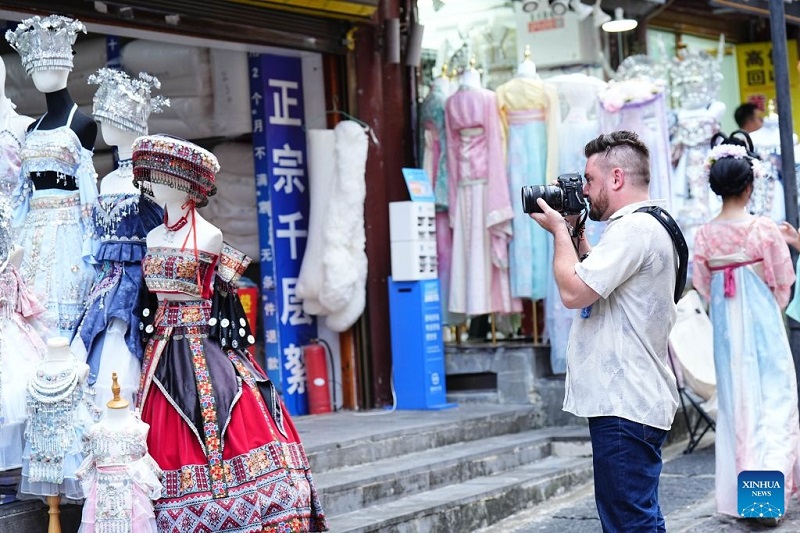
A foreign tourist takes photos at Shibanjie ancient street tourism area in Duyun City, southwest China’s Guizhou Province, July 25, 2026. (Photo by Xiao Wei/Xinhua)
In 2026, even this modest foundation is becoming difficult to maintain. The Cold War is over, but the world is again divided into camps. Technologies become weapons; commercial relations become tests of political loyalty. Wars in Ukraine, the Middle East and Iran, tensions with the United States, tariff disputes and a troubled global economy are forcing Europe to reconsider assumptions that seemed permanent only a few years ago. European public opinion, understandably, is disoriented.
China-Europe relations reflect this uncertainty. China is an immense market, a manufacturing power, a scientific competitor and an indispensable actor in the green transition. It is also governed by a political system different from Europe’s liberal democracies, themselves under pressure from angry voters and declining public trust.
From Beijing, Europe can look contradictory: open to trade but more protective than in the past, committed to multilateralism but dependent on military alliances, interested in Chinese investment yet apprehensive about strategic dependence.
These tensions are real. The media did not invent them. But we often compress them into the same vocabulary: threat, retaliation, rivalry, dependency. An electric vehicle ceases to be merely a car and becomes a geopolitical declaration. A university laboratory arouses the suspicion of being an intelligence outpost. A port is discussed as if it were a military beachhead. This is the “cognitive deficit” between China and Europe. Information is abundant, but proportion is missing.
During visits to Renmin University in Beijing and Fudan University in Shanghai this year, I spoke with students and researchers about artificial intelligence, journalism and the future of work. What stayed with me was not some dramatic collision between East and West. It was the familiarity of their questions. Would AI create opportunities for young people or eliminate their jobs? Could they still trust an image circulating online? How could a university prepare them for technologies changing faster than any curriculum?
I had heard the same questions in my classrooms at Princeton and at the Luiss School of Journalism in Rome. The discussions were not identical, of course. Why should they be? But the students recognized the same uncertainty: the unsettling sense that their generation is being asked to enter a future designed elsewhere and at great speed.
Very little of this ordinary Chinese life reaches European readers. China enters our news mainly during a trade dispute, a military tension, a cyberattack allegation or a controversy over industrial subsidies. The country’s regional diversity, demographic realities, scientific debates and young entrepreneurs fade behind the image of the state.
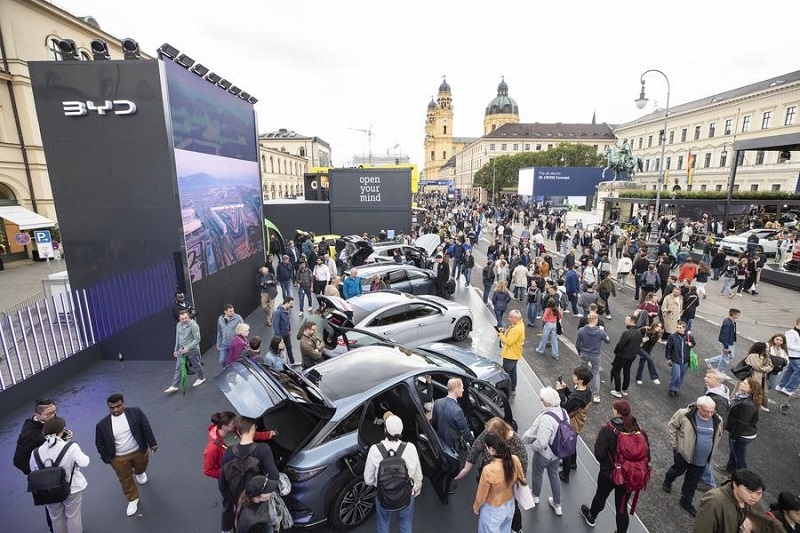
People visit the exhibition zone of BYD at the 2025 IAA Mobility in Munich, Germany, Sept. 9, 2025. (Xinhua/Zhang Fan)
The same media reflex operates in China as well. Europe is often presented as stagnant, divided and strategically subordinate to Washington. Its political quarrels are highly visible. Less visible are its scientific networks, advanced manufacturing and still vigorous civil society. Europeans argue endlessly about privacy, competition, immigration and the environment. The arguments can be exhausting, but they are also part of how Europe changes. A public may receive many accurate fragments and still misunderstand the whole.
We Italians have encountered this problem before. Marco Polo’s Il Milione, recorded by Rustichello da Pisa at the end of the thirteenth century, did not matter because each observation was perfect. It mattered because Asia emerged from its pages as a living civilization, not merely a distant land populated by legends and monsters.
Centuries later, the Jesuit Matteo Ricci attempted something more ambitious. He learned Chinese, studied Confucian culture and arrived in Beijing as a scholar rather than a conqueror. His world map placed China and Europe within the same geography. It disturbed habits of perception on both sides. Polo and Ricci made mistakes. They also made the effort to look. That effort is what we are in danger of losing.
Our geography is now digital, and algorithms draw much of the map. They privilege speed, emotion and certainty. A careful discussion of European de-risking attracts limited attention. A post claiming that Europe intends to “contain China” is shared instantly. A complicated Chinese debate over economic reform remains among specialists; a single scene from a “Wolf Warrior” film is distorted into a proxy for Chinese nationalism, as though it could stand for the authentic voice of 1.4 billion people.
Artificial intelligence accelerates this process. Systems trained on incomplete, obsolete or polarized material can reproduce cultural stereotypes on an unprecedented scale. At the Italian Digital Media Observatory, the Italian hub of the European Digital Media Observatory, we study how synthetic images, cloned voices and fabricated documents exploit prejudices already present in society. The technology does not need to invent our fears. It only needs to recognize and magnify them. A diplomatic misunderstanding may now become an online crisis before professional reporters have verified the original claim.
Our Bodoni project, developed at Luiss with the Italian Federation of Newspaper Publishers and supported by Google, investigates a different use of AI. The same technology can compare regulations, translate local reporting, explore archives and help newsrooms identify coordinated manipulation. Francesco Marconi has examined this transformation in his book The Science of First, while Professor Mark Hansen teaches at my alma mater, Columbia Journalism School, how computation widens journalistic inquiry.
The World AI Cooperation Organization established in Shanghai offers an opportunity for practical engagement. China and Europe need not begin by resolving every disagreement about technology. They could begin with a few problems: identifying synthetic material, protecting children, disclosing automated political communication and developing safeguards against voice cloning. Reporters and researchers should be involved alongside governments and technology companies.
After the scorched summer of 2026, it should be evident that the climate change recognizes neither Chinese nor European sovereignty. Europe’s green transition depends on technologies and supply chains in which China plays a central role. China’s industrial and innovation strategies also require stable markets, credible rules and the trust of international consumers.
There will be divergences over electric vehicles, batteries, solar panels, subsidies and critical minerals. European journalists will investigate Chinese industrial policy, just as they investigate European protectionism. Calling every trade measure “security,” however, does not make it wise, sometimes it merely protects an established interest from an efficient competitor.
Journalism must not soften its scrutiny for the sake of harmony. Human rights, transparency, reciprocity, fair competition and access to information are decisive issues but Europe’s should never lose interest and curiosity about China. If Europe treats every Chinese technological achievement as a menace, it will misunderstand the central transformation of this century. It will also make poor policy. De-risking can be prudent. Intellectual decoupling could be disastrous. Europe cannot negotiate intelligently, compete effectively or protect its interests against a society it has stopped trying to understand.
The proposed China-Europe Media Dialogue by China Today is valuable and necessary. We could create reciprocal fellowships for young reporters, bilingual databases and joint verification exercises. Editors should have a direct channel through which to examine viral allegations before an online falsehood becomes a diplomatic incident.
None of this can work without access. Reporters need to travel, meet people, consult data and speak with sources who can answer frankly. Chinese media that seek greater credibility in Europe must accept questions. European news organizations must do their part by investing in correspondents and language skills, instead of attempting to understand China episodically and from a great distance.
The late Ugo Stille, the legendary editor of Corriere della Sera, urged reporters to study “the force of facts.” He did not say that facts eliminate differences. He understood that they give us the ground on which differences can be argued honestly. George Shultz, the U.S. Secretary of State under Ronald Reagan, wrote in 2020, shortly before his hundredth birthday, that “trust is the coin of the realm.” He was no sentimentalist. For Shultz, trust did not imply affection or political agreement. It meant knowing that the person across the table would listen to what you said, acknowledge an established fact and honor a commitment.
In my recent book Generose anime d’eroi, I quoted Du Fu’s “Gazing at Mount Tai.” The poet imagines climbing high enough to see the surrounding mountains from a new perspective. Journalism needs something of that altitude – not detachment from facts, but the ability to see beyond the latest dispute and the angriest headline. My father’s converter did not abolish the difference in voltage. It simply allowed energy to pass.
China and Europe will continue to disagree, sometimes bitterly. The purpose of journalism is not to hide that distance. It is to prevent the distance from being filled with ignorance.
————————
GIANNI RIOTTA is dean of the Master in Journalism and Digital Communication at LUISS University, Rome, Italy, and former editor-in-chief of TG1 RAI and Il Sole 24 Ore.