The most compelling rebuttal to the “China Shock” and “China Squeeze” narratives in recent weeks is not coming from Beijing, but from Washington and Cambridge-on-the-Charles, Massachusetts.
In August 2026, Harvard Kennedy School professor Dani Rodrik and Michael Strain, director of economic policy studies at the American Enterprise Institute, publicly rejected the very premises that have anchored a decade of Western hand-wringing about China’s industrialization. Their verdict was straightforward: China’s trade policy is not “beggar-thy-neighbor” but might be “enrich-thy-neighbor.”

Visitors view the models of Chinese EV brand XPeng at the 2026 Brussels Motor Show in Belgium on Jan 10, 2026. (XINHUA)
Beyond finished goods, China is also a major exporter of production machinery, components and intermediate products that help lower the cost of industrialization for many countries. To demand that China sacrifice its own industries to make room for others is, in China’s Foreign Ministry’s words, “an off-base economic narrative.”
When two economists who typically sit on opposite sides of America’s trade-policy debates reach the same conclusion, the debate is, for all practical purposes, over. Yet the “China Squeeze” thesis rolls on – most recently in a New York Times commentary titled “The Next China Shock Is Here,” lamenting U.S. manufacturing job losses and the rise of Chinese competition in advanced industries.
A Narrative Built on a False Premise
The “China Squeeze” argument, introduced by two Indian scholars in Foreign Affairs in 2026, insists that Chinese manufacturing is simultaneously “crowding out” the West and “squeezing” the industrialization space of the Global South. However, as Columbia University historian Adam Tooze observed, unlike the “China Shock 1.0” or the latest “Shock 2.0,” which at least studied measurable labor or market impacts, “China Squeeze” is a wholly counterfactual speculation. It does not describe what has happened; it imagines what might have happened had China not industrialized, and then indicts China for the difference.
Rodrik’s rejection goes to the heart of the matter. Writing in Project Syndicate on August 10, he argued that when major economies run at near full capacity, trade deficits represent “a transfer of purchasing power from surplus countries” that can boost consumption or investment in deficit nations. “Under the current circumstances, then, China’s widely criticized surpluses might as well be called enrich-thy-neighbor,” he concluded.
Rodrik dismissed the “overcapacity” complaint as “often misplaced,” noting that the consumer benefits of cheap Chinese goods are real and that it is mostly genuine productivity gains – not subsidies – that drives China’s competitiveness. He argued that predatory pricing is not a valid concern regarding Chinese manufacturing exports, because there is no evidence that China intends to build or exercise monopoly market power.
The facts back this up. Affordable Chinese manufacturing has lowered the threshold of industrialization for developing countries. Open-source Chinese innovation has made frontier technologies accessible and affordable to more nations. Stable Chinese supplies have strengthened global supply-chain resilience, accelerating the modernization of Global South countries.
On August 20, Foreign Ministry spokesperson Lin Jian welcomed these “increasingly insightful voices” from the international community, saying that, “Facts prove that China’s development brings the world not ‘shock’ but opportunity, not ‘squeeze’ but empowerment.”
When American economists and Chinese diplomats come to the same conclusion, the propaganda value of “squeeze” collapses under its own weight.
What the New York Times Gets Wrong about the “Next Shock”
The recent New York Times commentary “The Next China Shock Is Here” leans heavily on the original “China Shock” research of David Autor, David Dorn and Gordon Hanson, who attributed millions of U.S. manufacturing job losses to the import competition from China. But Michael Strain, in his August 18, 2026 column in Project Syndicate, pushes back hard indicating every part of the argument is off base.
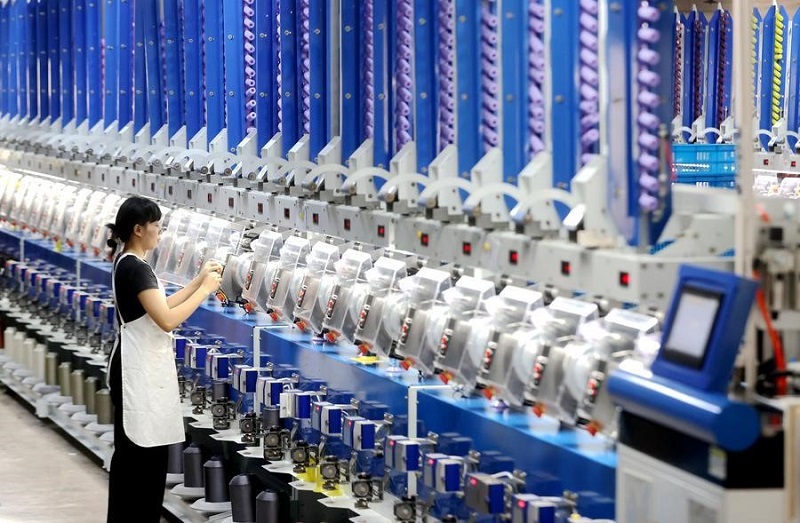
A worker checks automatic spool winders at a smart factory of a company in Xin'an Town of Deqing County, Huzhou City of east China's Zhejiang Province, June 15, 2026. (Photo by Xie Shangguo/Xinhua)
His reasoning is worth quoting at length. Between 2000 and 2007 alone, more than five million American workers – including roughly 425,000 manufacturing workers – separated from their employers every single month. Against that backdrop of ordinary labor-market churn, the China-attributed losses, while real, are far from the civilizational trauma the narrative implies. More importantly, Strain notes, the ledger has two sides: export-intensive U.S. firms and sectors gained jobs even as import-competing ones shed them. Automation, productivity growth and the natural dynamism of the U.S. labor market were doing far heavier lifting than any container ship from Shenzhen.
Strain contends that the political and cultural narrative surrounding trade with China exaggerates its negative impacts while ignoring the stabilizing effects of broader economic dynamism. As he argues, “Policymakers should not build walls around the economy or attempt to slow the pace of technological change. They should approach the future with optimism, not with fear.”
Even Autor himself, in his 2025 New York Times guest essay with Hanson, conceded that the practical path forward should see the U.S. “act in unison with other countries… and invite China to build plants in the United States,” invest in strategic new fields, and choose the battles that can be won. They argue that the U.S. should treat China’s industrial rise as a competitive challenge requiring strategic collaboration and targeted domestic investment in semiconductors and critical rare earths – rather than relying solely on tariffs.
Yet the New York Times article revives the same zero-sum framing for the so-called “Shock 2.0” – the rise of Chinese competitiveness in aviation, AI, telecom, batteries, biotech and quantum computing. This is not “shock.” It is what happens after a nation has invested deliberately in education, infrastructure and industrial policy for four decades. If the U.S. finds itself unprepared, the fault lies not in Beijing but in Washington’s own failure to upgrade the country.
Global South Knows Better than Western Pundits
The most revealing aspect of “China Squeeze” is whom it claims to speak for. The narrative insists that Chinese manufacturing is encroaching upon the industrialization development space of Global South countries. But what does the Global South actually say?

Guests interact with a humanoid robot during a partner conference held by Chinese company AGIBOT in Jakarta, Indonesia, June 9, 2026. (Xinhua/Agung Kuncahya B.)
On July 10, Foreign Ministry spokesperson Mao Ning put it plainly: “The so-called ‘China Squeeze’ is clearly inconsistent with the facts, and countries of the Global South would not endorse this narrative either.” As a member of the Global South, China shares its experience and helps other developing countries progress.
The data on trade, investment and technology all confirms her point. In May 2026, China extended zero-tariff treatment to manufactured and agricultural exports from all 53 African countries with which it has diplomatic relations. China has now granted zero-tariff treatment to 63 countries in total. Through the Belt and Road Initiative (BRI), China has delivered railways, highways, ports and power plants across Asia, Africa and Latin America. A World Bank report estimates that BRI cooperation could lift 7.6 million people in partner countries out of extreme poverty and 32 million out of moderate poverty by 2030.
In the hi-tech field, Chinese smart manufacturing technologies are boosting industrial capacity in more than 20 countries, from production lines in Malaysia to power grids in Chile. At the 2026 World Artificial Intelligence Conference, China announced 5,000 AI training opportunities for developing countries over five years, plus an AI-powered weather-warning system for 30 countries.
None of this looks like “squeezing.” In fact, it looks like the polar opposite.
Flawed Premise: A Fixed Pie in an Expanding Economy
Beneath “China Squeeze” lies a single, fatal assumption: that the global economy is a fixed pie, where one nation’s gain must come at another’s expense. Xinhua Commentary rightly calls this “another fallacy of zero-sum mentality.”
Consider the counterfactual that Adam Tooze and the Peterson Institute’s critics alike expose: If China exported fewer shirts, would the poorest countries automatically export more? No. That shirt might be made in Vietnam, in Bangladesh, or by an automated factory in Türkiye. A shirt not made in China does not magically become a shirt made in sub-Saharan Africa. Market share is not proof of exclusion; competitiveness is not misconduct.
Modern industrialization is not a ladder that countries climb one rung at a time. It is a network. A car may use minerals from one country, batteries from another, chips from a third and software from a fourth. Chinese EV makers are not merely selling cars in Southeast Asia – they are building assembly plants, battery factories and local supplier networks in Thailand and across the region, spreading industrial capacity across borders rather than “pulling up the ladder.”
As the Xinhua explainer notes, a standard where low prices imply dumping, large production implies overcapacity and export success implies a threat would render competitiveness itself an offense – a rule that, applied consistently, would criminalize Germany’s cars, Japan’s machinery, South Korea’s memory chips and America’s aerospace industry.

Visitors interact with an embodied AI robot at the World Intelligence Expo 2026 in Tianjin, north China, May 29, 2026. (Xinhua/Zhao Zishuo)
Real Motive: Deflecting from Domestic Failure
Why, then, does the “squeeze” narrative persist? Because it is convenient.
For Western politicians, “China Squeeze” is a readymade scapegoat for deindustrialization, stagnant wages, widening inequality and declining R&D spending – problems that are overwhelmingly domestic in origin. For certain think tanks and media outlets, it is a fundraising and click-generating machine. For the geopolitically anxious, it is a tool to drive a wedge between China and other developing countries, in order to “constrain China’s development and preserve the dominance of a handful of advanced economies.”
The so-called “China Squeeze” is, in reality, another attempt to squeeze China. It is the latest variant of the long-running “China threat” narrative, dressed up in academic jargon.
The vocabulary of “shock” and “squeeze” belongs to a zero-sum worldview that the global economy has long since outgrown. The future belongs to a different word: sharing.
China’s development has brought the world opportunity not “shock” and empowerment not “squeeze.” China’s own market – having imported RMB 10.74 trillion in the first half of 2026, up 22.1 percent year-on-year, with trade from Latin America and Africa growing 16.2 percent and 19.6 percent respectively – is becoming a major source of external demand for the Global South.
As Foreign Ministry spokesperson Mao Ning reminded the world: “A country’s greatness lies in serving the greater good and benefiting the world.”
Western economists have seen through the “squeeze” narrative. The New York Times would do well to listen to its own contributors. And the Global South – the supposed beneficiary of this Western concern – has already voted with its trade, its contracts and its cooperation agreements.
The next chapter of global industrialization will not be written in the language of “shock” and “squeeze.” It will be written in the language of sharing. China intends to develop this vision alongside every nation willing to collaborate.