The Global Governance Initiative invites us to reimagine a world order from the ground up – putting people before power in how nations work together. When Spanish and Chinese mayors have realized they share the same aspirations for their citizens, global governance ceases to be an abstraction and becomes a practical necessity.
There are moments in history when the world shifts so profoundly that the frameworks we have relied on for decades to understand international relations no longer suffice. I believe we are living through one such moment.
The international balance is being redefined in real time. New centers of development and influence are emerging, while societies grow more deeply entangled than at any point in modern history. The defining challenges of our time – peace, development, climate change, technological transformation, food security, inequality and migration – have outgrown the capacity of any single state to solve alone.
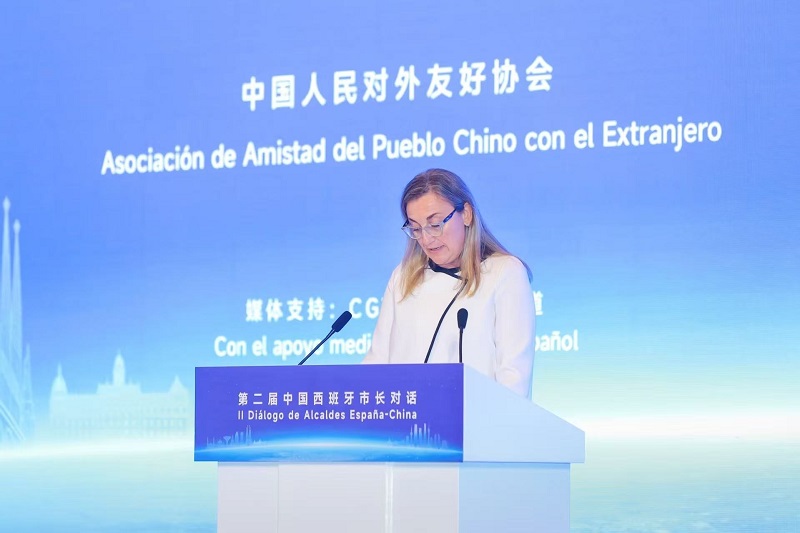
The author, Executive President of Fundación Cátedra China Marta Montoro Carrión, delivers a speech at the Second China-Spain Mayors’ Dialogue on August 28, 2026 in Yantai, Shandong Province.
Faced with this reality, the urgent question is no longer simply who commands more power, but rather how do we govern an increasingly more interdependent world together?
One year ago, President Xi Jinping proposed the Global Governance Initiative (GGI), placing a need at the heart of international debate that can no longer be deferred: to build a global governance system that is fairer, more equitable, more representative, and more effective, grounded in sovereign equality, respect for the international rule of law, multilateralism, a people-centered approach, and a commitment to tangible results.
I believe this initiative comes at an important moment for the world and that Spain should understand it and actively participate in this debate.
Beyond Zero-Sum: Governing an Interdependent World
To grasp the essence of the GGI, it is also necessary to consider the country’s historical traditions and its particular way of understanding human relationships.
The concept of tianxia (天下), often rendered as “all under heaven,” conveys a highly relevant idea for today: we inhabit a shared space, and the well-being of any part of that space cannot be secured in isolation from the well-being of the rest.
This perspective challenges one of the assumptions that has distorted international relations for decades – that the world must function as a zero-sum game, in which one country’s prosperity comes at another’s expense.
The reality of the 21st century tells us otherwise.
A region trapped in persistent poverty eventually becomes a risk to all. If technological gains are concentrated exclusively in a few countries, inequalities deepen. When environmental crises go unaddressed collectively, borders cannot shield anyone. And when war undoes a society, its consequences inevitably traverse frontiers.
We therefore need to think differently: the world prospers when every country has the opportunity to prosper.
Future global governance cannot mean a few decide while the rest comply. It requires institutions that reflect a plural world, and cooperation mechanisms through which common problems are met with shared responsibility.
Spain and China: Building Bridges, Not Blocs
Spain and China have an extraordinary opportunity to build a relationship grounded in mutual understanding, dialogue and cooperation. Realizing this means moving past polarization and the simplified narratives that make an objective understanding harder.
Spain is a plural society, and it is legitimate for our political parties to hold different positions. However, there are strategic issues that should rise above short-term political disputes. The relationship with China is one of them.
Spain needs to understand China better and vice versa. And both countries need stable channels of dialogue that outlast changes of government and election cycles.
Cooperation and competition can coexist. Spain and China may compete in certain areas, hold different positions on some international issues, and still cooperate extensively across others. For this reason, I believe we should move beyond excessively rigid categories and understand the relationship from a more mature perspective: We can be “friendly competitors,” capable of competing when necessary while cooperating whenever there are common interests. This is particularly relevant for Spain in areas such as investment, industrial modernization, science and technology, innovation, clean energy, infrastructure and business relations. Cooperation is not surrender; it is the disciplined search for shared interests.
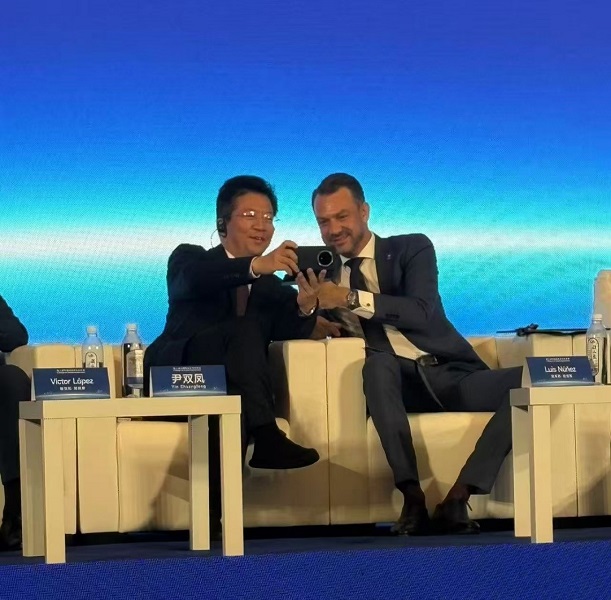
Chinese and Spanish mayors share a moment of exchange at the Second China-Spain Mayors’ Dialogue on August 28, 2026 in Yantai, Shandong Province.
The Human Core of Global Governance
What draws me most to the GGI is its human dimension. Talking about global governance may appear to be a matter reserved for presidents, governments, and major international organizations. But governance actually begins much closer to people.
It begins in cities. It begins in municipalities. It begins where citizens need housing, jobs, efficient transport systems, education, healthcare, security, quality public spaces and new opportunities for their children. That is why I believe we cannot build genuine global governance without listening to those who govern the places where people actually live.
International governance and local governance are not separate spheres; they are part of the same system.
Major international agreements ultimately land in our cities; city experience, in turn, answers global challenges. This connection between the global and the local is exactly why the work of Spanish think tank Fundación Cátedra China, which builds cultural, economic, and political bridges between Spain and China, really matters.
The surest test of an international idea is whether it takes root in reality. From August 27 to 29, in Yantai, east China’s Shandong Province, that idea took root at the Second China-Spain Mayors’ Dialogue, co-organized by Fundación Cátedra China and the Chinese People’s Association for Friendship with Foreign Countries (CPAFFC), with CPAFFC President Yang Wanming among the participants.
More than 40 Spanish and Chinese mayors and public representatives got to know each other, compared experiences and explored new avenues for cooperation.
Yantai could not have been a more appropriate setting. We were in Shandong, the birthplace of Confucius, whose philosophy put responsibility, harmony and the quality of human relationships at the center of governance. And we witnessed how international cooperation can begin at the grassroots level.
Once Spanish and Chinese mayors began talking about their cities, grand geopolitical concepts gave way to things that decide lives: employment, housing, transport, education, ageing, technological transition, sustainability, and public service.
Local problems are, in many cases, universal problems. And the discovery that mattered most was this: Spanish and Chinese citizens, despite living in different societies and thousands of kilometres apart, want the same things. To live in peace. To prosper. Decent work. A home. Good public services. A future their children can achieve.
When we put people at the center of politics, dialogue ceases to be an abstract concept. It becomes a necessity. The Mayors’ Dialogue also allowed us to better understand the reality of Chinese municipalities and their model of governance within the framework of socialism with Chinese characteristics.
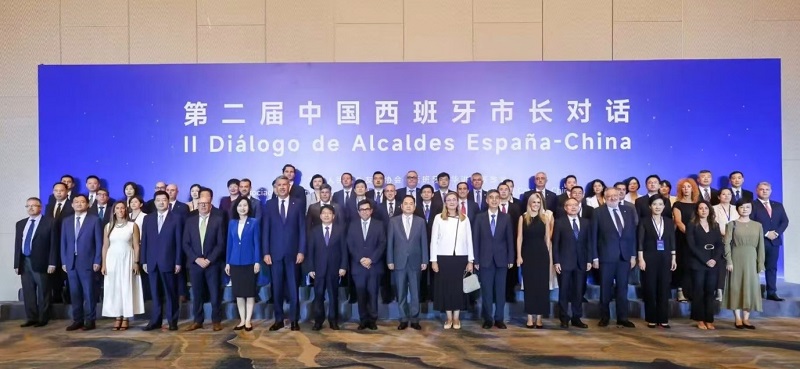
Participants in the Second China-Spain Mayors’ Dialogue pose for a photo on August 28, 2026 in Yantai, Shandong Province.
Understanding does not necessarily mean that we endorse each other’s every choice, it is to take seriously how another civilization organizes collective life. And understanding is an essential condition for building respect and cooperation.
The Mayors’ Dialogue is also an expression of the public diplomacy that Fundación Cátedra China has been developing. We believe that international relations cannot be limited to central governments alone. Universities, businesses, cultural institutions, municipalities and civil society also have an essential role to play.
Genuine global governance demands greater participation, greater knowledge and more dialogue – listening to cities, to governments and to businesses, universities and civic actors, incorporating local experience into the global debate.
Understanding, after all, is not endorsement. It is the discipline of seeking to comprehend – and the precondition for respect and cooperation.
Governing Our Future Together
My commitment to this way of understanding international relations also has a personal root. I was born in Quintanar de la Orden, a small town in Spain. Perhaps that is why I have always understood that the world is not made up solely of major capital cities, presidents and geopolitical strategies. It is also made up of towns, cities, families and people who simply want to live better lives.
That is why I believe Spanish political parties must be able to move beyond polarization when it blocks what truly matters: people. Politics should serve people, and so too should global governance.
At Fundación Cátedra China, we work to build bridges between Spain and China, and to contribute to building a community with a shared future for humanity, from an inclusive, cross-party stance, convinced that dialogue belongs to no single political party or ideology. It belongs to everyone.
The world our children inherit will not be defined solely by a nation’s military, economic or technological strength. It will be defined by our ability to cooperate.
The paramount question of the 21st century should not be who dominates the world, but how we govern it together. We need genuine, open and inclusive multilateralism, in which no country is permanently sidelined, and differences are not weaponized to cause confrontation. We need global governance capable of responding to the major challenges of our time while always remembering that behind every major international decision there are real people.
The Yantai dialogue confirmed to me that this aspiration is not a utopia. It can begin with something as simple as a Spanish mayor sitting down with a Chinese mayor and discovering that, despite living thousands of kilometres apart and belonging to different systems, both are working to solve remarkably similar problems.
That is where genuine cooperation begins.
And that may also be where a new understanding of global governance begins.
The GGI invites us to envision a world in which international decision-making is not the preserve of a few, but the result of cooperation that is more representative, more balanced and more focused on people’s well-being.
Spain and China have much to contribute to this process. We are not required to think alike. But we can learn to work together. Because the future cannot be built on the hegemony of some over others. The future must be built together.
------------------
Marta Montoro Carrión is executive president of Fundación Cátedra China.