In Beijing’s golden autumn, a gathering of intangible cultural heritage was a welcome attraction that boosted the city’s tourism market. Organized by the People’s Government of Beijing Municipality, the Beijing Municipal Bureau of Culture and Tourism, the Beijing Municipal Cultural Heritage Bureau, and the Tongzhou District People’s Government of Beijing, the 2025 Beijing International Week of Intangible Cultural Heritage was held in Tongzhou District from October 17 to 21, 2025.
The event, themed “Intangible Cultural Heritage Enriches our Life,” drew over 300 inheritors from more than 60 countries and regions in Asia, Africa, Europe, the Americas, and Oceania, who showcased nearly 10,000 exhibits. Through four major activities, the event promoted cultural exchanges and the tourism industry. In the Grand Canal Museum of Beijing, Beijing Library, and the Central Green Forest Park, over 100,000 visitors enjoyed what was on offer.
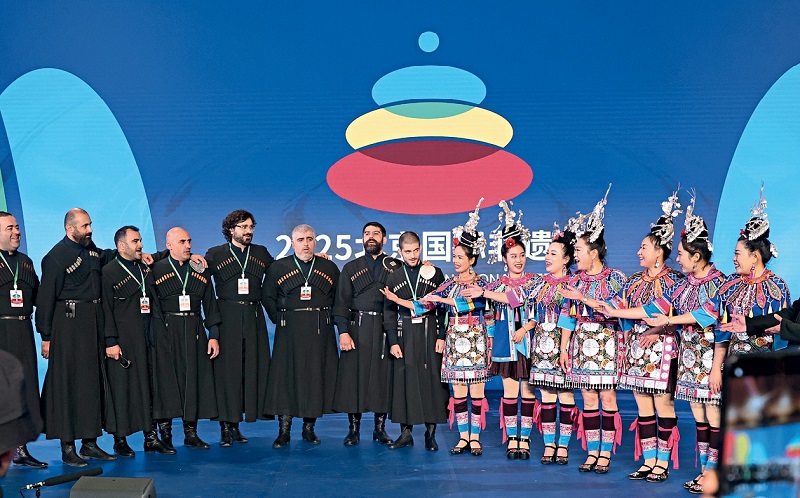
Inheritors of the Grand Song of the Dong ethnic group improvise songs with a group of Georgian artists at the opening ceremony of the 2025 Beijing International Week of Intangible Cultural Heritage in Beijing on October 17, 2025.
Interactive Experiences
At the opening ceremony on October 17, 2025, international representatives jointly launched the event in a melting pot of various shows. These included a Grand Song folk chorus of the Dong ethnic group from Guizhou Province and the polyphonic singing from Georgia performed together, a contemporary dance interpreting China’s famous painting from the Northern Song Dynasty (960-1127) – A Panorama of Rivers and Mountains, and a Peking Opera performance of five typical roles to showcase the unique charm of this genre.
“It’s a rare opportunity to perform with Georgian [cultural] inheritors. We are not only performers, but also messengers of cultural exchanges,” said an inheritor of the Grand Song of the Dong ethnic group. “I hope that our singing can go beyond the mountains and reach the broader world, so that more people can appreciate it.”
During the following week, the ethereal sound of the Zimbabwean thumb piano intertwined with a Bulgarian trio, Turkish artists painted with ink and wash, while Chilean singers showcased songs from the Andes Mountains. Other shows made up a symphony of world intangible cultural heritage, including traditional Maltese music, Scottish bagpipes, Brazilian Capoeira, Finnish folk music and dance, and Chinese shadow puppetry.
Visitors were enthralled with the variety, some even returning to watch repeats of the shows. “I live near Beijing’s West Third Ring Road, which is a more than 100 kilometers round trip [to the event], but I think it’s well worth it. The performances were unique, and I really enjoyed them,” said a senior female visitor.
The sparks of civilizational interplay were evident at the gathering. For example, the inheritors of Capoeira, a dancelike martial art of Brazil, invited the audience to dance together, while the Angolan inheritors played traditional instruments and taught visitors to provide the rhythm. A long queue was always present at the booth of Georgian traditional printing and dyeing. The Hungary booth was surrounded by big crowds eager to take photos with their Buzo masks. Chinese printmakers and Dutch artists improvised with an art collaboration, and local workers could be seen beating African drums during their breaks.
The Egyptian exhibitor said that this year’s event was very successful and hoped to participate in future events. The Malaysian exhibitor said that the event gave him a deep understanding of the essence of mutual learning among civilizations. “Intangible cultural heritage is not only a treasure of each nation, but also a common wealth of people. Representatives from all over the world gather together, which demonstrates the spirit of a community with a shared future for humanity,” he said. An inheritor from Zhejiang Province said he is so proud when he sees foreigners giving him a thumbs-up and when he hears children praise him at his booth.
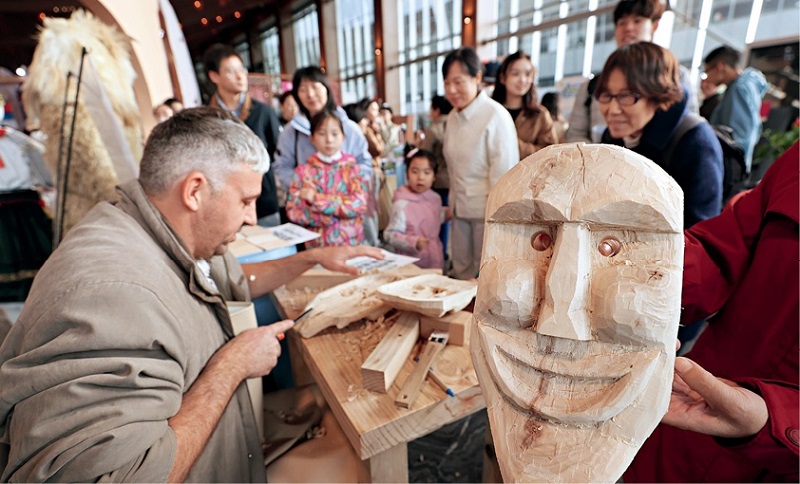
A Hungarian craftsman showcases the skill of making Busó masks.
Stimulating Consumption
In addition to the cultural significance, the intangible cultural heritage seek also proved to be a great commercial success.
The event promoted the integration of culture, business, and tourism. The popular products such as Turkish kebab, Tongrentang pancakes, and wind spinners frequently sold out. The enthusiasm of consumers remained high across the booths. For example, the Iranian carpets and Peru’s alpaca toys sold like hotcakes, while Turkish handicrafts and kebabs flew off the shelves.
Beijing’s traditional handicrafts with innovative designs such as imperial carpets, gilded lacquer inlay items, kites, and velvet fabric headwear also became fashionable products. An exhibitor of the gilded lacquer inlay art said that their cultural and creative products generated impressive sales. An inheritor of jade carving said that he sold a single artwork for RMB 6,000, which far exceeded his expectations. Meanwhile, the healthy food and beverages from Tongrentang, a time-honored brand of traditional Chinese medicine, also surpassed daily sales targets of RMB 10,000. These booming sales showed the strong appeal of intangible cultural heritage products.
The venue was also brimming with laughter and praise from visitors. A parent noticed children running around with tinkling wind spinners, attracting other children to ask where they bought them. Praise for pickled garlic and hotpot was frequently heard from the Tianjin specialty booth. Foreigners lined up for tastings, particularly enjoying the garlic.
At the Douyin Market innovative interactions empowered by technology allowed ancient culture to integrate into modern life, attracting many young visitors.
As Su Dan, deputy director of the Chinese Traditional Culture Museum, said, “Daily life cannot exist without intangible cultural heritage.” Innovation has breathed new life into intangible cultural heritage, allowing ancient techniques to resonate with contemporary life.
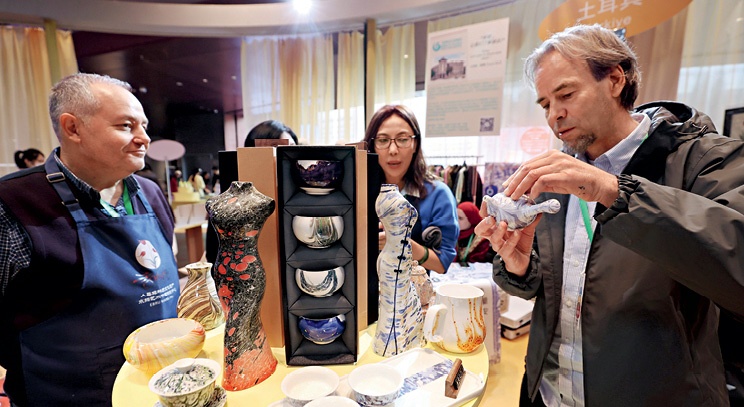
Visitors learn about Turkish ceramics at the exhibition.
Exchange of Thoughts
Apart from cultural interactions, many high-end dialogues were held during the event as well. A dialogue themed “Intangible Cultural Heritage Dialogue Discussion Forges Life Ahead” was held at the Beijing Library on October 17, 2025. Experts, inheritors, and representatives from China, Italy, Hungary, and Georgia spoke on the communication between and sustainable development of intangible cultural heritage.
As the root of civilizations, intangible cultural heritage has irreplaceable value. Yang Lan, a famous Chinese TV host, pointed out that it is the memory of human civilizations and the cultural genes of humanity. Cristina Carenza, minister of the Italian Embassy in China, said that culture does not emerge out of thin air, but has been accumulated over the past centuries. Tom Wolters, ambassador for Beijing Central Axis, noted that local residents have contributed to the vitality and development of the axis, keeping it alive in the modern era and preserving it for the future.
Guo Pei, a world-renowned couture designer, said that culture is the bloodline and root of a nation, nurturing its confidence and strength, while Si Ke, chairman of the Beijing Bianyifang Roast Duck Group, said the integration of talent and skills are essential to passing down cultural heritage. Lang Jiaziyu, a dough figurine artist, said that he has dedicated his life to the art and is finding the meaning of his life in it.
Cultural inheritors need a global view and joint action. “We live in the same global village. The sustainable development of intangible cultural heritage needs environmental protection and economic and social development,” said Carenza. Tinatin Kldiashvili, dean of the Faculty of Design at Tbilisi State Academy of Arts in Georgia, believed that cooperation can make everything possible. Meanwhile, Gabor Soos, secretary-general of the Hungarian National Commission for UNESCO, said that recording of heritage can inspire resonance and empathy. “Only by working together can we create a better future for the next generation. Instead of seeing single branches stand out, we are more eager to see a hundred flowers in full bloom together,” Soos said. 
The article is based on reports from media outlets including Global Times and Beijing Daily.