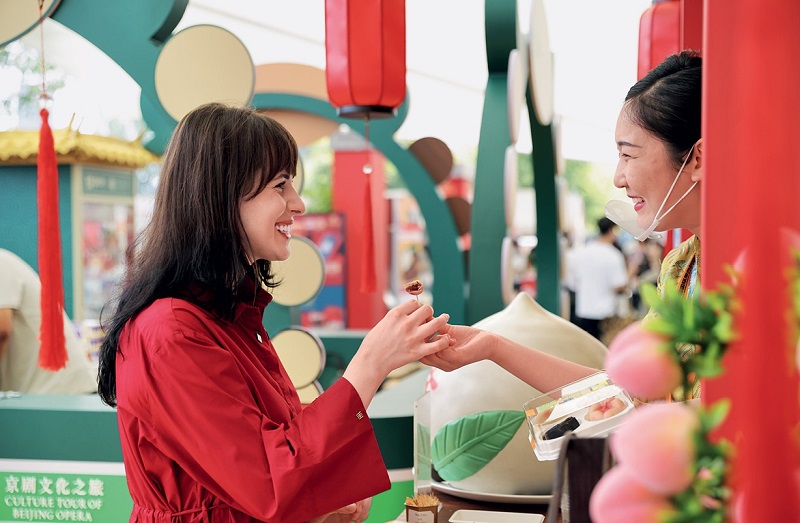
Bulgarian student Jood Ghazwan Sharaf tastes a dessert that is made with symbolic elements of Peking Opera.
Long regarded as rich yet remote, Chinese culture has often been presented abroad in abstract ways, leaving many foreign audiences with little more than a fleeting, surface-level impression with few opportunities to truly engage with its inner spirit. The question of how to make Chinese culture visible and tangible in Europe has remained a persistent challenge.
Driven by a mission of crosscultural dialogue, the Beijing Overseas Cultural Exchange Center has made progress along three key paths: the creative revitalization of Peking Opera, a global conversation on zodiac design, and community-rooted Chinese New Year celebrations. Moving beyond the traditional performer-audience divide, the Center has created interactive stages that invite Europeans to join in, engage, and relate.
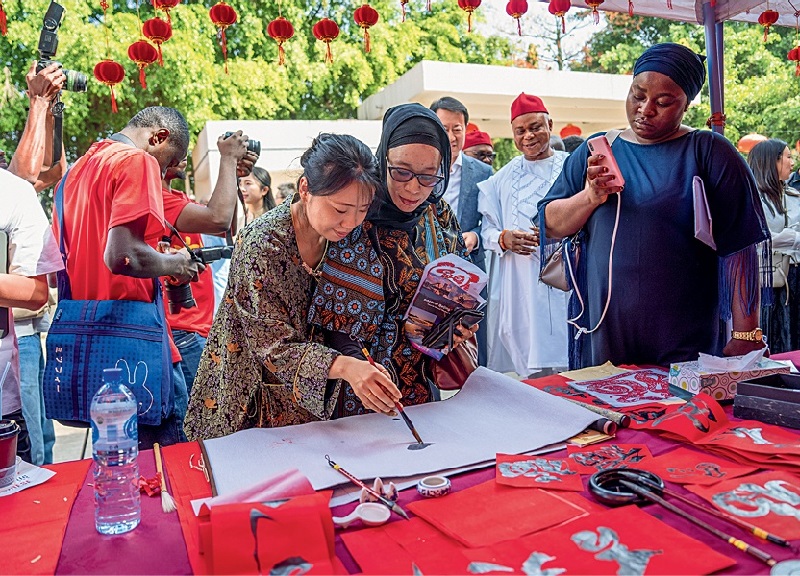
Participants at an outdoor activity hosted by the Beijing Overseas Cultural Exchange Center enjoy trying their hands at the intangible cultural heritage of Chinese calligraphy.
Peking Opera Reimagined
Peking Opera, China’s quintessential traditional art form, embodies the accumulated artistry of Chinese theater. Its stylized singing, recitation, acting, and martial arts – combined with elaborate costumes and refined movements – have long created a perceptual distance for overseas audiences. For decades, it was primarily presented through conventional stage performances.
To bring this art form more fully onto the global stage, the Center has pioneered a “Peking Opera Plus” approach that integrates opera with digital technology, leisure sports, and themed dining – reimagining it as something vibrant and accessible, woven into everyday life.
At the 2025 China International Fair for Trade in Services (CIFTIS), Bulgarian student Jood Ghazwan Sharaf was captivated by a Peking Opera themed special exhibition. From XR opera photo studios and costume try-ons to “Peking Opera workouts” and themed cuisine, the exhibition brought this innovative approach vividly to life. Inside an XR studio developed by Mrstage Technology, Sharaf, “dressed” in full opera attire, was transported via real-time rendering into the virtual palace setting of the classic piece The Drunken Concubine. Mimicking the graceful gestures of the noble consort and gazing into a blended world of virtual and physical scenery, she experienced firsthand the dynamic charm of Peking Opera.
Nearby, the organizer teamed up with the fitness platform Keep to launch a high-intensity interval workout infused with the art form’s core elements – hand gestures, eye movements, posture, technique, and footwork. Set to energetic rhythms and traditional choreography, the session allowed participants to sweat while intuitively absorbing the rhythmic beauty of opera. Beyond sight and sound, themed refreshments such as face-paint-inspired pastries and co-branded dairy products embedded Peking Opera into daily dining.
This multi-dimensional model breaks the stereotype of Peking Opera as an elitist “high-stage” art. Overseas audiences are no longer passive spectators but active participants. Rather than a distant cultural relic, Peking Opera becomes something tangible, playful, and close to daily life. This approach helps the art truly travel abroad and take root in European communities, offering a replicable model for the global dissemination of China’s traditional arts.
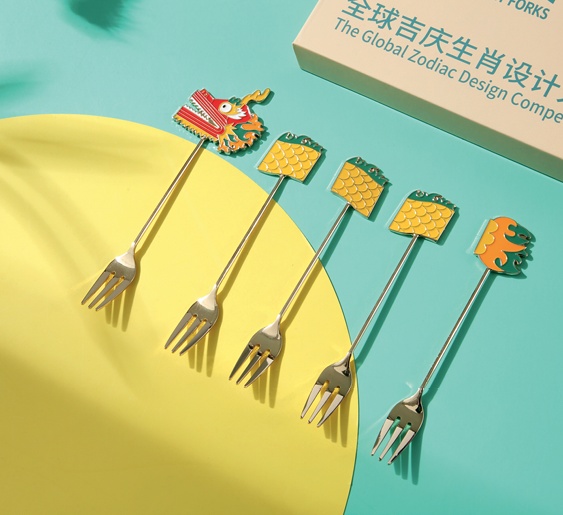
A set of Chinese dragon dance fruit forks.
Chinese Zodiac Themed Design
The Chinese zodiac is one of China’s most iconic cultural symbols. Carrying the spirit of reunion, auspiciousness, and upward striving, it combines accessible appeal with profound cultural depth. Since its launch in 2014 by the Beijing Municipal Bureau of Culture and Tourism and organized by the Center, the Global Zodiac Design Competition has run for twelve consecutive editions – a full zodiac cycle. Over the past twelve years, the competition has evolved from a simple call for submissions into a globally influential platform for cultural exchange. It has collected more than 40,000 entries from 28 countries, recognized 645 award-winning works, and staged 54 international touring exhibitions across 22 countries and regions, with significant participation from European designers.
Guided by the principle of “honoring tradition while innovating,” the competition explores the spiritual core of the Chinese zodiac, selecting works that embody traditional Eastern aesthetics, folk heritage, and practical value. It helps overseas creators understand the folklore, Five Elements philosophy, and the symbolic imagery behind each zodiac sign.
A significant example of this cross-cultural exchange is Year of the Fire Horse, created by Russian designer Pavel Pikskov for the Year of the Horse. Departing from literal realism, he rendered the horse’s head with halftone textures and conveyed its vitality through starburst motifs. Drawing on the Five Elements concept that “the Horse belongs to Fire,” he used abstract color gradients to express dynamic energy, translating Chinese zodiac symbolism into an artistic language more accessible to European audiences. Spanish designers, meanwhile, immersed themselves in Chinese Spring Festival customs, integrating scenes such as setting off firecrackers, making dumplings, eating long noodles on the seventh day of the New Year, and chewing sugarcane for “rising higher step by step” into their designs. Their personal, immersive experiences of celebrating the Chinese New Year became heartfelt sources of creative inspiration.
Wang Hairu, director of the Center, emphasized the competition’s value for overseas outreach: “The zodiac is naturally suited to cross-cultural communication. It transcends language barriers and expresses a shared human aspiration for a better life. For European designers, participating in the competition is itself an immersive journey into Chinese folklore, history, and traditional arts. Their locally grounded reinterpretations preserve the zodiac’s core spirit while aligning with European cultural habits, allowing Eastern symbols to be genuinely embraced and understood by local audiences.”
To attract more foreign attention to the zodiac, the competition has promoted the commercialization of outstanding designs, collaborating with trendsetting brands to produce collectible toys, tableware, stationery, and accessories. These items blending Eastern charm with everyday utility, have entered European markets through overseas touring exhibitions, transforming zodiac culture from gallery sketches into usable, collectible parts of daily life.
Today, selected works have been showcased at international landmarks such as the United Nations Headquarters and the Brussels Bright Festival. Regular partnership have been established with Belgium, Greece, Germany, and other European countries. With design as a bridge, Chinese and European creators inspire and learn from one another, turning the zodiac into a creative link that connects Eastern and Western civilizations.
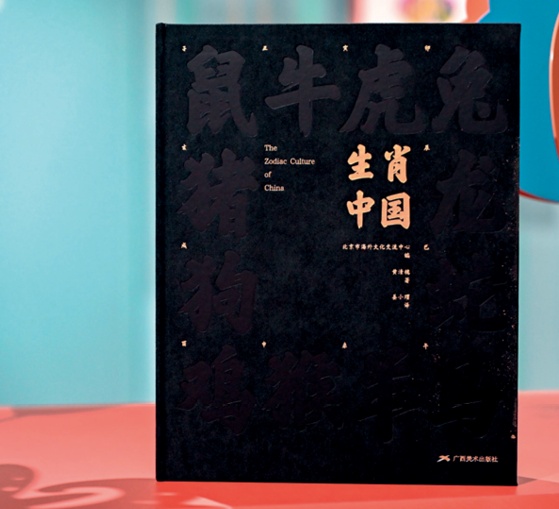
Compiled by the Beijing Overseas Cultural Exchange Center, The Zodiac Culture of China contains the condensed summary of the achievements of the Global Zodiac Design Competition. It serves as a bridge connecting traditional zodiac aesthetics with modern design expression.
Chinese New Year Celebrations Favored in Europe
The “Happy Chinese New Year” series serves as a vital vehicle for bringing Chinese culture into European communities and fostering people-to-people bonds. As a flagship overseas cultural initiative led by the Ministry of Culture and Tourism, the program has for years curated high-quality cultural and tourism resources in Beijing, dispatching performing arts delegations across Europe. Moving beyond formulaic stage showcases, it features temple fairs, collaborative performances, and interactive intangible cultural heritage (ICH) experiences, transforming the Spring Festival from a distinctly Chinese celebration into a joyous, participatory occasion for all.
Helsinki stands as a long-standing partner of Beijing’s Happy Chinese New Year efforts. As early as 2007, Beijing gifted two sets of Chinese dragon dance costumes to Finland, inaugurating the city’s Spring Festival temple fair tradition. In 2025, the 19th Happy Chinese New Year in Finland Fair drew 30,000 visitors in a single day. ICH activities such as mortise-and-tenon craftsmanship, Peking Opera mask painting, velvet flower making, traditional Beijing pinwheels, and New Year print workshops proved especially popular.
Local residents did more than spectate; they rolled up their sleeves to try their hand at traditional crafts, experiencing the charm of Chinese heritage through practice.
Even more touching has been the emergence of a homegrown Finnish community passionate about dragon and lion dance. In 2019, a Chinese team traveled to Helsinki to teach the art form. In recent editions of the festival, Chinese dragon dance troupes have performed alongside Finnish and Estonian teams in spectacular joint showcases, blending Eastern and Western performance styles and turning cultural exchange into genuine friendship.
In Germany and Greece, two-way cultural expression has become a highlight. Chinese folk orchestras have performed German classics such as “The Song of Baden,” while German pianists interpreted beloved Chinese melodies like “Colorful Clouds Chasing the Moon.” Chinese and German choirs have taken the stage together for “Unforgettable Tonight,” interweaving Eastern and Western musical traditions into harmonious dialogue. Meanwhile, China-Greece youth music concerts have brought together top artistic talents from both nations, with collaborative repertoires illuminating the stage through the interplay of classical traditions.
In 2024, the Chinese New Year celebration at London’s Trafalgar Square, the largest of its kind outside Asia, drew a record single-day attendance of over 700,000. Highlights included Peking Opera excerpts, folk music performances, and martial arts demonstrations, alongside hands-on ICH workshops that kept visitors engaged. That same year, a delegation organized by the Center brought art troupes performing classic Peking Opera performances such as The Drunken Concubine and Havoc in Heaven to the U.K. and Ireland, along with other troupes who performed folk music classics like Dance of the Golden Snake, and ICH displays featuring clay figurines, Beijing silk figurines, and more. The festivities filled the British Isles with the festive spirit of the Chinese New Year.
Wang observed that making Chinese culture tangible and resonate with people in Europe ultimately hinges on emotional connection among ordinary people. Today, roughly one-fifth of the world’s population celebrates the Spring Festival. Dragon and lion dances, ICH crafts, and folk music are no longer distant Oriental spectacles – they have become living cultural experiences embedded in everyday European life. The Spring Festival has, in effect, become a vital bridge for mutual understanding and friendship.
Looking ahead, as talent exchanges and cultural tourism cooperation between China and Europe continue to deepen, a growing array of cultural activities grounded in Chinese heritage yet expressed through international accessible ways will emerge, allowing the enduring brilliance of traditional Chinese culture to shine on the world stage.