Yang Peizhang ponders the evolution of Chinese painting at the crossroads of Chinese and Western art.
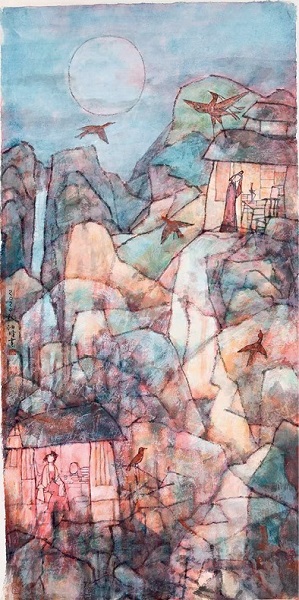
Parting Is Harder than Meeting, 135 × 69cm, 2024.
As an artist with a broad vision, Yang Peizhang examines the evolution of Chinese painting at the crossroads of Chinese and Western art.
Specializing in free-hand ink-wash figure painting, Yang is a prominent contemporary artist who is not restricted by subject matter or technique. He paints ancient figures with great skill and modern-day people with even more uninhibited flair. Well versed in traditional brushwork, Yang is also skilled in sophisticated modern ink-wash techniques, which empowers his creative spectrum to cover both representational realism and abstract free-hand expression.
He has consistently pursued an artistic path that moves between tradition and modernity, two distinct creative approaches that allow him to seek innovation through the revival of tradition and forge a fusion of Chinese and Western art.
From his depiction of the unrivaled beauty of legendary ladies, and his subtle capture of diversity of feminine grace, to the mesmerizing poetic landscapes inspired by classical verse — each painting represents Yang’s invention of a new artistic vocabulary and exploration of fresh horizons, embodying his guiding principle of preserving the spirit of antiquity while expressing modern sensibilities.
His genre upholds the brush-and-ink tradition centered on calligraphic strokes and preserves the distinct feature of Chinese painting — modeling forms through lines. The practice of “expressing” runs through the entire creative process of his figure paintings, where the shape, implication, and quality of his lines are adjusted to suit different subjects. The line is the soul of Yang’s artwork. He firmly believes that in the realm of line art, Chinese painters undoubtedly rank among the world’s finest.
Having introduced Western realistic techniques into his figure paintings, Yang strives to remedy the drawbacks of both traditional and modern literati painting — prioritizing brushwork over form, and spirit over physical likeness. He stresses that brush and ink should serve form-building, so as to achieve a perfect integration of form and spirit, as well as brushwork and artistic conception.
He has also incorporated Western color application methods into his creations. Boldly drawing on the vivid, striking colors typical of Western art, Yang outlines and washes the painting with varied ink tones. This yields a harmonious, refined, and elegant visual effect and elevates the artistic quality of his work.
Infusing landscape, bird, and flower motifs into his figure paintings, Yang places human figures amid blossoms, mountain views, and the cool shade of banana trees. The cultural undertones emanating from these works offer abundant food for thought and reflection.
His ancient-themed figure paintings draw nourishment from the profound depth of Chinese culture, through which Yang infuses every brushstroke with his insights into traditional culture. These insights form the soul of the figure painting and serve as a guide to his inner artistic homeland. Meanwhile, the richness and subtlety of traditional Chinese culture is interpreted in his own distinctive way. Creating paintings steeped in poetic conception, Yang depicts the most beautiful and soul-stirring aspects of traditional Chinese culture that convey his love for the goodness in life.
Yang addresses the longstanding demand for realistic skills in traditional Chinese figure painting, using ink-wash rooted in traditional brush-and-ink techniques. However, he has devoted the bulk of his artistic exploration to integrating Chinese and Western art and enriching Chinese ink painting with Western influences. This is largely attributable to shifts in his aesthetic sensibility and artistic philosophy brought about by his many exhibitions and art exchanges in France and other Western countries.
Though the undertaking of enriching Chinese art through Western influences calls for long-term effort, Yang’s reflections, practices, and remarkable artistic achievements have already revealed the potential of this path.