An Italian scholar argues that genuine intercultural understanding is not built at summits but in daily interaction – in places where people can openly discuss and learn.
In the southern part of Beijing’s Temple of Heaven stands a quiet complex of courtyards known as the Divine Music Administration. Built in 1420, together with the Temple itself, it was never intended to be a stage. It was a school and a rehearsal hall, where several hundred musicians and dancers trained year after year, rehearsing the ceremonial music performed at the altar a few hundred meters away. Most of the people who witnessed those rites never saw the place where they had been prepared.
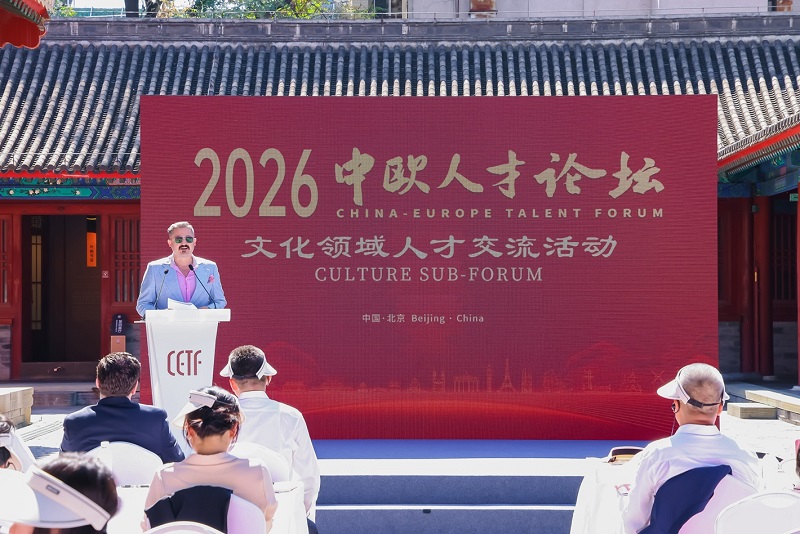
Andrea Lorenzo Baldini addresses the culture sub-forum of the 2026 China-Europe Talent Forum, on September 21, 2026.
To me, that is a useful image for a subject we too often approach from the wrong end. The ceremony was the visible part. The learning took place in the courtyards: slowly, repetitive, and largely out of sight.
Exchange between civilizations works in much the same way. We tend to picture it as the ceremony: the summit, the agreement, the forum. Those things matter. But they are only the visible part. The real learning happens elsewhere, gradually and usually without an audience.
Civilizations, strictly speaking, do not meet. People do. And they meet at close range.
I can only speak from my own experience. I am an Italian philosopher who has taught in the United States, India, and China – first at Nanjing University and currently at Peking University. Almost nothing I understand about this country has come from documents or official narratives. It came instead from ordinary moments in which I discovered that my own assumptions were incomplete.
I remember one such moment vividly. During my first experience teaching art history in China, I mentioned “abbeys” in a lecture on medieval Europe. When I asked the class what an abbey was, no one answered, so I explained: it is a place where monks live. I thought that had settled the definition. Then a student said that China has its own population of monks too. In that moment, I realized I had been presenting a local European case as if it were a universal category. My conceptual framework was narrow, and it took one of my students to reveal how obvious this blind spot of mine was.
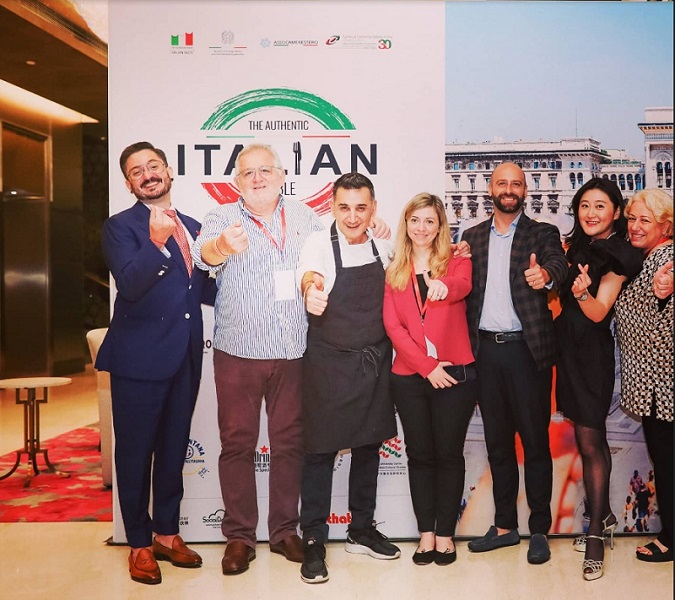
Baldini (first from the left) builds bridges between Chinese and Italian civilizations by sharing about cultural heritage through the topic of gourmet.
This is what mutual learning actually looks like. It is not the exchange of polished positions or official viewpoints. It is the moment when someone shows you that your concepts do not fully account for their world, and you are compelled to widen them. What you gain is not merely knowledge of another culture, but a clearer understanding of the limits of your own.
And this kind of learning can only happen up close. From a distance, one may learn facts about another society. But, one cannot easily see what one’s own description leaves out. For that to happen, another person must be present – someone able to notice the gap between your categories and lived reality.
The reason is not sentimental. Our conceptual habits are most invisible precisely where they function most effectively. A concept that has never failed us begins to feel like reality itself rather than a partial interpretation of it. It often takes an outsider to reveal its boundaries. And this cannot happen in abstraction. It emerges in concrete situations, through actual interaction.
That is one reason I work at what might literally be called “street level.” My research focuses on what people create in cities without being instructed to do so: not monuments or master plans, but the improvised forms of everyday life that fill urban space. I observe how a courtyard is used after dinner; how a street changes between morning and night in Milan, Philadelphia, Nanjing, and Beijing.
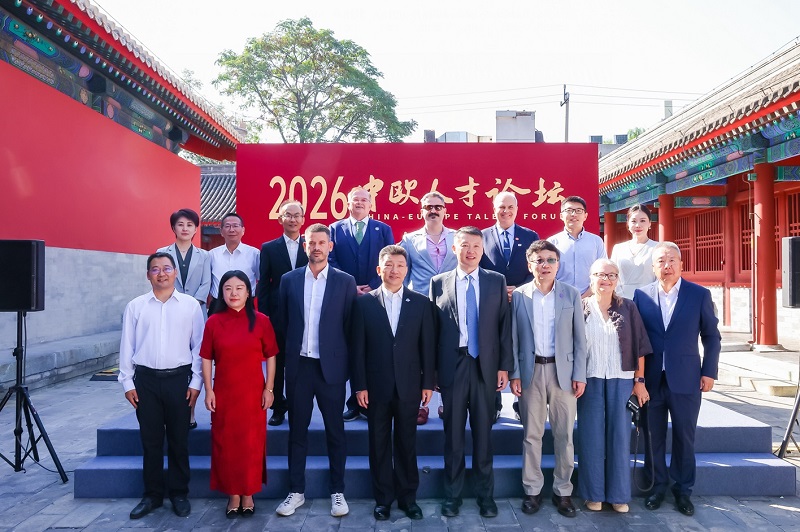
Chinese and European guests pose for a group photo at the culture sub-forum of the 2026 China-Europe Talent Forum.
Seen from above, the world’s large cities appear to be converging into homogeneity. But seen from the pavement, they are not converging at all. Each city improvises in its own way, out of its own habits, materials, and rhythms. The difference is where the interest lies, and it is invisible unless you are standing in it. This, I think, matters even more as we consider the future.
More and more, our first encounter with a distant place is mediated by a machine. We ask a digital system to describe a city, translate a text, summarize a tradition, or tell us what is worth seeing there. The answer arrives in a second, and it arrives without hesitation. It is easy to mistake that smoothness for understanding.
But a model sees what its training has taught it to see, and its training data is not evenly distributed. Information accumulates where archives are richer, platforms more dominant, and research infrastructures more powerful. A system trained mainly on European and American sources may not interpret a Chinese case as simply another case; it may interpret it as an exception. Difference, in such systems, risks being treated not as diversity but as deviation.
That is the risk I want to identify. Artificial intelligence is quickly becoming the layer through which cities, cultures, and people encounter one another. If that layer is shaped overwhelmingly by the assumptions of one part of the world, then mutual learning may quietly become mutual mirroring. We would still appear to be looking at each other, yet increasingly we would see only reflections of ourselves.
The remedy is not technical. No adjustment to an algorithm can compensate for perspectives that were absent from the beginning. The remedy is human. Who builds these systems? Who decides what counts as data? Which experiences are treated as normative, and which are treated as marginal? These are questions about people, and they are settled long before any code is written.
If we genuinely care about exchange between civilizations, we should invest not only in connectivity but in duration. Delegations can meet without truly learning. Learning requires people who stay long enough to be corrected, surprised, and changed – as I was in that first classroom. It requires students, artists, researchers, and teachers willing to inhabit another context for extended periods of time. The value of a scholarly exchange rarely lies in the conference itself. More often, it lies in the slow and unremarkable relationships that begin there – relationships that may produce nothing visible for years, yet eventually alter how people think for the rest of their lives.
Six hundred years ago, the courtyards in the Temple of Heaven existed so that people could practice together before performing together. The process was slow, disciplined, and largely invisible.
I do not believe the logic of that process has changed.
ANDREA LORENZO BALDINI is the Changjiang Chair Professor at Peking University’s School of Arts.