“Over the past years, we have seen more and more tourists coming to our village, and their stay here has grown longer. Many even said they don’t want to leave,” Pan Chunlin, a resident of Yucun Village in Anji County of Huzhou City, east China’s Zhejiang Province, told China Today. Pan is the owner of the Chunlin Lodge, a bed & breakfast (B&B) which received more than 70,000 visitors last year, generating over RMB 4 million in revenue.
This tourism boom is largely attributed to the region’s “cluster development” mode. Since 2023, Yucun has worked with 23 neighboring villages to jointly build the Greater Yucun area by promoting resource sharing and complementary advantages. As a result, it is more convenient for tourists to explore a group of closely situated villages in one trip.
The Green Rural Revival Program, launched in 2003, has reshaped thousands of villages across China into more scenic landscapes. To tackle the challenge of scarce resources and weak industries in these areas, Zhejiang’s solution is cluster development for win-win cooperation.
In January last year, the government of Zhejiang Province issued a plan outlining cluster development in rural areas as a key task in advancing common prosperity.
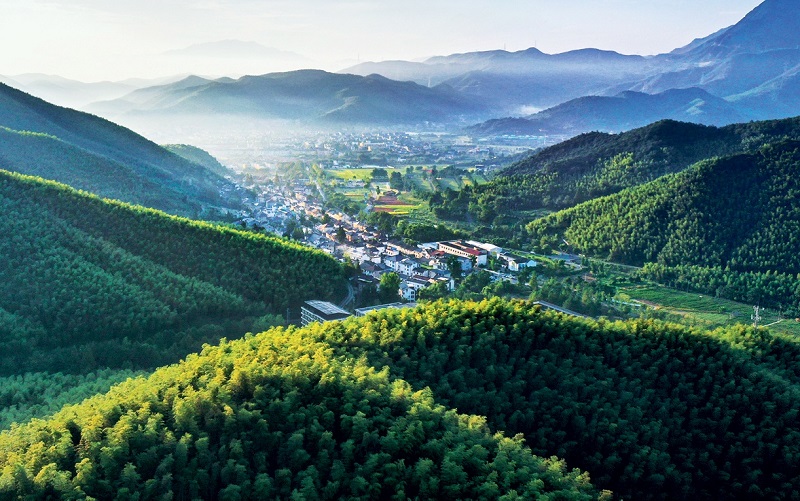
An aerial view of Yucun Village in Tianhuangping Town, Anji County, Huzhou City of Zhejiang Province. Photo courtesy of the Publicity Department of the CPC Anji County Committee
Creating Synergy
In the 1980s and 1990s, Yucun was Anji’s richest village due to its mining and cement businesses. However, this short-lived economic boom took a heavy toll on local ecosystems, with vast tracts of vegetation destroyed and serious air pollution. In 2003, Yucun decided to shut down its mines and cement plants and embarked on a green journey.
Pan, once a tractor operator working at a local mine site, opened the village’s first B&B in 2004. At that time, the environment there had not yet recovered, and his accommodation business had so few visitors that he earned the name “man in debt” in the village.
The turning point came in August 2005, when Xi Jinping, then secretary of the Communist Party of China (CPC) Zhejiang Provincial Committee, visited Yucun during an inspection tour, where he put forward the concept that “lucid waters and lush mountains are invaluable assets” for the first time.
Since then, the village has been working to promote eco-tourism while improving the environment and restoring its ecosystems. In 2021, it was added to the first select list of the Best Tourism Villages by the UN Tourism initiative.
As its popularity increased and visitors flocked in, the 4.86-square-kilometer community soon found itself confronting another issue: the village could not accommodate all the visitors, and the goods and services on offer were rather limited. Apart from that, neighboring villages, though also blessed with wonderful natural beauty, remained largely unknown to outsiders. To overcome this conundrum, the idea of developing rural clusters through coordinated cooperation emerged as the best option.
In 2023, the Greater Yucun came into being. It spans 245 square kilometers and encompasses 23 villages in proximity. Under unified planning, each village focuses on growing its distinctive strengths: Yinkeng taps into film and television IPs; Maji promotes its rich revolutionary culture; and Henglu highlights water-based recreational activities.
These differentiated tourist attractions, which provide unique travel experiences throughout the year, have extended the average length of visitors’ stays from half a day to two or three days. Data show that in 2024, Yucun alone received 1.22 million visitors, while the Greater Yucun saw over 10 million tourists, generating RMB 10 billion in tourism revenue. The average collective income of the 24 villages reached RMB 2.82 million, up 11.5 percent year on year.
Today in Zhejiang, one village after another is leveraging brand spillovers and resource sharing to drive the coordinated development of surrounding areas.
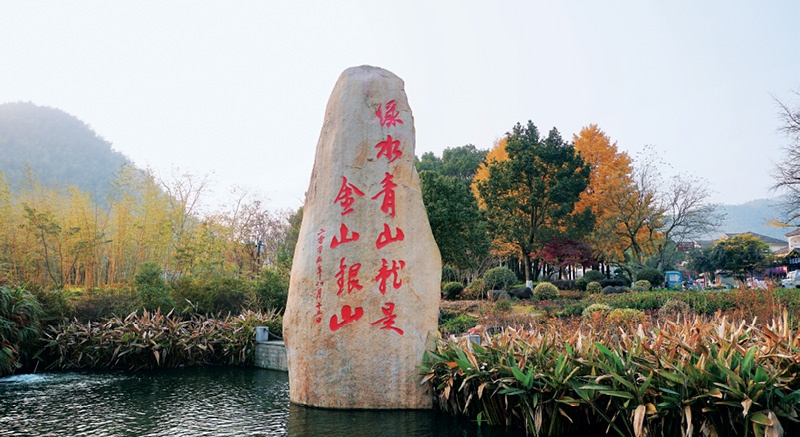
A stone monument in Yucun bearing the inscription “Lucid waters and lush mountains are invaluable assets.” Liu Ting
Youth Power
“A new development dynamic requires new business models, and new business models cannot thrive without the participation of young people,” said Yu Xiaoping, deputy secretary of the CPC Yucun Village Committee. To this end, Yucun has launched the Global Partners Program and brought together idle resources in surrounding areas to create a startup hub named “Youth to Rally,” which is designed to provide comprehensive services for young entrepreneurs.
To date, the program has attracted more than 60 new economy projects and teams, giving rise to over 50 new business models and scenarios, including a digital nomad community and a robotics base. More than 1,200 young professionals now work here on a regular basis.
Changqin Village, located in Yuxin Town, Nanhu District in Jiaxing City, has also recreated its image thanks to youth power. Just two years ago, it was a traditional agricultural community, with vast stretches of rice fields and deserted farmhouses. Today, it has turned into a vibrant landscape featuring rice field-themed homestays, a pet park, and a lively Young Market, offering tourists a unique experience of pastoral lifestyle.
This dramatic change has been made possible by the combined efforts of cluster-based village development. In 2023, Nanhu District promoted the development of a demonstration zone for beautiful villages, which included six administrative villages. By pooling resources across them, the cluster has advanced the integrated development of agriculture, culture, and tourism.
Changqin as the central village of the cluster has attracted a large influx of young people through its Youth-Village Partners program, boosting local development and employment. Xu Zhiqiang, head of the village, told China Today that these partners, numbering 50, are mainly in their early 20s and 30s, and up to 80 percent are natives.
The return of young people to their villages who had previously migrated to large cities has not only boosted rural tourism but also spurred economic growth across the entire town. In 2024, Yuxin Town recorded a 21.7 percent increase in average collective income per village, and each village’s operating income exceeded RMB1.2 million. The participation of young people has unleashed villages’ endogenous vitality and development momentum.
The transformation of Yucun and Changqin mirrored rural development across Zhejiang. Over the past five years, authorities across the province have rolled out a series of targeted support policies aiming to boost the economy and attract young people. Under these polices, more than 100,000 rural entrepreneurs and 584,000 modern “new farmers” have emerged. These young talented people are crucial to stimulate rural vitality from within.
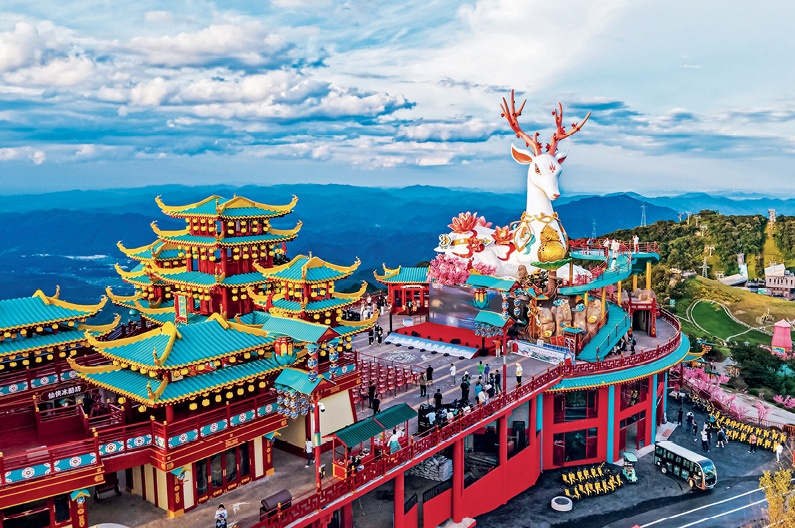
The Skyland Resort in Anji’s Xianxia Town is an immersive fantasy-themed cultural tourism project developed in the Greater Yucun area. Photo courtesy of the Publicity Department of the CPC Anji County Committee
 Village Companies
To break down administrative barriers between villages and advance cluster-based development requires leveraging the organizational network, pooling collective efforts, and coordinating policies and resources. The Badoujie Scenic Area in Xiaopu Town, Changxing County in Huzhou City, is renowned for its 30,000-plus ancient ginkgo trees. Yet these trees are scattered across five villages. In the past, each village operated independently, resulting in uncoordinated planning and outdated, limited services.
In 2019, the five villages jointly invested in a new company — Changxing Xingfu Cultural Tourism Development Co., Ltd. The village-invested company adopted market-oriented operation methods and launched projects such as a glass skywalk and ginkgo valley rafting. Professional managers were engaged to guide villages in developing differentiated attractions, including ginkgo-themed cuisine, folk cultural performances, and parent-child study tours.
By doing so, scattered attractions have been grouped into one program and managed as a whole. In 2024, the Badoujie Scenic Area received more than 1.53 million visitors, generated RMB 245 million in comprehensive tourism revenue, and achieved an average collective income of RMB 2.2 million per village.
Village-invested enterprises are becoming the new engine of rural cluster development across Zhejiang. In June 2023, a document jointly issued by multiple provincial departments declared that policy support would be given at the provincial level for the healthy development of such companies. “Cluster development plays a vital role in realizing village prosperity,” said Wang Tonglin, director of the provincial rural work office.
During the 15th Five-Year Plan period (2026-2030), Zhejiang will further improve mechanisms for rural cluster development. It plans to build 500 key provincial-level village clusters engaging more than 3,000 surrounding villages, so as to build an integrated development pattern on the path toward common prosperity.