A 21-kilometer limit test measures not only the steps of robots but also the real progress China’s embodied intelligence is making as it moves from the laboratory to commercialization.
At the 2026 Beijing E-Town Humanoid Robot Half-Marathon on April 19, a humanoid robot named Flash claimed first place, finishing in 50 minutes and 26 seconds in autonomous navigation mode, surpassing the human world record of 57 minutes and 20 seconds.
This event has long been more than just a competition.
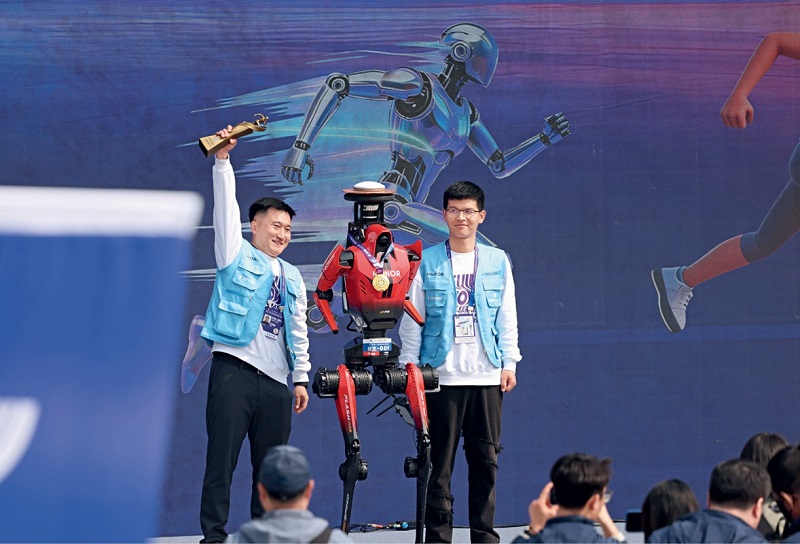
Gold medalist “Flash” and its technical support team pose during the awarding ceremony for the 2026 Beijing E-Town Humanoid Robot Half-Marathon on April 19. Li Muyi
Technological Leapfrogging
In China’s first human and robot half-marathon a year ago, most of the participating robots could hardly move independently after they left their remotely controlled environment, and operators had to provide guidance throughout the entire race. Only six teams managed to complete the competition, all taking more than 2.5 hours to finish.
Just one year later, the capabilities of robots have improved dramatically, the most remarkable breakthrough being speed. Flash has increased the robot half-marathon record by more than three times. Besides, the scale of participation has expanded from two dozen teams to over 100, covering more than 10 provinces nationwide. Participants include universities and research institutes such as the Tsinghua University, the Peking University, and the University of Science and Technology of China, as well as leading tech companies like Honor, Unitree, and Noetix Robotics. In addition to Chinese companies, five international teams from Germany, France, Portugal, and Brazil made a debut, all using domestically produced robot platforms.
The differentiation and competition of technological routes have become increasingly clear. For the first time, this event set up separate groups for autonomous navigation and remote-control operation, with both groups competing on the same field and ranked together. The net timing of the remote-control group was multiplied by a factor of 1.2 for ranking purposes, while the autonomous navigation group was limited to four scenarios where manual intervention was allowed. Nearly 40 percent of robots had the ability of running autonomously without remote control, with on-site staff only needing to follow in vehicles to provide support when battery power ran low or batteries got overheated.
Zhao Wen, an algorithm engineer at the Beijing Humanoid Robot Innovation Center, explained the secret behind the leap in speed, “A large number of robot motion control algorithms, communication technologies, and perception system upgrades, through intelligent adjustment of step frequency and stride, deeply combine humanoid characteristics with engineering stability.”
According to Zhao Mingguo, a researcher at the Department of Automation at the Tsinghua University, rapid progress is being made in the development of robots in terms of their stability and battery endurance. Robots are also becoming increasingly mature in fields such as autonomous movement and outdoor applications. Behind their transformation from stumbling along to darting away like an arrow lies the systematic optimization of core indicators in China’s embodied intelligence industry: more powerful motors, stronger thermal management designs, more flexible limb joints, and higher peak torque. This is not the solo performance of a single company but the collective achievement across the entire industry chain.
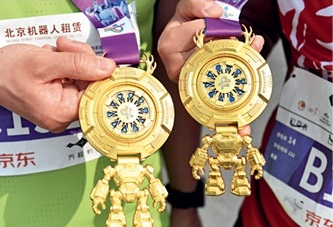
Participants show the medals they received from running in the Beijing E-Town Humanoid Robots Half-Marathon. Dong Ning
Activating the Industrial Chain
“Promoting research, production and application through competition is our objective for hosting this event,” said Liang Jing, deputy director of the Management Committee of Beijing Economic Technological Development Area.
The urban marathon pushes the five core capabilities of robots to their limit: motion control, autonomous navigation, endurance and heat dissipation, environmental adaptation, and system reliability. According to the organizers, the competition course is designed to integrate more than 10 types of terrain, including flat ground, slopes, curves, and narrow sections. Among them are nearly 90-degree turns, a maximum eight percent uphill and six percent downhill gradient, with a total elevation gain of 100 meters, comprehensively testing the robots’ perception and decision-making abilities in complex real-world scenarios.
Battery swapping is another key challenge. There was a significantly reduced number of battery swaps among all the participating robots, with one team only swapping their robot’s battery one time before it reached the finish line. The length of time to swap out batteries was reduced to under 10 seconds, comparable to a pit stop during a car race, and the system did not need to restart. Some teams designed their robots with a liquid cooling system, which lowered the temperature of the main joints while running from 70-80 degrees Celsius to around 60 degrees Celsius.
Promoting production through competitions like this event has indeed brought real industrial impetus. Beyond the track, robots were also seen carrying supplies and handing out water and towels to runners. Zhang Yujia, marketing director of Galaxea AI, stated that such services place higher demands on the perception and decision-making capabilities of embodied intelligent technologies. Currently, the company has fulfilled thousands of orders for robots to carry out tasks in real-life scenarios such as transporting, grasping, placing, and packaging objects. By 2026, it plans to start mass production at the 10,000-unit level.
The spillover effects of the race continue to empower the infrastructure of the industrial chain. The Beijing Humanoid Robot Innovation Center’s pilot testing and verification platform was launched in E-town in January 2026. This six-story building, covering an area of 9,700 square meters, includes functional areas such as smart warehouses, testing service zones, production demonstration lines, small-batch trial production lines, and joint production demonstration lines. It can complete the assembly of a robot in an average of one hour and is equipped with 500 sets of trial production and testing equipment, with an expected annual robot production capacity of up to 5,000 units.
The effect of industrial clustering has become increasingly prominent. Beijing E-Town has attracted over 300 embodied intelligence enterprises and has introduced special supporting policies on embodied intelligence. It has established the nation’s first developer community for embodied intelligent robots, E-Bot Hub, accelerated the construction of the Beijing-Tianjin-Hebei region’s first embodied intelligence super factory, and formed a complete industrial chain covering core components, whole machine manufacturing, system integration, and scenario-based solutions.
In 2025, there were over 140 Chinese companies producing complete humanoid robots, with shipments reaching 14,400 units, accounting for as much as 84.7 percent of the global market. Zhang Yunming, vice minister of China’s Ministry of Industry and Information Technology, stated that efforts will continue to be made to promote significant progress in humanoid robot technology and products, accelerating their transition from moving around on the stage and running on the track to working in factories and helping in households.
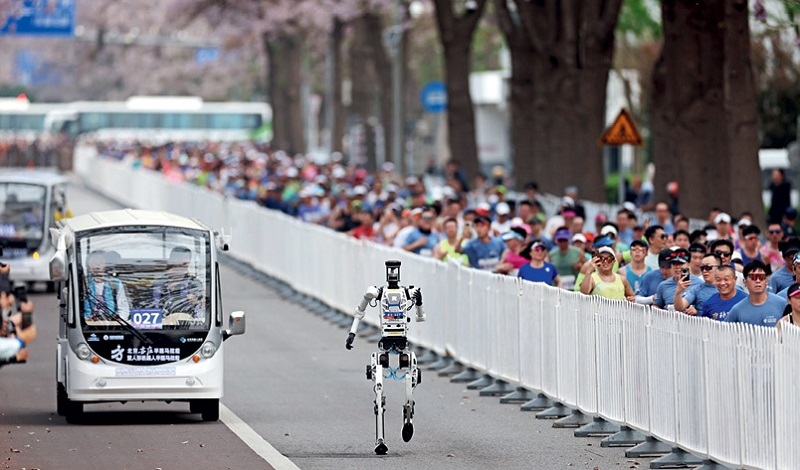
A humanoid robot running during the 2026 Beijing E-Town Humanoid Robot Half-Marathon in the Beijing Economic-Technological Development Area on April 19, 2026.
Towards Future Industry
Pan Helin, a member of the Expert Committee on Information and Communication Economy of the Ministry of Industry and Information Technology, pointed out that currently, there are still many shortcomings to overcome in the application ecosystem of embodied intelligence. Many embodied intelligence technologies lack generality and compatibility, and there is still a gap to close before they can operate smoothly in open scenarios.
This precisely illustrates the value of hosting marathons: problems are exposed in real-world scenarios, and extreme pressure forces technological innovation.
The voices from the international industry are also worth noting. Julio Rogelio Guadarrama Olvera from the Technical University of Munich stated that long-distance robot running competitions drive multiple companies to develop more advanced actuators and controllers, which will ultimately empower long-range applications such as industrial inspection, emergency rescue, and healthcare services.
All five international competing teams chose Chinese-made robot bodies and then carried out secondary development of algorithms and functions. Doctoral student Dou Yuhan from Huazhong University of Science and Technology deployed his self-developed algorithm on a robot body, enabling it to run steadily at a speed of 3.5 meters per second. His metaphor is quite representative: “The body is like a bare shell, and we are responsible for delivering creative ideas.”
The year 2026 marks the beginning of China’s 15th Five-Year Plan (2026-2030) period and is also a crucial year for accelerating the application of humanoid robots in various scenarios and mass production. At the national level, the 2025 government work report for the first time included embodied intelligence in the list of key industries for future development. The 15th Five-Year Plan outline explicitly says that promoting embodied intelligence serves as a new driver of economic growth. The Ministry of Industry and Information Technology established a technological standardization committee for humanoid robots and introduced the first humanoid robot standard system. The National Financial Regulatory Administration, together with three other departments, included humanoid robot insurance within the framework for high-quality development of science and technology insurance.
The act of crossing the finish line takes only a second to complete, but industrial development is endless. What humanoid robots demonstrated on the 21-kilometer track is that China’s embodied intelligence industry has not only caught up but taken the lead in key areas. In the future, it will be necessary to truly transform the technological breakthroughs on the track into products that are accessible and affordable for countless industries and households.
This marathon has exhibited the infinite possibilities arising from the convergence of technology and future industry.