Qingdao and Barcelona cooperate across an ocean of trade, culture and economic muscle.
China’s Qingdao, one of East Asia’s key port cities, and Barcelona, a leading hub in the Mediterranean, serve as prime examples of China-EU relations. Their cooperation is anchored in economic strength, innovation, deep-rooted cultural ties, and a shared commitment to long-term growth synergies.
These themes were explored at the “Qingdao-Spain Economic and Trade Cooperation Conference” held in Barcelona on May 19. The event was organized by the Qingdao Municipal Investment Promotion Centre with the backing of the EU Chamber of Commerce in China. It was attended by senior representatives from Spanish government agencies, business associations, and prominent figures from both cities, as well as delegates from Madrid and Valencia.
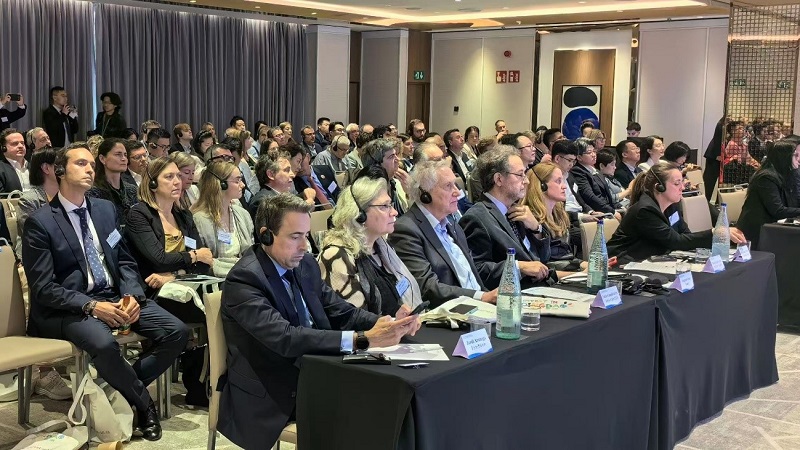
The Qingdao-Spain Economic and Trade Cooperation Conference is held in Barcelona, Spain, on May 19, 2026.
Historical ties between the two cities can probably date back to 1911, when Spanish merchant ships arrived in Qingdao to establish commercial operations. This enduring connection was solidified when Barcelona native Juan Antonio Samaranch – President of the International Olympic Committee and affectionately known in China as “Grandpa Sa” – visited Beijing in 1982 to discuss the Olympic movement with Deng Xiaoping, the architect of China’s reform and opening-up policy.
A 2018 CGTN report revealed how Samaranch first proposed that China could host the Olympics. This sparked a dialogue that deepened bilateral ties, which was followed by Barcelona securing the 1992 Olympics and Beijing the 2008 Games. Both Barcelona and Qingdao have hosted sailing events for the Olympic Games, drawing on their rich maritime histories. Samaranch was later named honorary president of the China-Spain Economic Forum, reflecting this enduring international friendship. In December 2018, during a ceremony led by President Xi Jinping at the Great Hall of the People marking 40 years of China’s reform and opening-up, the Central Committee of the Communist Party of China and the State Council posthumously awarded Samaranch the China Reform Friendship Medal.
It was precisely this bond between Barcelona and Qingdao – sharing a spirit of openness and urban dynamism – that visiting official Zhang Hui, deputy secretary of the Communist Party of China Qingdao Municipal Committee, resorted to in her keynote address at the May 19 conference. She informed the participants that Qingdao is China’s second-largest export port, with connections to over 700 ports globally. She also underlined the importance of the healthcare sector as strategic priority for Qingdao, specifically noting that Spain is home to world-leading businesses in this field.
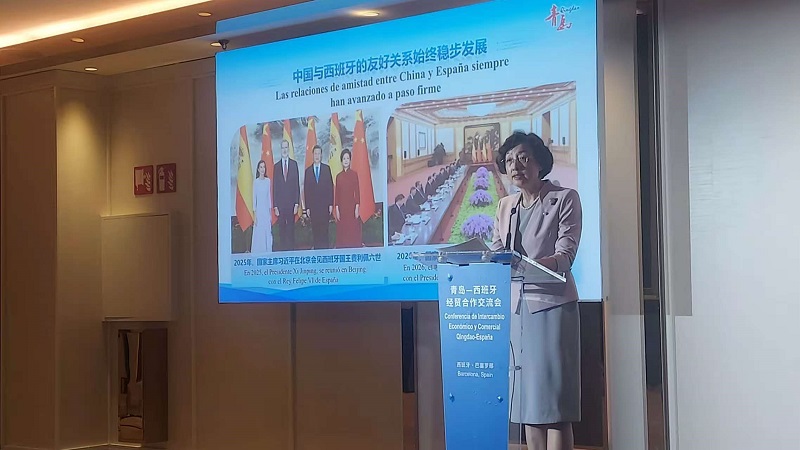
Zhang Hui, deputy secretary of the Communist Party of China Qingdao Municipal Committee, addresses the conference in Barcelona.
The event was attended by more than 150 VIP’s and several key institutions and companies, including the Barcelona Chamber of Commerce, Catalonia Trade and Investment, Port of Barcelona, Grifols, a giant global conglomerate operating in the healthcare and plasma-derived medicines sector, and Abanca, a prominent financial institution – both from Spain. Meng Yuhong, Chinese Consul General in Barcelona, Nadia Quevedo, Spain’s Commissioner for Economic Development, Trade and Hospitality at Barcelona City Council and Mireia López Leonar, International Promotion Manager of Catalonia Trade and Investment, emphasized the need to enhance economic, trade, investment and industrial cooperation as both cities and regions are among the world’s most dynamic. The “Twinning Agreement” between Qingdao and Barcelona, signed in May 2012, has helped to foster mutual cooperation in trade, investment, tourism, education, sport and urban management. Standouts are the links between the two ports, collaborating for over 25 years on logistics, innovation and energy transition, according to El Canal Marítimo y Logístico, a specialized online newspaper covering the Spanish shipping industry.
Qingdao is the birthplace of Tsingtao Brewery, Haier Group, leading tyre manufacturer Sailun Group, and Qingdao Port Group – one of the world’s largest port conglomerates. With a population exceeding 100 million, Shandong Province, where Qingdao is located, is home to nearly 20 million more people than Germany, the EU’s most populous nation.
Participants expressed a shared desire to use the conference as a launchpad to a long-term matchmaking platform, unlock cooperation across multiple sectors, and drive mutually beneficial development. Interestingly, Barcelona’s ties with China run deep through the prestigious IESE Business School, which co-founded the China-Europe International Business School (CEIBS) in Shanghai – a flagship initiative of EU-China cooperation. Many key executives at the conference are IESE alumni or close affiliates, including Jordi Aranega, President of Association for Sino-Spanish Collaboration for Responsible Business Development, and Ricardo Ferrer, President of the Spain-Hong Kong Business Association. Adding to these synergies is the CEIBS Alumni Qingdao Chapter, active since 2004 and now numbering thousands of members. As municipal dialogues deepen, these parallel networks offer vital reference points. Such a longstanding entrepreneurial partnership is also embodied by leading figures like Victor Campdelacreu, board member and head of Consular and Diplomatic Relations at PIMEC, and Ramon Maria Calduch, president of the European Foundation of Traditional, Complementary and Integrative Medicine, who attended the event as distinguished participants.
Zhao Yang, general manager for Central Europe at Haier Smart Home, delivered a compelling speech highlighting the company’s global reach, regionally in Europe and Spain, and locally in Catalonia and Barcelona. His high-tech focused presentation clearly demonstrated that Haier is dedicated to simplifying daily life by providing solutions to real human needs – an invaluable trait for a world-class home appliances and consumer electronics multinational headquartered in Qingdao.
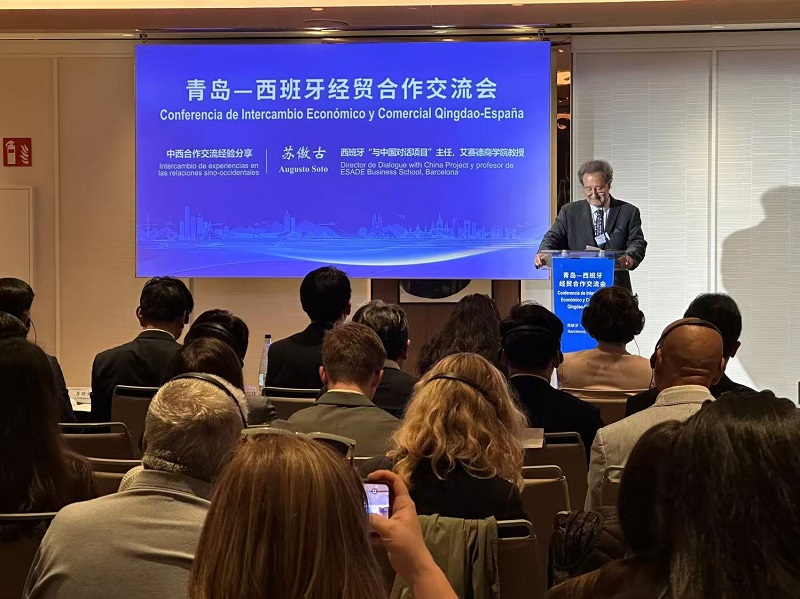
Augusto Soto, director of the Dialogue with China Project, speaks at the conference in Barcelona.
Speaking to participants I mentioned that when engaging in long-term interactions, it is crucial to gain a deeper understanding of the culture of long-standing partners. I pointed out that Confucius, considered the paragon of Chinese sages, was born in the city of Qufu, a place a short high-speed train journey from Qingdao. He lived between the 6th and 5th centuries BC: an era preceded the golden age of Classical Greece, the rise of the Roman Empire, and the eventual emergence of Europe as a distinct cultural entity.
Confucius stands as the cultural father of East Asia; without him, we would be unable to grasp a significant portion of the contemporary mindset of both the Chinese people and the Chinese business community. A continuous capacity for learning, combined with a deep respect for experience – alongside an ethical sense of community, encapsulated in the maxim ‘do not do unto others what you would not have them do unto you’ – will sound very familiar to most people. In China, these teachings originate from Confucius; in the West, they stem from Christianity. Without Confucius we would understand neither the Chinese sense of frugality, nor their capacity for saving. Consequently, it is fortuitous to have a Confucius Institute in Barcelona, where entrepreneurs, including our current and future generations of business leaders, pursue their studies.
Another significant parallel, on the European-Chinese exchange dimension, is the translation of one of humanity’s oldest texts into German: The Book of Changes (also known as the Yijing 易經). Translated in the early twentieth century, in the city of Qingdao, by German sinologist Richard Wilhelm, it was subsequently adapted into other languages. Without the Yijing, we could neither comprehend the very concept of change, which is so deeply ingrained in the Chinese mindset, nor understand how prominent Chinese entrepreneurs and investors perceive and navigate change, as confirmed by many leading Chinese innovators.
In addition, one of the most pivotal texts on strategy was written in Shandong Province. The Art of War by Sun Tzu, is studied in world-class business schools in Barcelona, such as ESADE and IESE, as well as in other business schools across the continent. Written over 2,500 years ago, it originated in the vicinity of the Shandong city of Yinqueshan, 200 kilometers from Qingdao. Sun Tzu’s book, one of humanity’s enduring classics, is far more profound than its title might suggest; indeed, as we know, it is highly valued within major corporations throughout the Western world. Its fame and inspirational power stem from its focus on self-knowledge and the potential to transform competitiveness into an exchange of a fundamentally different nature – one characterized by meticulous planning, strategic insight, and wise, original foresight.
At the conference, officials from Qingdao were reminded that near Barcelona lies the small town of Empúries, the root of the word emporium (and empori in Catalan/ emporio in Spanish). Originating as a term for a market or trading port, it is now present in every European language. Empúries was an ancient Greco-Roman enclave founded in the 6th century BCE, demonstrating the region’s exceptionally long history of international trade. Overlooking this deep-rooted tradition would provide only a partial understanding of why the Catalan and Barcelona’s business community is not just a pioneer within Spain, but also the Mediterranean.
Spain’s Prime Minister, Pedro Sánchez, who has visited China four times in four years, has consistently emphasized the importance of fostering bilateral ties, a fact to which I can personally attest.
_____________
Augusto Soto, director of the Dialogue with China Project, distinguished by United Nations Alliance of Civilizations and United Nations Global Experts Resource.