The inland city of Yiwu in east China’s Zhejiang Province has expanded its commercial ties to the globe. It hosts over 10,000 foreign-invested business entities, with 38,000 resident foreign businesspeople, and its total import and export value reached RMB 209.37 billion during the first quarter of 2026, marking a historic high.
The things that were once unimaginable and seemed impossible to achieve can all become a reality in Yiwu.
The dazzling array of various goods is its most distinctive emblem. However, upon delving deeper into this city, one will find that the reason why foreign businesspeople want to stay here is far more than that.
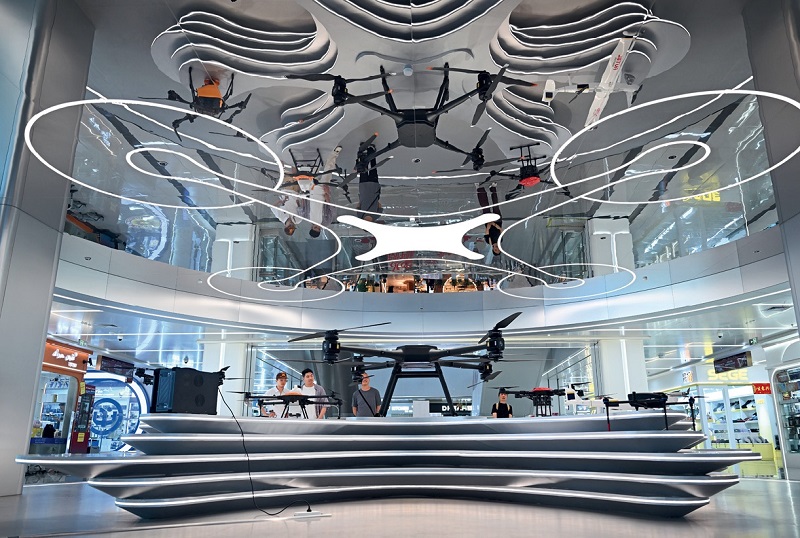
Drones are displayed in the Yiwu Global Digital Trade Center on May 26, 2026.
Turning Impossible into Possible
“Without Yiwu, I would not be what I am today,” Sourakhata Tirera from Senegal often says. He first came to Yiwu in 2003 to purchase hardware products after hearing many positive reports about it. “You can buy anything here; if you don’t see a product, it can only be said that you have not found it yet,” he said.
Between 2003 and 2007, Tirera often flew back and forth from Dakar, capital of Senegal, to Yiwu every 45 days, staying for two weeks each time and sending two or three containers of goods back home each trip. In 2007, he established a foreign trade agency in Yiwu. In 2012, leveraging the policy opportunities provided by the Yiwu comprehensive reform pilot for international trade, he established a wholly foreign-owned trading company. Today, his company has the capacity to dispatch more than 200 containers of goods each month, covering over 1,000 types of products and provides one-stop procurement services for traders from multiple African countries.
He is convinced that Yiwu is a highly open and inclusive place where changes are taking place every day, providing entrepreneurs with a stage to pursue their dreams.
Daring to think and venture is part of the fabric that defines Yiwu as a city. Tirera’s entrepreneurial journey is the most straightforward embodiment of this spirit. Being unable to speak Chinese when he first arrived, he seized every opportunity to learn and practice the Chinese language by communicating with local people. With no ready-made experience to follow, he immersed himself in the market to explore through practice.
“Foreign businesspeople in Yiwu have all come through similar experiences, encountering both ups and downs, tasting success as well as setbacks,” Tirera said. Yiwu, along with its local merchants, inherently embodies a spirit of resilience, proactive adaptation to change, and courage to face challenges. “Growing together with Yiwu has been the proudest choice of my life,” he recalled.
Businessman Maged Mohammed Ali Al-Huraibi from Yemen has always regarded Yiwu as an ideal testing ground for entrepreneurship. Driven by his entrepreneurial dreams, he came to Yiwu alone and founded a cosmetics trading company in 2008, primarily engaged in the procurement of makeup and skincare products for export to the Middle Eastern market. “A friend told me that as long as you have dreams and goals, you can realize them in Yiwu. What he said has been proven right,” he said. His foreign trade business quickly got on track and steadily grew.
After China’s Foreign Investment Law came into effect in 2020, all restrictions on foreign investment in the manufacturing sector in Yiwu were lifted. In 2024, the city actively promoted a one-stop entrepreneurship service reform for foreign professionals, providing foreign investors with comprehensive services including factory leasing, policy consultation, and talent recruitment.
Al-Huraibi decisively seized the opportunity and invested in a cosmetics factory at the beginning of 2024, successfully starting up his own manufacturing operation. Today, within the factory’s 4,400-square-meter workshop, multiple production lines are operating at full capacity, producing a full range of makeup products. “Yiwu has made it possible for me to fulfill my entrepreneurial dream, and I hope to sell Yiwu-made beauty products to more countries and regions around the world,” he said.
The Yiwu spirit of “studying diligently and working hard, uprightness and courage, integrity and inclusiveness” inspires entrepreneurs both at home and abroad to pursue their dreams. The benefits foreign investors gain here are not only success in business, but also strength rooted in an ethic of hard work and belief in the future.
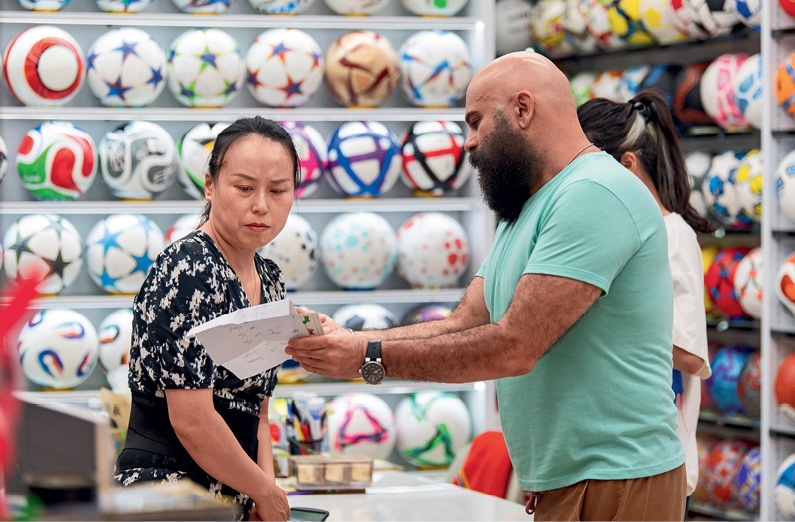
A foreign businessman verifies his purchase orders with a store owner in Yiwu on September 16, 2025.
Proactively Create
If “having everything” is the first impression that attracts foreign businesspeople to Yiwu, “creating something out of nothing” is the deeper reason they stay.
Yiwu’s development has never been merely about the aggregation of commodities; it lies in the fact that this city can proactively create whatever the market needs: when there is no ready-made path, it pilots and experiments; when there is no mature experience, it explores and innovates along the way.
Khadka Raj Kumar, a businessman from Nepal, came to Yiwu for the first time in 2002 to explore the market after hearing that goods here were reasonably priced. Over the next decade, he frequently traveled back and forth to engage in foreign trade. In 2011, Yiwu pioneered a dual-track system of representative agencies and foreign-invested operating entities, which solved difficulties related to foreign residents’ staying, employment, and business operations. The following year, Kumar established a foreign trade company in the city and bought a house to settle down here.
“This is a city that sincerely welcomes foreigners,” he said. Yiwu always respects differences in cultures and embraces diversity, providing fair development opportunities for enterprises of different countries and sizes. Today, his clients are spread around the world including South Asia, South America, and Europe.
China’s first evaluation criteria for foreign business talent was unveiled in Yiwu in June 2025. It used actual contributions such as years of work, employment promotion, and import-export volume as key indicators to evaluate these professionals. “I submitted my application in no time, and it was processed very quickly,” Kumar said with a smile. Category B talent status enjoys more conveniences regarding visas and other matters, which gives him greater confidence in developing his career long-term in Yiwu.
Yiwu established China’s first people’s mediation committee for foreign-related disputes in 2013, appointing foreign merchants as mediators for disputes involving foreign businesspeople. Since 2017, Kumar has served as a foreign mediator and participated in mediating over 150 foreign-related disputes to date. “In Yiwu, we are not considered as outsiders, but fellow townspeople,” Kumar said.
Behind this lies institutional innovation in urban governance. Faced with 38,000 foreign businesspeople from over 100 countries and regions, the local government of Yiwu applies a pragmatic and efficient market-oriented approach to social governance.
Jimingshan Community is home to foreign residents from 74 countries and regions. In recent years, Yiwu City Procuratorate, in collaboration with multiple departments, has published multilingual legal brochures, established foreign-related legal service offices, and regularly organized legal awareness activities, bringing legal services directly to the doorsteps of foreign businesspeople.
The community also started offering free Chinese language courses and set up English and Spanish speaking activities as early as 2014. Many foreign businesspeople who learned Chinese there voluntarily took on roles as foreign language teachers. One such businessman is Armando from Peru. While studying Chinese in the community, he also teaches Spanish to both Chinese and other foreign residents. “My neighbors teach me Chinese, and I teach them Spanish. This gives me a strong sense of participation,” he said.
He also shares stories of conducting Sino-Latin American trade through his overseas social media accounts with more than 200,000 followers. “Many people want to know how to do business with China and how to cooperate with Yiwu.” He records the trade process, sharing his observations from living and working in Yiwu, and has even been recognized as a foreign communication messenger of Yiwu.
Yiwu’s comprehensive urban service system enables foreign residents to stay. The city’s institutional innovation to simplify administrative procedures enables foreigners to integrate into the local society. In turn, foreign residents participate in public welfare and cultural exchanges with greater enthusiasm, giving back to the city that has provided them with a sense of belonging. Increasingly, foreigners are becoming locals.
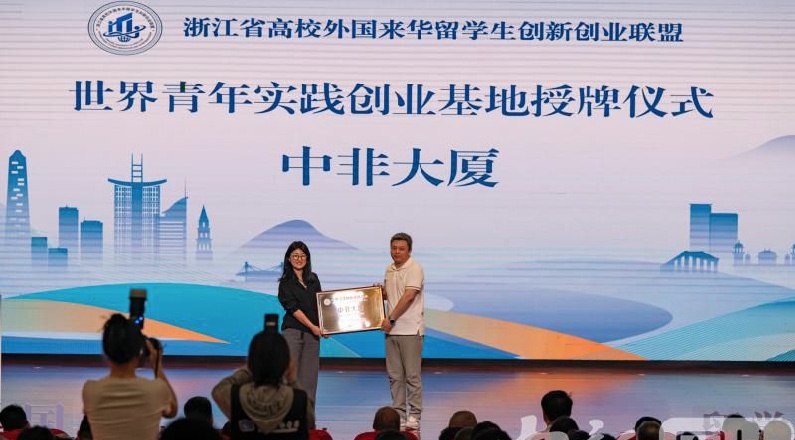
The 7th "International Maker" Innovation and Entrepreneurship Competition of Zhejiang Province is launched on May 20, 2026 in Yiwu, alongside the 10th International Culture Carnival of Yiwu Industrial and Commercial College.
 Turning Ideas into Reality
The Global Digital Trade Center marks a new phase in Yiwu’s transition from traditional to digital trade models. An increasing number of foreign merchants are participating in new industries and business formats, jointly promoting the city’s upgrade from “Made in Yiwu” to “Created in Yiwu.”
Sheikh Jamil, a Pakistani businessman who has been engaged in commerce in Yiwu for 21 years, feels these changes acutely. “In the past, doing foreign trade meant spending more than half the year on airplanes traveling to trade shows, meeting clients, and negotiating orders,” he said. Nowadays, an increasing amount of business can be conducted online. To expand his company’s market, he has specially built a team to produce short videos and promote products overseas through websites and social media platforms. In addition to this, with the help of AI, he can also quickly generate product plans for different markets. “AI can tell you what styles are trending in New York or what designs consumers in Los Angeles prefer,” he said.
The upgrade of cross-border payments has made global transactions smoother. Nowadays, most of his cross-border settlements are completed through YiwuPay, a payment platform launched by Yiwu China Commodities City. “The operation is similar to Alipay; foreign customers pay locally, and the funds can arrive as quickly as the next day,” he said. Compared with bank transfers, YiwuPay not only reduces fees but also allows direct settlement in RMB, making it convenient to pay suppliers immediately. The application of cloud computing and intelligent technology in international business transactions, logistics, and customs clearance has driven more remote foreign trade orders. “Now I can do global business while sitting in my office,” Jamil said.
One decade ago, Yemeni businessman Hasan Mohammed ventured into the cosmetic sales business in Yiwu. Later, as the city fostered a growing atmosphere for original brands, driven by the ambition of establishing his own brand, he registered a cosmetics brand in Saudi Arabia in 2018. During the following years, he completed brand development within China and other members of the Madrid system, taking an important step in transitioning from a trader to a brand operator.
The model of “registered in Saudi Arabia, manufactured in China, and sold worldwide” has enabled his products to maintain high quality while possessing strong market competitiveness. “Yiwu is more like an ecosystem where ideas can be quickly turned into reality,” Mohammed said. This city provides the potential for continuous growth.
For Brazilian merchant Juliana Assuncao, the transition from “Made in Yiwu” to “Created in Yiwu” is inseparable from the full-chain empowerment of branding, digitalization, and internationalization. The first time she visited Yiwu, she was struck by the vast array of goods and attracted by the city’s highly efficient and complete industrial ecosystem.
“The industrial chains of batteries, cables, and plastic accessories are closely interconnected, and logistics and supply systems are highly coordinated. This is not magic but efficiency,” Assuncao said. This advantage of industrial clustering led her to establish a business consulting company to help overseas clients accurately identify markets, clarify procurement needs, and select quality suppliers. It also provides full-process supply chain services which include product selection, inspection, logistics, and customs clearance.
Not long ago, Assuncao led a team of reporters from Brazil’s TV Globo to Yiwu to film a special feature on Chinese manufacturing, aiming to help more overseas clients gain a better understanding of Chinese small commodities. “The prices of Chinese small commodities are extremely competitive due to the strong industrial supporting capabilities, which greatly reduce logistics costs and production cycles.” In her view, today is an era of deep integration between brand positioning and supply chains, and Yiwu offers more opportunities for brands to achieve that end.
Bold in exploration and experimentation, riding the winds of opportunity, keeping pace with the times, and deeply cultivating its strengths, Yiwu helps businesspeople from around the globe turn more “impossibilities” into “possibilities,” and let the “Yiwu innovation” benefit more people and countries around the world. 
LIU LINGLING, BAI ZIWEI and LIU JUNGUO are reporters with the People’s Daily.