On June 22 of this year, the artificial intelligence developer Zhipu AI crossed the HK $1 trillion market valuation mark, becoming China’s first large language model company to reach this threshold. Its share price has surged over 2,000 percent since its listing in January this year.
The catalyst behind this round of skyrocketing stock prices was the launch and open-sourcing of Zhipu AI’s new flagship model GLM-5.2 on June 17. Because the model centers on long-horizon tasks, it enables AI to evolve beyond performing instant question-and-answer (Q&A) interactions to working continuously for several hours like humans. In blind tests conducted by millions of global users on the Code Arena leaderboard, GLM-5.2 claimed the top spot among all viable models worldwide.
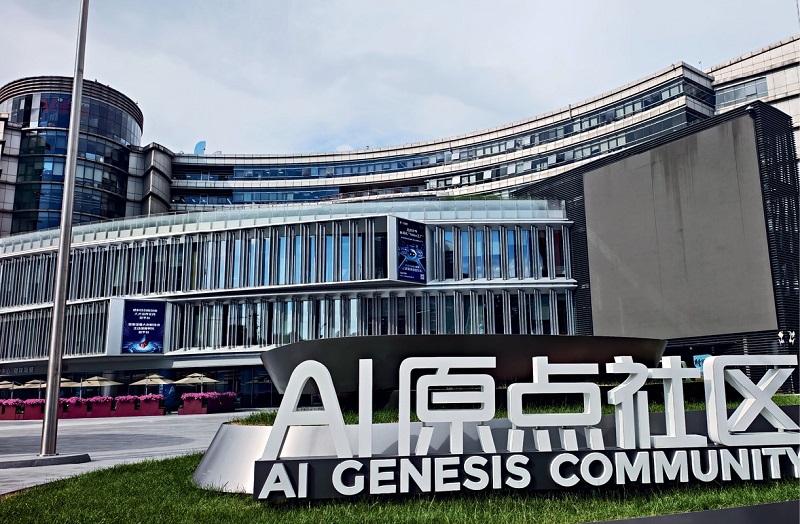
Wudaokou, a street in Beijing’s Haidian District famous for attracting many foreign students to the universities located there, is emerging as the gathering place of AI enterprises.
From Lab to Developer
Beijing Zhipu Huazhang Technology Co., Ltd. spun off from the Knowledge Engineering Group (KEG) under the Department of Computer Science and Technology, Tsinghua University in 2019 to commercialize its lab research outcomes. Focused on conducting research and development (R&D) and industrial deployment of artificial general intelligence (AGI), it was one of China’s earliest large model developers with an open-source strategy and now is a core contributor to the development of Beijing’s open-source AI ecosystem.
Zhipu AI open-sourced GLM-130B in 2022, a large model with hundreds of billions of parameters. At that time, being that the industry landscape was dominated by closed-source models, this release filled a technological gap in the domestic market. The company has since open-sourced more than 60 models in succession.
Zhipu AI rolled out its flagship model GLM-5 in February. Rather than merely operating as a code-generation tool, the AI functions as an “engineer” capable of autonomous testing and iterative optimization. The company rolled out its upgraded iteration GLM-5.1 in April, featuring markedly enhanced autonomy and long-horizon task execution capabilities; it can also independently work continuously for over eight hours within a single task session. Zhipu AI launched and open-sourced its new-generation flagship model GLM-5.2 on June 17.
“Once large models gain closed-loop capabilities for long-horizon tasks, core competitiveness will be redefined by TAC (Token Architecture Competence),” said Zheng Qinkai, Zhipu AI’s technical spokesperson. Globally large models are shifting from knowledge-driven to task-driven paradigms. Instead of merely delivering knowledge-based services such as dialogue and Q&A, they are evolving to independently accomplish complex tasks.
An AI productivity measurement framework put forward by Zhipu AI in 2025 enables every Token consumed by enterprises to function as a digital employee and translate into deliverable economic growth. During the same year, the company also took the lead in launching its coding package called the GLM Coding Plan. The number of paid developers exceeded 242,000, and token calls surged 15 times within six months. According to Zheng, large model-generated tokens already handle a large share of programmers’ workloads today and will be further expanded into more high-value sectors in the future.
According to Zheng, the development of AGI can be divided into five phases. The industry has completed the phases of pre-trained models, as well as agent and robot development, and is now entering the self-learning phase. To develop further, the autonomous iteration capability of large models will be pivotal. Zheng is certain that when large models can independently handle iterative work including structural optimization and data updating, their evolutionary efficiency will be drastically boosted.
The reason Zhipu AI has gained wide recognition in the industry is not because of any single performance metric it made, but its capacity to conduct end-to-end independent R&D. “We maintain full independence across underlying algorithms, pre-training frameworks, and adaptation to domestic hardware,” said Zheng. This means that Zhipu AI has enhanced risk resilience and autonomous evolution capabilities amid an uncertain external landscape.
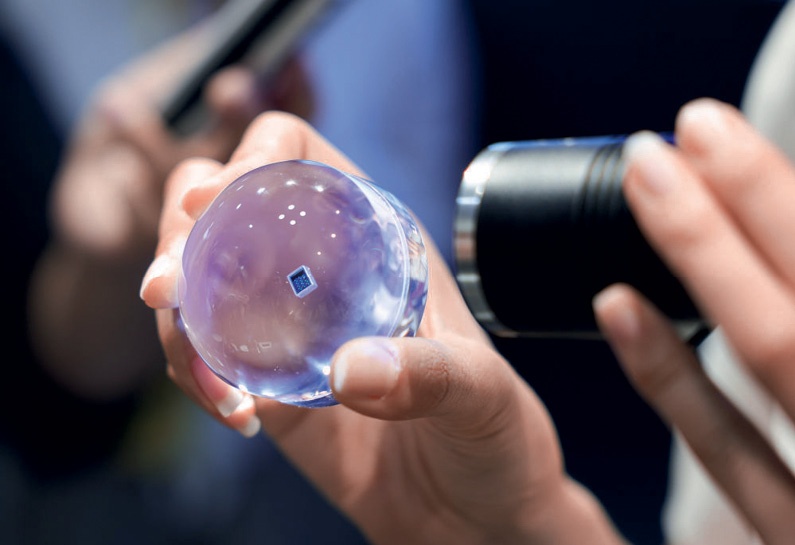
The advanced technological ability of imbedding quantum-dot spectral chip in a wide range of terminals, including smartphones, drones and pipeline inspection robots, now enables the fast, low-cost spectral fingerprint identification of substances anytime time and anywhere.
First Mover and Pathfinder
“We have always been committed to exploring those fields which are difficult to understand yet must be mastered,” said Wang Zhongyuan, director of Beijing Academy of Artificial Intelligence (BAAI), who reviewed the institute’s five-year technological journey, unpacking the iterative evolution of China’s large AI models.
Founded in 2018, BAAI launched the WuDao project back in 2021. Representing a groundbreaking milestone for homegrown large models at the time, WuDao delivered an indigenous foundational large model that was comparable to global state-of-the-art alternatives. Centered on linguistic interaction, its inaugural iteration handled core tasks including Q&A sessions, copywriting, and consultation. Its success broke through the technological monopoly held by large models of other countries and laid the technical bedrock for domestic AI industry.
BAAI released WuJie·Emu in 2024, a multimodal large model that endows AI with integrated capabilities to “see, hear, and comprehend.” Integrating multi-dimensional perception of text, images, audio, and video, it can not only accurately analyze all types of multimedia content, but also generate visual creations based on creative prompts. Its Emu3 model was featured in a subsidiary journal of Nature, marking China’s multimodal AI technologies entering the world’s top tier.
In the year 2025, BAAI began to conduct in-depth research in neuroscience and life sciences, developing as a result a neuroscience large model and an all-atom life model. This innovative suite of models can simulate mechanisms of biological activities, assist in analyzing protein structures, and support research on disease pathogenesis. It turns AI into a brand-new tool for life science exploration and delivers in-depth cross-industry empowerment via AI technologies.
BAAI unveiled its brand-new embodied intelligence large model WuJie·RoboBrain in 2026. Distinct from conventional virtual AI systems, this model is compatible with physical intelligent devices such as robots, enabling AI to seamlessly integrate into the physical world and delivering core technical support for the popularization of humanoid robots and consumer smart terminals.
According to Wang, BAAI has taken an active role in helping build an open-source ecosystem. To date, it has open-sourced more than 200 high-quality AI models, and its global downloads have exceeded one billion. By making these core technologies freely accessible, BAAI has substantially lowered the AI R&D barriers for startups, small and medium-sized enterprises, and research institutes. It has also built a public technology platform to fuel innovative growth across the entire industry.
BAAI has pioneered a unique operational framework which is anchored in three core tenets: pooling resources to advance major strategic research, empowering young talents to take on leading roles, and fostering innovation through an open ecosystem. It launched the BAAI Scholars Program to recruit top young scientists worldwide. Awardees receive sustained long-term research backing, free from rigid short-term quantitative assessment benchmarks.
By leveraging platforms including the BAAI Conference and BAAI Community, BAAI has built an expert ecosystem which integrates industry, academia, research, and commercial application. There exists no hierarchy of supervisors or subordinates here—only scholars, engineers, and entrepreneurs. To date, BAAI has brought together hundreds of leading scholars and full-time R&D professionals, focusing on developing system-level breakthroughs that entail technical hurdles and require sustained research efforts.
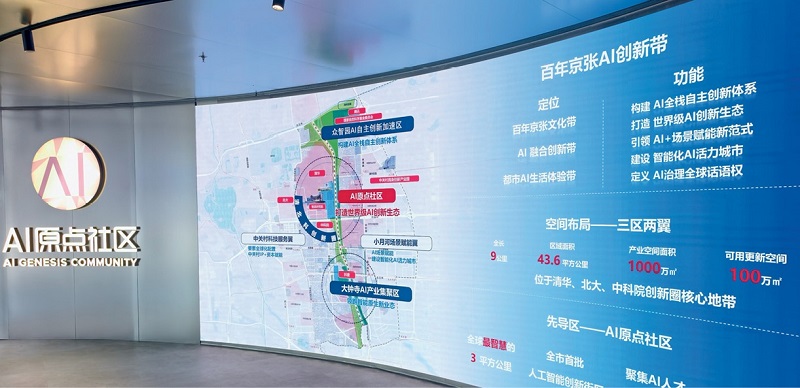
The group of around 13,000 talents based in the AI Genesis Community in Beijing forms an unmatched pool of elite talent both nationwide and worldwide.
A Testbed for AI for Science
AI for Science Institute, Beijing (AISI) boasts a distinct ethos from BAAI and Zhipu AI. Its core mission is to empower scientists and unlock their research potential through AI.
“We are the world’s first research institute named after and dedicated to AI for Science,” introduced Li Xinyu, director of AISI. Founded in 2021, AISI is a new-type R&D institution. Guided by its mission of “empowering scientists and enabling industries,” the academy is continuously building a full-stack infrastructure system for AI for Science, driving the shift of scientific research paradigms from experience-driven to intelligence-collaborative models. As a result, a host of pioneering breakthroughs in fundamental research have emerged one after another.
AI for Science leverages AI to tackle longstanding bottlenecks in traditional scientific research, including intractable computation, inaccurate measurement, and lengthy research cycles. “We are committed to developing a full-fledged infrastructure system for AI for Science,” said Li, “In the past, scientists relied on trial and error in experiments. Formulation development alone could require hundreds or even thousands of rounds of testing. Today, AI can run virtual pre-experiments to screen out the most promising solutions for scientists to validate in physical labs.” Li explained. Rather than individual research groups working in isolation, an AI-powered platform enables closed-loop iteration across data, models, and physical experiments.
“Searching for a specific piece of knowledge amid the vast ocean of scientific literature has always posed a major challenge for researchers,” said Li. To address this challenge, AISI, in collaboration with DP Technology, has launched Bohrium, a research cloud platform dedicated to enabling collaborative scientific research and industrial design on the microscale level.
As the world’s first AI-powered research platform to integrate the full workflow of literature review, computational simulation, experimental testing, and interdisciplinary collaboration, it has closely unified foundational scientific large models, research databases, knowledge base management, intelligent computing scheduling, and smart experimental tools. The platform systematically resolves the core bottlenecks which researchers face across literature retrieval and organization, cross-disciplinary knowledge mining, and integrated experimental-computational workflows. It now serves over 4.5 million users worldwide.
Since its establishment, AISI has taken an active role in advancing the construction of the AI for Science ecosystems, delivering groundbreaking achievements across energy materials, biomedicine, fluid mechanics, and other disciplines. Its large atomic model targets the most fundamental question in scientific research: understanding the microscopic material world. Empowered by its newly upgraded DPA4 large atomic model, researchers can simulate microscopic processes at larger scales and over longer timeframes with identical computing resources. For rocket engine development, the team from AISI has built a platform which enables the full-process intelligent automation of design, simulation, manufacturing, and testing.
Looking Ahead
To achieve an all-round leap forward in China’s large model technology in the years ahead, the industry should not stake its future on a single blockbuster product, but build a complete industrial ecosystem instead.
We need more innovation hubs like BAAI which are dedicated to original innovation and fundamental research; solid tech pioneers like Zhipu AI that pursue full-stack independent R&D spanning algorithms and hardware to build risk-resilient foundational model infrastructure; and cross-disciplinary explorers such as AISI, which unlock brand-new value frontiers by integrating AI into traditional research paradigms.
As researchers from BAAI, engineers from Zhipu AI, and scientists from AISI work in synergy, an innovation chain with infinite potential is taking shape. 
WANG ZHE is a reporter at China Report.