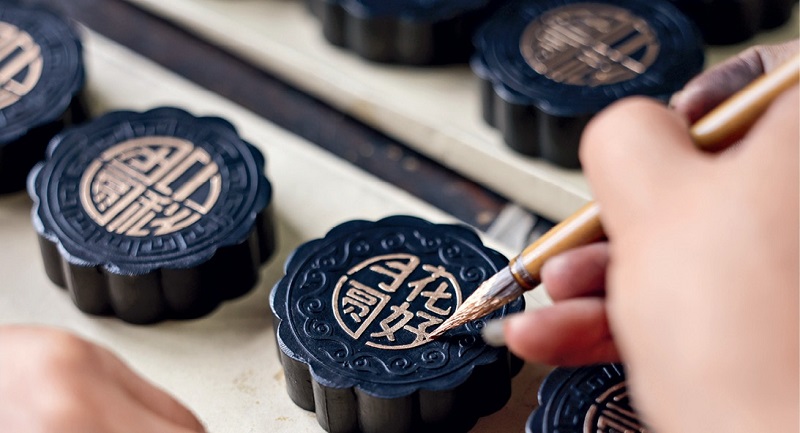
An artisan uses gold lines to decorate a moon cake-shaped Huizhou inkstick in Shexian County, east China’s Anhui Province.
Huizhou ink, produced in the historic region of Huizhou (covering parts of present-day Huangshan and Xuancheng cities in Anhui Province), is one of China’s most celebrated traditional inks. For centuries, it has been prized for its lustrous black hue, smooth flow, lightfastness, and subtle fragrance. The craft of making Huizhou inksticks dates back to the late Tang Dynasty (618-907), and in 2006, in recognition of its cultural significance, this age-old craft was inscribed on China’s first national list of intangible cultural heritage items.
The enduring appeal of Huizhou inksticks is inseparable from their intricate, entirely handmade production process. From soot collection, glue preparation, and ingredient mixing to pounding, molding, shaping, drying, polishing, and gold detailing, a traditional inkstick passes through numerous stages. The entire process often takes several months to complete, with each stage reflecting the maker’s experience, skill, and patience.
Soot collection is a crucial first step. In the traditional method, materials such as tung oil and pinewood are burned under a tightly controlled temperature and duration, and the fine soot particles are gathered in specially positioned vessels. The soot is then sifted and blended with other ingredients to form the ink mixture. Different types of soot lend Huizhou inksticks their distinct colors and textures.
Animal glue is then added, and the mixture is pounded repeatedly until the soot particles form a dense, uniform mass. After being pressed into molds, the inksticks are left to dry slowly in a cool, well-ventilated place. Finally, they are polished and embellished with gold lettering or designs, becoming objects that combine practical use with artistic value.
Making Huizhou inksticks is not merely a craft; it also embodies the aesthetic sensibility of traditional Chinese calligraphy and painting. When used on traditional xuan paper, the ink produces a rich range of shades and effects, from dark and dense to light and clear.
Although the digital era has transformed everyday writing habits, the many people who continue to practice traditional Chinese calligraphy and painting sustain a substantial demand for inksticks. Meanwhile, inheritors of the craft are exploring new ways to keep it alive. While preserving traditional materials and core techniques, they refine formulas and design new inkstick shapes to appeal to younger generations. Online platforms are also playing a vital role in introducing the craft to wider audiences, giving more young people the chance to discover this ancient art.