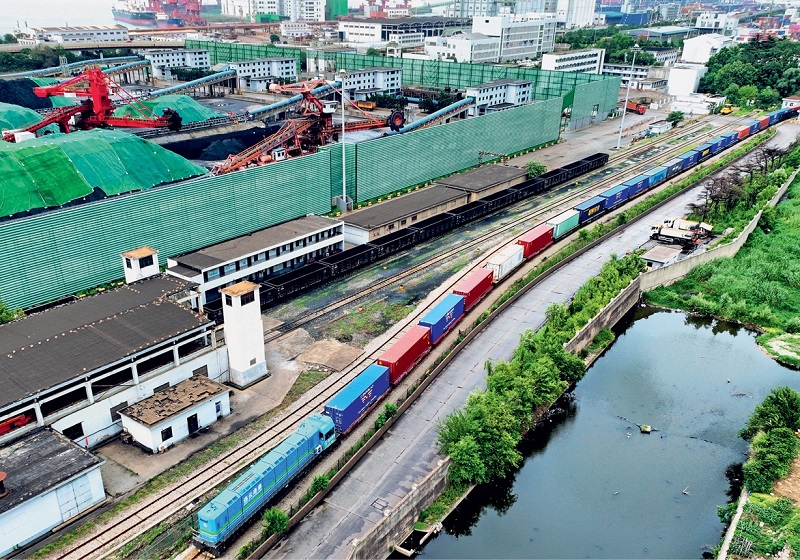
A China-Europe (Asia) Railway Express freight train is being loaded with containers before departing for Ablik, Uzbekistan, at the China-Kazakhstan (Lianyungang) Logistics Cooperation Base in Lianyungang, Jiangsu Province on July 6, 2026.
Every technology revolution creates new possibilities. It also creates a potential gap between those equipped and those who could be left behind. This is also true of AI.
The defining challenge of the AI era is not technological advancements. The real question is whether societies can help enough people to thrive using technology. Skills are the bridge between innovation and opportunity.
For China and Europe, this presents both a shared challenge and a shared opportunity. For decades, bridges have been built through trade, investment, education, research, and people-to-people exchanges. Now, in the age of AI, talent and skills could become the most important bridge of all.
The impact of AI is already visible in the workplace and its clearest effect to date has been on tasks, not entire jobs. AI can analyze data, generate content, automate processes and support decisions. In many roles, this changes what people do in the job before it changes whether the job exists.
Yet the implications go far beyond productivity gains. AI is beginning to reshape how work is organized, performed, valued, and governed. In other words, it is changing how work is designed.
This is why organizations must move beyond tool adoption. They need to redesign work, so people, AI agents, automation, and physical AI (such as robots) can contribute where they create the most value. This form of hybrid workforce orchestration is quickly becoming a core management capability.
However, organizational change and workforce redesign alone are not enough. Preparing for the intelligent era requires collaboration across governments, businesses and educational institutions. AI preparedness must become a societal priority.
The AI Skills Imperative: A Shared Challenge
In this context, China and Europe have much to gain from working together because they face a remarkably similar challenge.
AI is changing jobs and tasks faster than traditional education and training systems can adapt. Of course, every economy needs leading tech experts to push the boundaries of the possibilities of AI. At the same time, they need a workforce able to use AI effectively; leaders capable of redesigning work around AI; and pathways for people whose jobs are disrupted to acquire new skills. No single institution can solve this challenge alone, including employers, governments, universities and schools. Success, therefore, depends on collaboration between these three.
Most importantly, AI should not be something that happens to people. It must happen with people, and China and Europe bring different, but highly complementary strengths to the task.
China’s approach of increasingly connecting AI, education, vocational training, and industrial development is commendable. Its recently announced “AI Plus Education” action plan provides a strong example of a coordinated approach to ensure impact at scale, with AI education throughout different stages of learning, a focus on greater AI literacy across society, universities adapting disciplines and curricula, as well as vocational education responding to changing occupations. This is accompanied by stronger employer involvement, continuing education and retraining for people already in work.
One of the strengths of this approach is thinking about skills development at scale and connecting it with technological and economic priorities.
Europe is addressing many of the same challenges through a different, yet similar model. The “European Union’s Union of Skills” initiative puts human capital at the center of European competitiveness. Its priorities include lifelong learning and retraining, development of stronger STEM capabilities, and a focus on digital and AI skills. It also emphasizes skills mobility across borders, talent attraction and retention, and stronger links between education providers and employers. At the same time, Europe brings strong traditions in vocational education, apprenticeships, worker transition, and social partnership.
An Opportunity to Build Together
Launched in 2018 by the Chinese Embassy in Switzerland and the Adecco Group, the China-Europe Talent Forum provides a key platform for building stronger China-Europe ties. Co-hosted by the Beijing Talent Work Bureau and the Adecco Group, it alternates annually between China and Europe. At its core, the Forum has always been action-driven – turning dialogue into concrete outcomes.
Three priorities stand out.
First, understanding together. China and Europe should deepen the sharing of research and labor-market intelligence on how AI is changing jobs, tasks and skills. Better understanding of the similarities and differences will help policymakers, educators and employers make better decisions.
Second, learning together. Building on this, employers, universities and vocational institutions can develop and test new approaches to AI literacy, reskilling and human-AI collaboration, while openly sharing lessons learned.
Third, developing talent together. Expanding exchanges involving students, apprentices, educators and young professionals would allow the next generation to have direct experience of both economies and the chance to build relationships that last throughout their careers.
AI creates a shared responsibility: ensuring technological transformation benefits people and societies. The most valuable connection between China and Europe may ultimately be neither a supply chain nor a technology platform, but rather the flow of knowledge, skills and human potential between them. The long-term success of both China and Europe depends on whether people can be helped to cross the bridge from today’s reality to tomorrow’s opportunities. 
JEAN-CHRISTOPHE DESLARZES is chair of the Board of the Adecco Group.