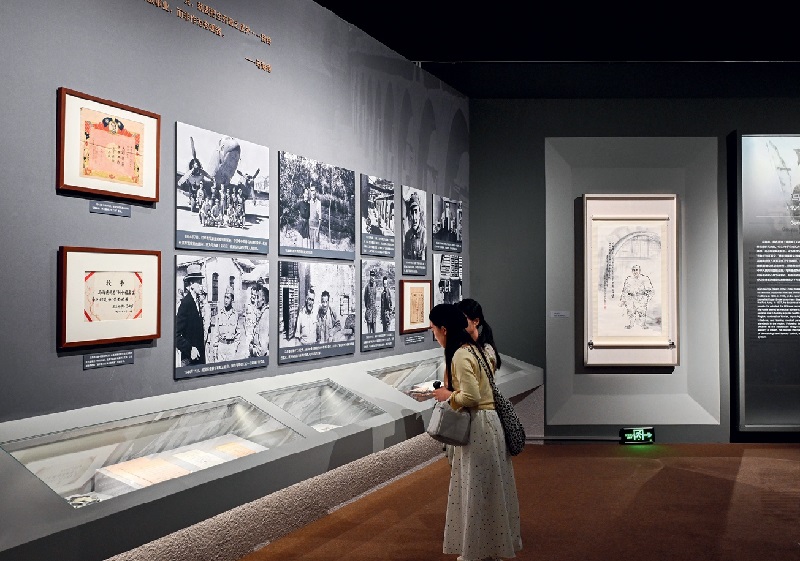
Visitors look at historical materials about George Hatem (Ma Haide), a major section of the special exhibition of “International Friends and China’s War of Resistance” at the National Museum of China on September 19, 2025.
 In October 1935, the Central Red Army, a principal force of the Chinese Works’ and Peasants’ Red Army led by the Communist Party of China (CPC), completed the Long March and arrived in northern Shaanxi. The Red Army’s two leaders Mao Zedong and Zhou Enlai wrote to Madam Soong Ching-ling, wife of Chinese revolutionary leader Sun Yat-sen and at the time an influential political figure in China, after her husband’s death. They sought her recommendation for an impartial foreign journalist and a highly skilled foreign doctor to visit the revolutionary area, conduct on-the-ground investigations, and present the truth to the world – a truth that had until then been tightly sealed off by a blockade. Soong immediately recommended Edgar Snow, an American journalist, and George Hatem, an American doctor of Lebanese descent.
Snow was 31 at the time. After graduating from university in 1928, he had originally planned to stay in China for only a few weeks, but the suffering and turmoil of what was happening at the time kept him here. He wrote for European and American newspapers and witnessed the chaos in Northeast China following the September 18th Incident – a sinister “false flag” attack orchestrated by Japanese militarists on Chinese soil in 1931. Hatem was five years younger than Snow. After qualifying as a medical doctor from the University of Geneva in Switzerland in 1933, he crossed the ocean to Shanghai to research tropical diseases. There, he came face to face with the desperate poverty and illness of ordinary people, and gradually developed a deep sense of responsibility toward the country.
In June 1936, arranged by underground CPC agents, Snow and Hatem broke through the blockades of the Kuomintang (KMT) military and police, arriving in Bao’an (today’s Zhidan County of Yan’an City, Shaanxi Province), the capital of the Shaanxi-Gansu-Ningxia revolutionary base, in mid-July. Mao Zedong received them, and Zhou Enlai drew up an itinerary of approximately three months for their investigation and interviews.
Snow and Hatem became the first Westerners permitted to enter the revolutionary base to conduct on-the-ground reporting and work after the Central Red Army’s arrival in northern Shaanxi. Snow thus became the first foreign journalist in the world to provide a complete account of the Long March to the outside world, while Hatem became the first foreign doctor to join the Red Army and participate in the Chinese revolution.
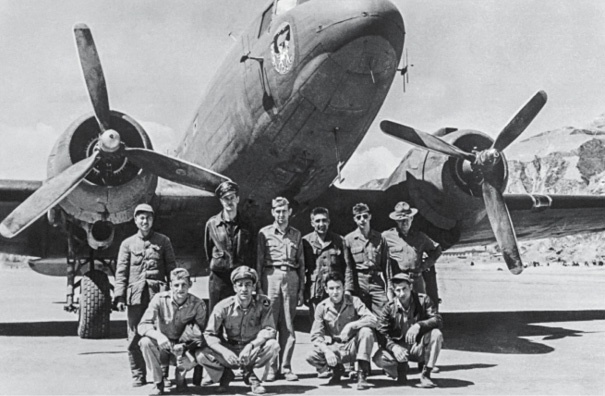
In July 1944, the U.S. Army Observation Group was dispatched to Yan’an. The CPC Central Committee assigned George Hatem and Huang Hua to serve as advisors to the group. George Hatem (third from right, back row) with U.S. military personnel at Yan’an Airport.
Recording the Long March with Pen and Camera
During his nearly four months in Bao’an, Snow lived in a cave dwelling and conducted dozens of long conversations with Mao Zedong. The discussions centered on the Long March: the reasons for the strategic shift, the bloody battles at the Xiangjiang, Chishui, and Dadu rivers, the Zunyi Conference, the capture of Luding Bridge, and the passage through snow-capped mountains and uninhabited grasslands. Mao answered each question in detail, and Snow recorded every word. He also visited the Red Army University, frontline troops, and rural households, collecting a large amount of oral testimony from Red Army commanders and soldiers.
Snow returned to Beiping (present-day Beijing) in October 1936. One year later, Red Star Over China was published in London and immediately caused a sensation in the West. In the book, Snow wrote, “It is impossible to deny recognition of their Long March – the Ch’ang Cheng, as they call it – as one of the great exploits of military history … In one sense this mass migration was the biggest armed propaganda tour in history.” The classic portrait he took of Mao wearing an octagonal cap, along with his black-and-white photographs of Red Army drills and theater troupe performances, later became the most direct window through which the Western world came to know Red China.
As the American historian and Harvard professor John King Fairbank said, the book opened a new window for the West – and American society in particular – to understand China, which was the main reason for its wide circulation in the United States. Then-U.S. President Franklin D. Roosevelt was also moved by the book and invited Snow to the White House. In 1938, when speaking to a German journalist, Mao Zedong pointed out that when the whole world had forgotten us, Snow came here to know us and told the outside world what was happening here. We must always remember Snow’s tremendous contribution to China.
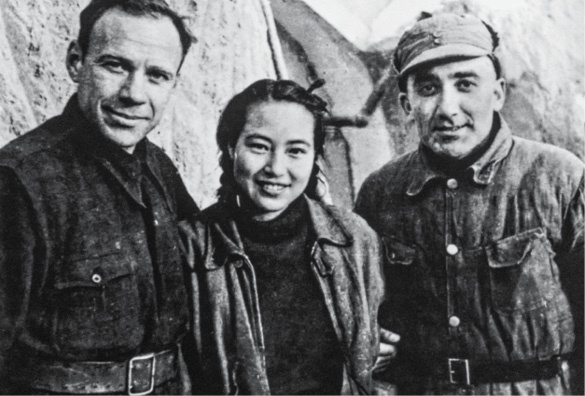
The Soviet surgeon Alov (Andrei Yakovlevich Trebin) with George Hatem (right) and his wife in front of a cave dwelling in Yan’an.
From Visiting Doctor to Red Army Fighter
Hatem had originally intended only to conduct a medical survey. However, while reviewing medical records at the Red Army’s field hospital and conducting free clinics for chronically ill soldiers and civilians, he saw many Long March survivors left permanently disabled due to the lack of medicine and medical care. Deeply moved, he told Snow, “They need doctors here so badly. I’m not leaving.”
In August 1936, Hatem accompanied Snow to Yuwangbu in Ningxia (today’s Tongxin County), where he guided rescue efforts at a frontline field hospital and treated local Muslim residents of the Hui ethnic group. He observed the equality between officers and soldiers, their shared hardships, and their close bonds with the people. The men and women in the army were thin and weak; they had suffered greatly. They lacked everything, except spirit and will. Hatem was deeply impressed by what he saw.
Wherever Snow and Hatem went, they were welcomed with enthusiasm and open arms by Red Army officers and soldiers, who affectionately called them “American comrades.” Hatem found his own value in this form of address and decided that he would stay and fight alongside them.
Entrusted by Mao Zedong, Hatem spent more than a month surveying the needs of the Red Army’s medical teams. Seeing the extreme shortage of qualified medical personnel, the rudimentary medical equipment, and the scarcity of medicine, he wrote a detailed survey report with multiple recommendations for improvement, providing an important basis for subsequent efforts to secure international aid.
When Snow left northern Shaanxi in October 1936, Hatem submitted his survey report to Mao Zedong and applied to stay and join the Red Army. Mao praised the report, welcomed him into the Red Army, and appointed him as an advisor to the Health Department of the Central Military Commission.
Hatem’s wish was fulfilled. He donned the Red Army’s blue-gray coarse cotton uniform, an octagonal cap, a leather belt, puttees, cloth shoes, a stethoscope around his neck, and a medical pack on his back. He trekked across the loess plateau of northern Shaanxi and shuttled among Red Army units. During combat, he disregarded his own safety to rescue the wounded, used his horse to carry wounded soldiers to the rear, and carefully attended to them along the way.
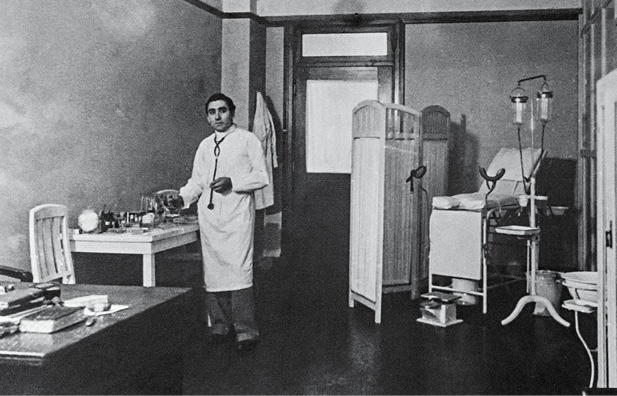
A clinic opened in Shanghai in 1934 by George Hatem and his classmate from the University of Geneva which later became a meeting place and contact point for underground Communist Party of China workers.
Because of his Lebanese ancestry and his basic knowledge of Arabic, Hatem was deeply respected by the Hui people. Noticing that most local Hui people had the surname Ma, he adopted the Chinese name “Ma Haide” to better connect with the local people. In February 1937, He was admitted into the CPC for his outstanding service, becoming the first foreigner to join the Party.
In the spring of 1938, the renowned Canadian surgeon Norman Bethune led a medical team of Canadian and American personnel to Yan’an. Hatem participated in the reception, serving as their guide and interpreter. In 1939, he also received the Indian medical team, whose members included Dwarkanath Kotnis, B.K. Basu, and M.M.Atal, as well as the young German doctor Hans Müller. Drawing on his own experiences, Hatem introduced them to the conditions in the resistance bases, helped them understand the CPC’s policies against Japanese invasion, and taught them how to adapt to the harsh life in Yan’an.
Neither Snow nor Hatem – one with a pen, the other with a scalpel; one telling the world why the Red Army deserved respect, the other joining the Red Army’s ranks to heal the wounded – was born a communist, yet in the cave dwellings and battlefield tents of northern Shaanxi, they witnessed the revolutionary ethos of integrity, equality, and a bond with the people.
They transcended the boundaries of mountains, seas, and nations, making important contributions to the great rejuvenation of the Chinese nation. The visits of Edgar Snow and George Hatem marked the CPC’s open and proactive engagement with the world, and also marked the beginning of a community of shared destiny between a group of international friends and the Chinese people.