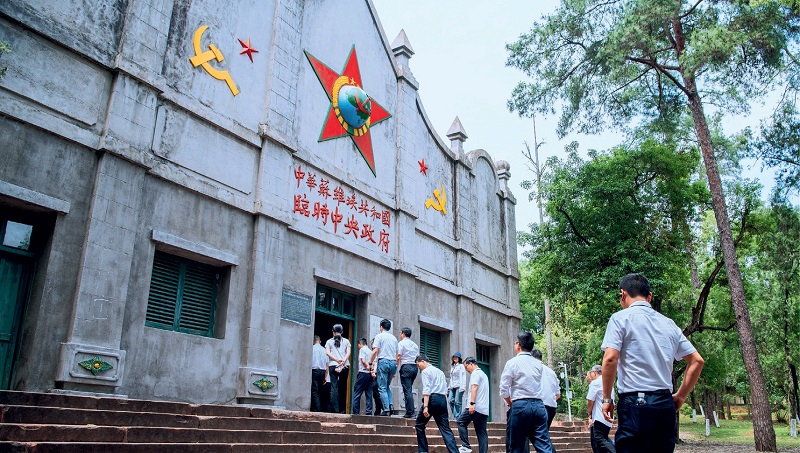
A group of visitors enter the site of the Provisional Central Government of Chinese Soviet Republic in Ruijin City, Jiangxi Province to retrace the history of Chinese red revolution and honor revolutionary predecessors on May 19, 2024.
The Long March belongs, first and foremost, to the history of China, to the Communist Party of China, and to the heroic experience of the Chinese people. Yet there are historical events whose meaning cannot be confined within the borders of the country in which they took place. They become part of the wider memory of humanity, because they express something deeper than the immediate circumstances that produced them.
For a Cypriot communist, and a member of the Progressive Party of Working People (AKEL), the Long March (1934-1936), a strategic military relocation undertaken by the Chinese Workers’ and Peasants’ Red Army, speaks not only of military endurance or strategic relocation. It speaks of the capacity of a people’s movement to survive under conditions of extreme danger, to reorganize its forces, to keep faith with its ideals, and to transform hardship into a source of moral and political strength. As an old Chinese saying reminds us, “Adversity makes one stronger, just as polishing makes jade finer.” The Long March gave this truth a historical and political form. It showed that suffering, when linked to a just cause, collective discipline and confidence in the people, can become a force of renewal.
This is why the Long March can be understood as a universal revolutionary metaphor. It represents the refusal to surrender when the balance of forces appears overwhelming. It represents discipline, collective courage, unity, sacrifice, and the belief that history is not made only by the powerful, but also by those who organize, endure, and struggle for justice.
Mao Zedong captured this meaning in December 1935, in “On Tactics Against Japanese Imperialism,” when he wrote that “The Long March is a manifesto.” He described it also as “a propaganda force” and “a seeding-machine,” because it had proclaimed the heroism of the Red Army and carried to millions the message that the road of the Red Army was the road to liberation. This is a crucial point. The Long March was not only a movement across mountains, rivers, and provinces. It was also the movement of an idea. It not only preserved a revolutionary force, but also spread a political message that liberation was possible, that the people could become makers of history, and that even retreat could become the beginning of a new advance.
From Cyprus, this symbolism has a particular resonance. Cyprus is a small island in the Eastern Mediterranean, but its modern history has been shaped by great international struggles. Colonial domination, the anti-fascism and anti-colonial movement, the fight for workers’ rights, the struggle for peace, and the continuing demand for freedom and reunification. AKEL, the Progressive Party of Working People, was born and developed under these conditions. Its roots go back to the Communist Party of Cyprus, which emerged from the historical need of the Cypriot working class to organize itself politically and socially, to acquire consciousness of its role, and to connect the struggle for social justice with the struggle for national and democratic rights.
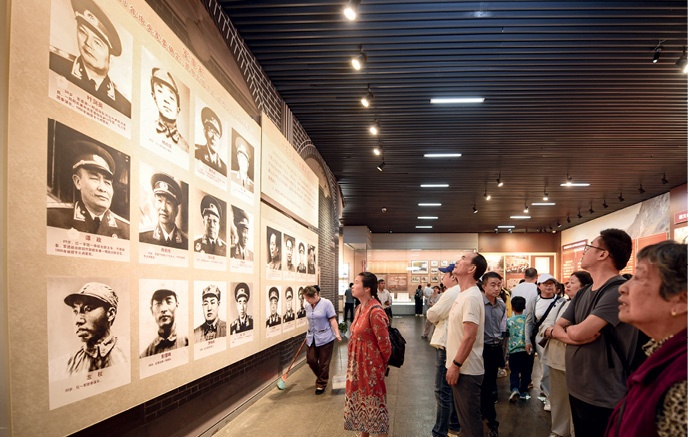
A crowd of tourists view cultural relics and learn about historical events at the Zunyi Conference Memorial Museum.
The Cypriot communist movement from its first steps, carried the ideas of social progress, solidarity, internationalism, and socialism into the life of the Cypriot people. It organized workers and peasants, challenged colonial repression, and insisted that the liberation of Cyprus could not be separated from the wider liberation of peoples from imperialism, fascism, and exploitation.
This internationalist tradition was expressed with particular clarity during the years of the Second World War. Cyprus was then a British colony. The Cypriot people lived under colonial rule, without national freedom and with severe restrictions on political and civil rights. For the communists, repression was even harsher. Organizations were banned, leaders were exiled, and censorship and persecution were widespread. Yet when fascism threatened humanity, AKEL did not treat the struggle as someone else’s war.
On June 16, 1943, the Central Committee of AKEL took one of the most important decisions in the history of the Party and of the Cypriot people. It called on its members and supporters to voluntarily enlist in the Allied forces, under the Cyprus Regiment, in order to fight Nazism and fascism. This was a conscious anti-fascist and internationalist act. AKEL understood that the defeat of Hitler-led fascism was necessary not only for the liberation of Europe, but also for the future of all oppressed peoples, including the people of Cyprus.
The decision was both internationalist and patriotic. It was internationalist because AKEL responded to the call to save humanity from the darkness and barbarism of fascism. It was patriotic because the Party linked the struggle against fascism with the struggle for the liberation of Cyprus from colonial chains. The response was remarkable. Hundreds of AKEL members and cadres volunteered. Eleven of the seventeen members of the Central Committee placed themselves at the head of this call.
The generation that fought fascism did not return unchanged. War had been a harsh school. Many Cypriot volunteers experienced battlefields, captivity, hardship, contact with other peoples, and direct confrontation with the brutality of fascism. Their return strengthened the political consciousness of the popular movement in Cyprus. Many of them became cadres of AKEL, of the trade-union movement and of the broader struggle for freedom. The anti-fascist experience became part of the anti-colonial struggle. It helped shape the generation that would demand democracy, workers’ rights, social progress, and the end of British colonial rule.
This is where the symbolism of the Long March acquires deeper meaning for Cypriots. A revolutionary journey is not only the movement from one place to another. It is the transformation of people through struggle. The Long March forged cadres, deepened discipline, strengthened the bond between the revolutionary movement and the people, and preserved the possibility of a different future. In Cyprus, the anti-fascist and anti-colonial struggles also forged generations of militants who learned that history does not reward passivity. It rewards organization, endurance, and faith in the people.
Yet the internationalist tradition of the Cypriot Left did not begin in the Second World War. Before that, in the 1930s, Cypriot anti-fascists had already taken part in one of the most moving expressions of international solidarity in the 20th century: the International Brigades in the Spanish Civil War. Around 60 Cypriots, many of them from working-class backgrounds and having suffered from poverty, migration, unemployment and political persecution, travelled to Spain to defend the country against fascism.
Among those Cypriot volunteers were figures who would later become central to the history of the Cypriot Left, including Ezekias Papaioannou, who later became general secretary of AKEL. Their example shows that the Cypriot communist movement was part of a wider current of global anti-fascist and revolutionary struggle, rooted in the common belief that the freedom of one people is inseparable from the freedom of all.
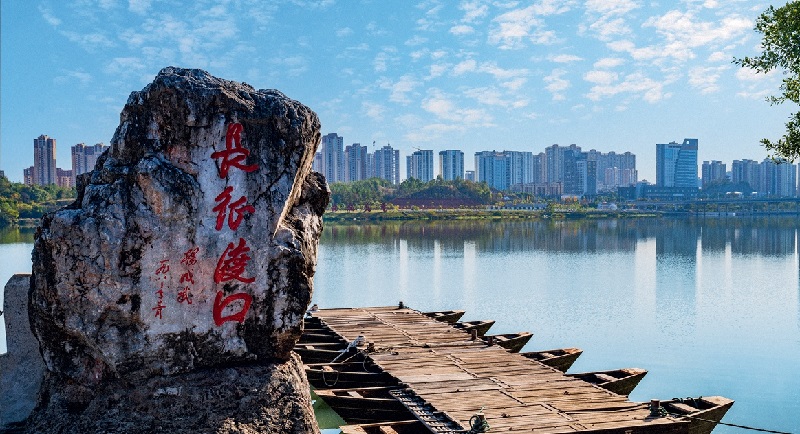
The site of the crossing where the Central Red Army sets off on the Long March at Yudu County, Ganzhou City, Jiangxi Province.
Today, when China speaks of building a community with a shared future for humanity, this idea can be understood against the background of these long histories of internationalism. Humanity again faces dangers that no people can confront alone: war, militarism, poverty, climate crisis, inequality, racism, new forms of colonial domination, and the return of dangerous bloc politics. The answer cannot be the fragmentation of the world into hostile camps, nor the imposition of the will of the powerful upon the weak. The answer must be cooperation, mutual respect, peace, common development, and the recognition that the future of each people is tied to the future of all.
For a small country such as Cyprus, this is not an abstract principle. Cyprus knows from its own experience what occupation, foreign intervention, and division mean. It knows what it means for the destiny of a people to be treated as an object of geopolitical calculations. It knows, through painful experience, that peace, sovereignty, and international law are not abstract principles, but conditions for survival. This is why the Cypriot Left has always connected the struggle of Cyprus with the struggle of all peoples for freedom, peace, and justice.
The vision of a community with a shared future for humanity can therefore be approached not as a diplomatic slogan, but as a historical necessity. It expresses the idea that no people can build a secure and dignified future alone, against the rest of humanity. It rejects the logic that relations between states must be governed by domination, coercion, and the right of the strongest. It points instead toward cooperation, mutual respect, common development, equality among nations, and the peaceful coexistence of different civilizations and social systems.
From the perspective of AKEL, this idea resonates with the deepest meaning of internationalism. Internationalism is not the denial of one’s own country. It is the highest form of genuine patriotism, because it understands that the freedom of one people cannot be secured through the oppression of another. It understands that a small country’s independence is protected not by submission to powerful alliances, but by a world order based on peace, law, solidarity, and respect for sovereignty.
This was the lesson of the Cypriot volunteers in Spain. This was the lesson of AKEL’s decision on June 16, 1943. And this remains the lesson for our time. When humanity faces common dangers, neutrality before injustice is not an option. The answer is not withdrawal into narrow nationalism. Nor is it blind alignment with imperial power. The answer is organized solidarity among peoples.
The Long March reminds us that history is made by those who refuse to surrender to despair. It reminds us that even under the harshest conditions, a movement rooted in the people can survive, learn, reorganize and open new paths. The history of AKEL and of the Cypriot popular movement, in its own different conditions and proportions, carries the same conviction, that struggle, sacrifice, and faith in the people can transform historical weakness into political strength.
There are no identical histories. The mountains and rivers crossed by the Chinese Workers’ and Peasants’ Red Army are not the same as the colonial streets, villages, and battlefields that shaped the Cypriot Left. Yet between them resonates a common echo of people who understood that liberation is never given as a gift. It is won through endurance, organization, sacrifice, and solidarity.
Today, as humanity searches for a path beyond war, inequality, domination, and division, that echo remains alive. From the Long March to the anti-fascist volunteers of Cyprus, from the battle against colonialism to the contemporary struggle for peace and social justice, internationalism continues to offer a compass. It tells us that the future cannot belong to hegemony and exploitation. It must belong to the peoples.
And if the Long March teaches us anything, it is this: even the longest and hardest road can become the road toward a new world, when it is walked by a group of people who believe in justice, organize with discipline, and keep their eyes fixed on the future. 
NIKOS IOANNOU is a member of the Central Committee of the Progressive Party of Working People (AKEL) of Cyprus.