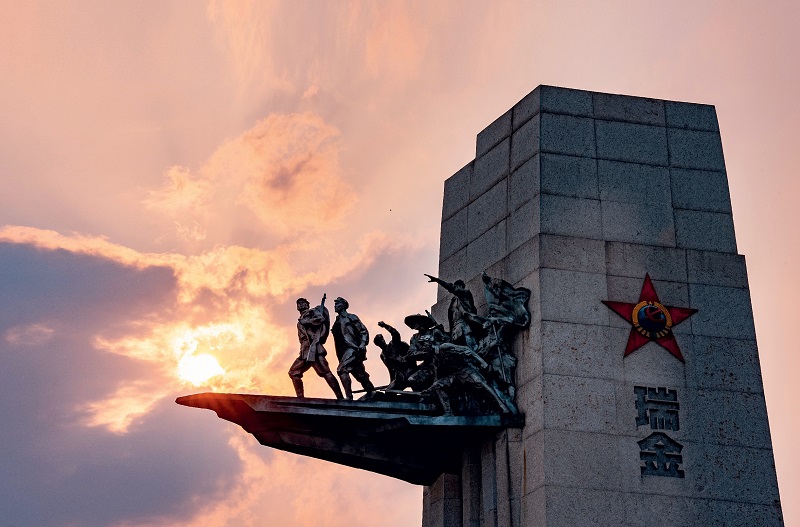
A Long March-themed sculpture in Ruijin City, Jiangxi Province – the starting point of the Long March by the First Front Army (also known as the Central Red Army) of the Chinese Workers’ and Peasants’ Red Army.
Ninety years after the Chinese Workers’ and Peasants’ Red Army accomplished its epic strategic relocation (1934-1936), the Long March spirit continues to illuminate China’s modernization drive – and its broader global governance endeavors. The relevance of the Long March has long since transcended national boundaries. What the Long March forged was not only a fighting force but a way of moving through history: discipline tested by adversity, unity chosen over disruption, and the belief that justice isn’t bestowed from a higher authority but by mobilizing ordinary people.
That belief echoed far and wide across the world. When American journalist Edgar Snow entered the Shaanxi-Gansu-Ningxia revolutionary area in 1936 and later published the book Red Star Over China, he broke a blockade of silence and distortion; readers encountered not myths, but lived conviction. The same spirit drew others – doctors, volunteers, and internationalist activists – to stand with China’s anti-fascist and anti-colonial struggle, and to recognize the Chinese revolution not as something remote and abstract, but as a deep story of human history.
This Special Report marks the 90th anniversary of the Long March’s culmination by focusing on how that story continues to reverberate across the world. If the Long March proves that even an “impossible” road can remake history, the question for today is clear: what does that teach a fractured world? If interpreted for the world we live in today, the Long March spirit points toward a community with a shared future for humanity: where resilience is collective, development is cooperative, and no-one is seen as being disposable in someone else’s master plan. The echoes of the past are real. We need to listen – and act accordingly.