As China set its sights on building a satellite internet constellation, Xiong’an is emerging as a powerhouse of the aerospace information industry.
As a new quality productive force, the aerospace information industry has become an indispensable part of the integrated “land-sea-air-space” network envisioned for sixth-generation mobile communications (6G) technology. It is also widely regarded as a new driver of global socioeconomic development.
Nine years ago, Xiong’an New Area in north China’s Hebei Province seized the opportunity of building a city from scratch to position aerospace information as one of its strategic industries. Aerospace information and satellite internet were included among the three pillar industries designated for stimulating Xiong’an’s future development.
In October 2024, China Satellite Network Group Co., Ltd. relocated its headquarters to Xiong’an. As a state-owned enterprise responsible for advancing China’s satellite internet initiative, it became the first state-owned enterprise to establish its headquarters in Xiong’an. To date, it has attracted 69 enterprises related to aerospace information to the area.
In March this year, during an inspection tour of Xiong’an, President Xi Jinping called for efforts to build the new area into an innovation hub in the new era and a model of high-quality development.
The outline of China’s 15th Five-Year Plan, a development blueprint for the 2026-2030 period, also stresses the need to strengthen emerging industries, accelerate the development of strategic sectors such as next-generation information technology, high-end equipment, and aerospace, while fostering new growth drivers such as 6G technology.
Recently, China Today visited the Testing Base of Xiong’an New Area Science and Innovation Center and got a glimpse of how companies there are exploring the future frontier of aerospace information.
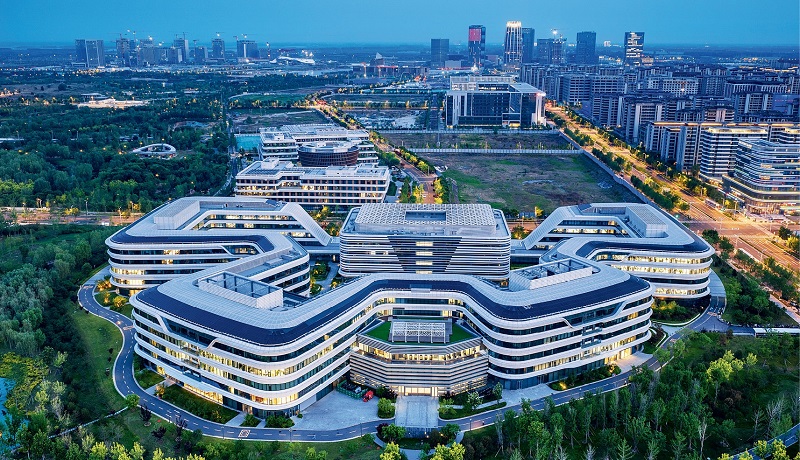
The headquarters of China Satellite Network Group Co., Ltd. is located in Xiong’an New Area, Hebei Province.
An Essential Role
The aerospace information industry uses satellites and other space-based infrastructure to transmit and collect data from the air and space, for the purpose of enabling a wide range of services. From everyday navigation and mobile communications to the operation of aircraft, autonomous vehicles, emergency response systems, and smart-city management, aerospace information technologies are playing an essential role. When ground-based communication infrastructure is disrupted or unavailable, satellite network is a “life-saver”, ensuring a more stable and efficient transmission of information.
China is actively building a mega commercial satellite network, which will eventually see thousands of communication satellites operating in orbit.
The industry’s exceptionally long value chain connects numerous types of cutting-edge technology, spanning from rocket and satellite manufacturing and launch services to downstream data applications. Comprising high-end equipment manufacturing and next-generation information technologies, it holds enormous growth potential and is widely viewed as one of the most promising industries of the future.
The Testing Base in Xiong’an is now home to many aerospace information and satellite manufacturers. Entering the base, visitors can see massive factory buildings line the roads. Inside them, research, production, and testing operations are underway.
One Satellite Every 30 Hours
Inside a factory of LandSpace Hong Qing Technology Co., Ltd. (Hong Qing Tech), reporters saw Xiong’an-1, the first made-in-Xiong’an satellite, in a testing area surrounded by technicians dressed in anti-static suits conducting final adjustments before it was launched.
Xiong’an-1 is a communication technology testing satellite that integrates dozens of advanced technologies, including those for a high-performance onboard computer, large flexible solar panels, and Hall-effect electric propulsion. Its design allows multiple satellites to be packed into a single rocket fairing, significantly improving launching efficiency.
At another side of the factory, nimble robotic arms were installing satellite panels with precision. “This is China’s first automated production line for mass satellite manufacturing,” said Chen Ying, director of public relations at Hong Qing Tech. At this line, more than 70 percent of the assembly steps have been automated, allowing satellite manufacturing to move beyond traditional labor-intensive methods and achieve greater efficiency.
“Construction of the production line began in April of last year. It was completed last September, and then began operating the following month. Remarkably, Xiong’an-1 rolled off the line that same month. The entire assembly process took only 30 hours,” Chen told China Today. According to Chen, the rapid implementation of the project would not be possible without Xiong’an’s supporting policies.
Besides its manufacturing base, Hong Qing Tech also established R&D and testing centers in Xiong’an. The satellite maker plans to leverage the region’s industrial ecosystem to produce more reliable satellites at a lower cost.
A Utility Ride-Sharing Vehicle
Once satellites are built, the next challenge is transporting them to their preset orbits. FutureSpace Technology Co., Ltd. (FutureSpace), is China’s first and the world’s third commercial spacecraft manufacturer committed to satellite deployment and in-orbit services. Its Fengxing (FX) series spacecraft can conduct orbital maneuvers on its own and deploy multiple satellites to different destinations in a single trip.
“After the rocket detaches, our FX vehicle turns on its onboard chemical propulsion system in space, thrusting satellites into medium and high Earth orbits,” explained Bai Junbiao, deputy general manager of FutureSpace.
Without such a vehicle, satellites would have to rely on their own propulsion devices for orbital transfers, a process that can take months. FX can reach altitudes up to 1,100 kilometers above Earth within three hours and transfer payloads to higher orbits within 24 hours.
After satellite deployment, FX can remain in space for more than three years, providing “after-sales services” such as refueling satellites and removing space debris. When a satellite runs low on fuel, FX is able to fly to it and transfer propellant, thus extending its operational lifespan. In addition to this, the spacecraft can also remove orbital debris.
“For satellites that cannot be used anymore and debris fragments, we maneuver over to their locations, capture them with a net, and tow them to a ‘space graveyard,’ reducing collision risks for other spacecraft,” Bai explained. In addition, FX carries cameras capable of inspecting satellites, rocket bodies, and debris in orbit, enabling data collection.
The next-generation FX vehicle is designed to carry more fuel, support payloads of up to 7.5 tons, and operate across orbital ranges from 200 to 36,000 kilometers, allowing the rapid deployment of larger satellites.
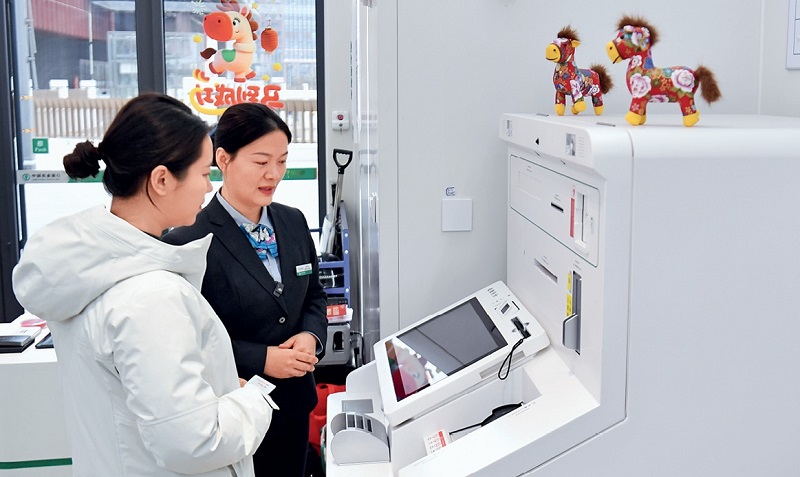
A staff member helps an applicant with a “Xiong’an talent card,” which grants its holder benefits related to business ventures, transportation, healthcare, and children’s education.
Link Satellites via Lasers
As for how communication satellites are linked into a functioning network once they are deployed in orbit, Chip Linking Inno (Hebei Xiong’an) Technology Co., Ltd. offers a key solution. Operating upstream in the industrial chain, Chip Linking Inno develops lasers, optical amplifiers, communication modules, and other core components for inter-satellite communications, ensuring stable and precise signal transmission between satellites.
Founded in Xiong’an in January 2023, the company develops all of its hardware and software independently. Of its more than 40 employees, roughly 70 percent are engaged in research and development. “Our latest ultra-high-speed transceiver module delivers nine times the bandwidth of previous products, enabling much faster and smoother data transmission,” said Chairman Chen Wei.
Chen previously worked at the Institute of Semiconductors of the Chinese Academy of Sciences in Beijing, specializing in semiconductor laser R&D. Explaining why he chose to launch his business in Xiong’an, Chen said, “Our focus is satellite internet and laser communications. Since China Satellite Network Group is headquartered here, it makes sense to be close to the demand side. Proximity to customers also accelerates product iteration. With companies across the industrial chain concentrating here, collaboration is much easier.”
Currently, the team is working on ultra-high-speed optical components and ultra-narrow-linewidth laser technologies to support high-speed satellite interconnection and future quantum technology applications.
Shared Production and Testing Lines
At the testing base, a shared satellite manufacturing line and testing line are expected to help commercial aerospace companies reduce costs and improve efficiency, accelerating the development of the aerospace information and satellite internet sectors.
Inside Xiong’an Shared Satellite Intelligent Manufacturing Center and Xiong’an Shared Satellite Testing Center, vast spaces are filled with large-scale equipment, including flexible satellite production lines, thermal vacuum chambers, and high-capacity vibration testing equipment.
The flexible production line can manufacture various types of satellites, including communications and remote-sensing satellites of different sizes. The testing center also conducts electrical, thermal, mechanical, and magnetic simulations. All equipment used there has been independently developed and manufactured in China.
“Once a company completes its satellite design and possesses the necessary documentation for subsystems, components, and technologies, it can use the shared manufacturing center to complete the final assembly, integration and testing,” said Yang Jinshuo, operations manager for the aerospace information industry at Xiong’an Science Park.
According to Bai Junbiao of FutureSpace, the shared testing platform has brought significant benefits. “Mechanical and thermal testing equipment is extremely expensive, and renting a shared platform substantially reduces our costs. Our factory is located right next door, which also saves time and effort in transportation for us,” he said.
Yang noted that demand from commercial aerospace companies is growing rapidly. “We built these shared platforms specifically to serve commercial aerospace enterprises in Xiong’an, the Beijing-Tianjin-Hebei region, and even across the country,” he said. “Our goal is to support the fast-growing satellite and aerospace information industry with efficient and accessible infrastructure.”