As the global innovation landscape undergoes rapid changes, Beijing is redefining China’s technological frontier with the steadiness and ambition of true innovation. The city’s society-wide R&D investment intensity has remained above six percent for many years. Its investment in basic research has ranked first on the Nature Index Science Cities for nine consecutive years, and nearly 30 percent of China’s national key laboratories are based in Beijing.
A wave of “zero-to-one” breakthroughs is emerging here and reaching the world, including the TongTong 2.0, an upgraded artificial general intelligence system, 225 registered large models, the Zhuque-3 reusable rocket, and China’s first approved stem-cell therapy product. Beijing’s advanced development is not only the fruit of its own innovation practice, it also stands as a vivid example of China’s broader drive toward greater self-reliance and strength in science and technology in face of a changing global landscape.
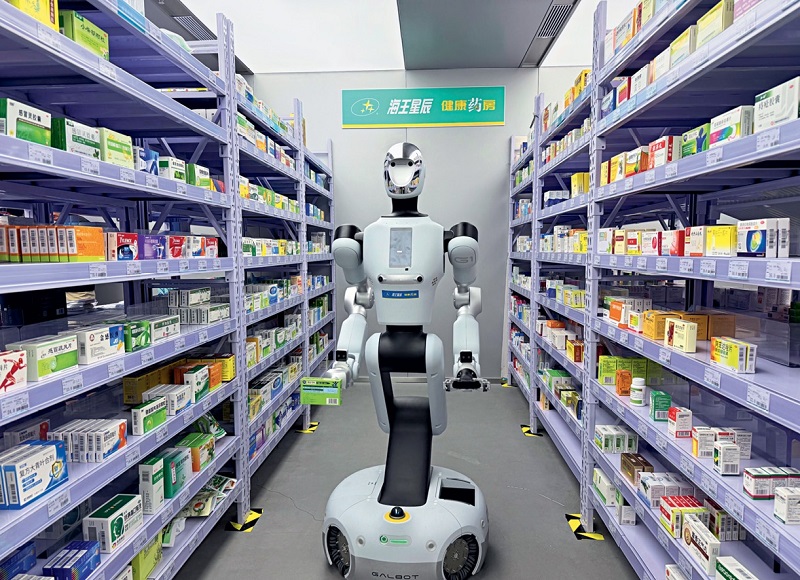
The humanoid robot Galbot G1, developed by Galbot Company, is working independently on duty in a smart pharmacy in March 2026.
More Humanoid Robot Co-Workers
Embodied intelligence refers to intelligent systems that perceive and interact with the world through a physical form, driving the evolution toward general-purpose robotics. As a premier national hub for the robotics industry, Beijing is home to over 400 core enterprises and more than 30 humanoid robot manufacturers. Today, the city leads the country in the sophistication of embodied intelligence algorithms, the number of 100-billion-parameter large models, and the overall scale of industrial clustering.
Inside a smart convenience store in Zhongguancun (China’s Silicon Valley), Beijing’s Haidian District, a humanoid robot clerk skillfully prepares grilled sausages for customers. Using a mechanical gripper, it steadily lifts a sausage from the oven and places it onto a takeaway tray, completing the entire process autonomously and smoothly.
The robot, named Galbot G1, was developed by Beijing-based Galbot Company. Its seamless movements are powered by the company’s proprietary “AstraBrain,” the world’s first embodied large-model system to integrate “brain, cerebellum, and neural control” in an end-to-end architecture. The system connects multimodal perception with real-time feedback control, enabling its seamless operation.
Zhang Zhizheng, co-founder of Galbot, said that the company’s humanoid robots now independently operate smart retail spaces deployed in more than 100 stores across over 20 Chinese cities. The project has become an important symbol of how embodied intelligence can be integrated into urban smart service systems.
Beyond retail, Galbot’s robots are also being applied in industrial manufacturing and healthcare. “Our robots have entered production lines at companies such as CATL, Bosch, and Toyota, handling tasks including automated quality inspection, transport, and sorting,” Zhang said. “We have also partnered with several top-tier hospitals to provide automated services such as medication sorting and material delivery in hospital wards, pharmacies, and nursing homes.”
Another Beijing-based company focusing on the “brains” of robots is Robotera. In its showroom, the company’s robot, Robotera M7, identifies parcels of different shapes along a conveyor line and then quickly adjust its grip to pick them up.
Xi Yue, co-founder of Robotera, said the company enjoys deep partnerships with China Post and SF Express, deploying robots in more than 10 logistics centers across north, east, and south China. “Our goal is to put robots to work in factories and logistics hubs, so as to turn them into real productive forces,” Xi said.
At present, Beijing is accelerating its efforts to build itself into a global hub for artificial intelligence (AI) innovation. In the city, robots are no longer just exhibits at trade shows or in laboratories, they are also becoming the new co-workers for people in convenience stores, factory lines, and many other industries.
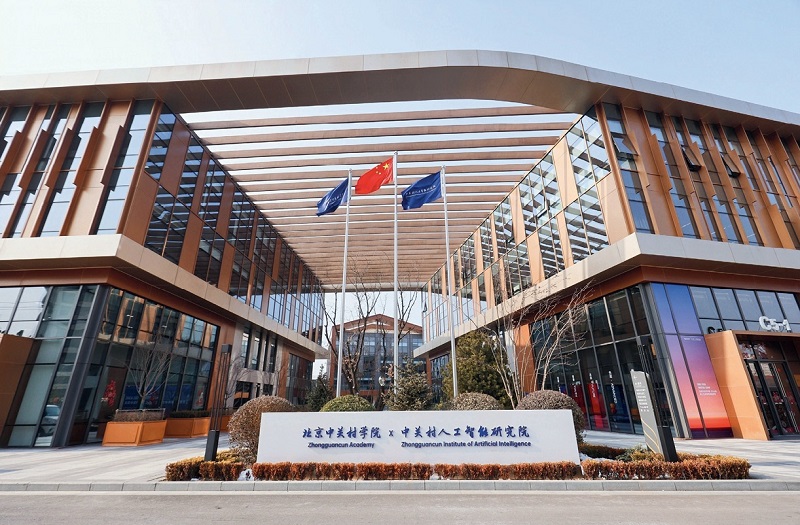
A front view of the Zhongguancun Academy and Zhongguancun Institute of Artificial Intelligence.
A New Paradigm of AI Education
The younger generation is both a driving force behind fundamental research and the spark that ignites innovation. Established in 2024, Zhongguancun Academy and Zhongguancun Institute of Artificial Intelligence (ZGCA×ZGCI) serve as an integrated platform for education, science and technology, and talent development. Focused on making groundbreaking advances in frontier technologies, pioneering approaches to talent cultivation, and fostering deep collaboration between academia and industry, the two institutions showcase the vibrant and ever-surging spirit of innovation that defines Zhongguancun.
“The reason we use a multiplication sign between the two institutions instead of a plus sign,” said Dong Bin, executive vice president of Zhongguancun Academy, “is because the multiplication sign represents mutual empowerment and amplification to create exponential impact together.”
It is within this integrated framework that the two institutions pursue coordinated development: the academy focuses on talent cultivation and educational innovation, while the institute concentrates on frontier technology research and industrial application. In the nearly two years since its establishment, the academy has trained more than 600 Ph.D. students and launched over 110 research projects, 11 of which were independently initiated by students. Several of these projects have already secured investment.
Students are encouraged to initiate their own projects by identifying real-world problems and addressing genuine needs through hands-on practice.
One example is the AI-enabled minimally invasive breast surgery system, initiated by a six-member cross-disciplinary student team. The project aims to tackle key challenges in breast cancer diagnosis and treatment by integrating AI technology with medical devices.
“Guided by a multidisciplinary team of mentors at Zhongguancun Academy, we aim to build both a true ‘X-ray vision’ and a ‘smart scalpel,’” said Zhang Boya, a team member. “The ‘X-ray vision’ can clearly visualize lesions in real time, while the ‘smart scalpel’ enables the intelligent and highly precise removal of diseased tissue.”
Looking ahead, the team plans to extend the system to treat more diseases. This will promote the development of AI-driven minimally invasive surgical technologies with Chinese patents as well as contribute Chinese innovation to global healthcare.
Another startup, Beijing Shuzheng Dongcha Technology Co., Ltd., was co-founded in February 2026 by Jia Zuolong and Sun Qiyao, two Ph.D. candidates at Zhongguancun Academy. The company aims to become an AI partner for law firms within civil law jurisdictions.
Its product is built on a proprietary large language model developed by the academy and deeply integrated into the workflow commonly used by Chinese lawyers. The system’s proprietary database includes more than 190 million judicial decisions and over 400,000 laws and regulations.
After its official launch, the product achieved an 82 percent direct adoption rate for generated legal documents and successfully assisted in winning two court cases. The company also plans to expand into overseas markets such as Singapore and Japan.
“Our core concept is to let AI handle the breadth and speed, while lawyers provide depth and human understanding,” Jia said, “The goal is not to replace lawyers, but to help them serve ordinary people better. When someone’s rights are violated, the system can offer both professional guidance and a sense of reassurance.”
Beijing is currently accelerating the integrated development of education, science and technology, and talent cultivation. The city has taken the national lead in establishing a municipal leading group dedicated to these fields, strengthening overall coordination and fostering synergistic development.
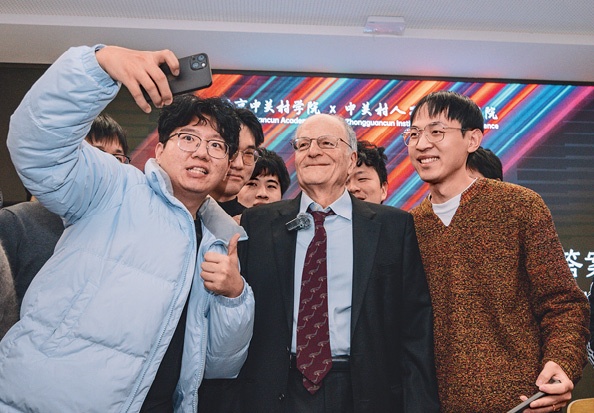
Teachers and students take a group selfie with Professor Thomas J. Sargent, the Nobel laureate in economic sciences in 2011, at the Zhongguancun Academy in Beijing.
Super Incubators for Life Science Innovation
One original innovation project launched R&D the very day it moved in, running multiple research pipelines at the same time. Within just one year, it secured nearly RMB 100 million in series A financing. In less than two years, it obtained Orphan Drug Designation from the U.S. Food and Drug Administration (FDA) for the treatment of amyotrophic lateral sclerosis (ALS), commonly known as Lou Gehrig’s disease.
The project was launched by SineuGene, whose core therapy is China’s first targeted gene therapy for ALS. With the support of ATLATL Center for Frontier Science, SineuGene has grown rapidly. Stories of innovation like this are unfolding across Beijing every day.
Serving as a “super incubator” for life science research, ATLATL provides comprehensive, end-to-end solutions for innovative drug developers, as well as offers ready-to-use laboratory and on-site technical support. Through innovative business models, it has also built an integrated R&D platform that connects early-stage research with commercialization, creating a complete innovation ecosystem. This significantly shortens start-up timelines and helps companies gain an early advantage in the race of developing new therapies.
“Our vision is to engineer life sciences, design bio-enterprises, and institutionalize innovation incubation,” said Jiang Maohua, deputy manager of ATLATL. Their ultimate aim is to help scientists accelerate their research through ATLATL’s innovative model, enabling them to reach key R&D milestones faster.
Among the companies incubated at ATLATL, Deepwave Biotechnology is building a new infrastructure for life science research: an AI scientist intelligent laboratory system.
The system goes beyond traditional automated experimentation, featuring end-to-end autonomy including intelligent planning of scientific projects, autonomous execution of experiments, and continuous self-iteration and capability improvement based on experimental data. It represents a crucial leap from “machine-assisted” to “machine-driven” research.
Wang Chengzhi, founder of Deepwave, said his team is committed to turning the vision of designing biological molecules on demand into a scalable, general-purpose technology platform.
Having become part of the ATLATL, Wang said, “ATLATL offers abundant equipment and computing power. We are also collaborating with other companies incubated here. They can use our computing resources and AI models to support their own R&D.”
“Beijing’s benchmark incubator development has now entered the 4.0 era,” said Xia Hongge, deputy director of the Innovation and Entrepreneurship Department of the Beijing Municipal Science & Technology Commission and Administrative Committee of Zhongguancun Science Park. Beijing is now home to nearly 600 incubation platforms with about eight million square meters of incubation space.
Going forward, Xia added that Beijing will continue optimizing six major benchmark incubation models, proactively developing new incubation platforms in frontier sectors, and improving the full-chain incubation system to support the high-quality development of the Beijing (Beijing-Tianjin-Hebei region) International Center for Science and Technology Innovation.