Higher education communities around the world share the obligation to help develop AI for the positive and for good, contributing to shared prosperity and common security.
In today’s world, artificial intelligence (AI) is reshaping human society to an unprecedented extent, and its influence is becoming increasingly profound and far-reaching. In his address to the 2026 World AI Conference, Chinese President Xi Jinping said that all countries should take a people-centered approach and develop AI for the positive and for good. He emphasized that we should ensure that AI is an important driver for shared prosperity and common security.
In this historic process, universities – as cradles of scientific and technological innovation, primary talent incubators, and key conduits for inter-civilizational exchange – bear a special mission. Looking to the future, higher education communities in China and Europe should build consensus and embrace cooperation in talent cultivation for the AI era, and find answers for the defining question of our time: How can we use AI to serve the common good of all humanity?
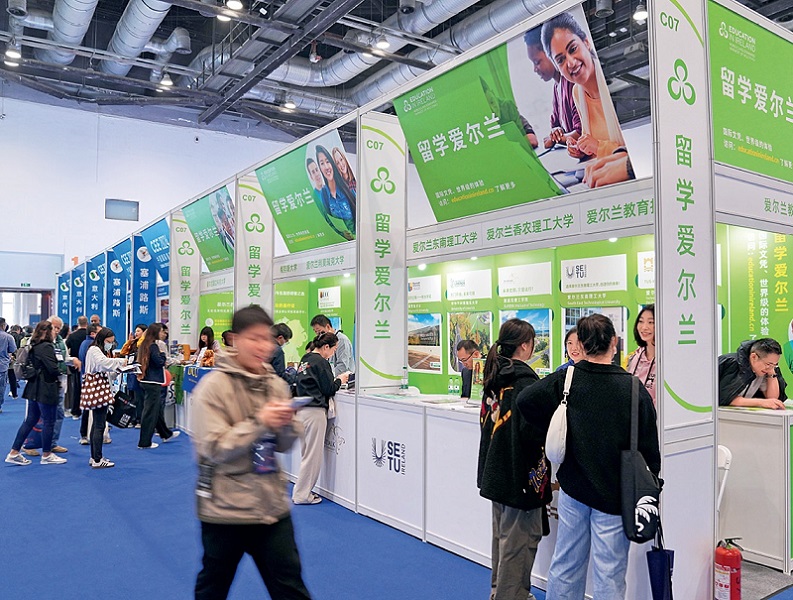
The booth for learning about studying abroad in Ireland at the 2024 China Education Expo, held in Beijing in November 2024.
Returning to the Essence of Education in the AI Era
The rapid development of AI technology is fundamentally transforming the ways knowledge is produced and disseminated. When large language models can provide answers in the blink of an eye, what is the value of university education? In my view, creativity is a uniquely human quality that cannot be replaced by AI, and therefore possesses essential value. What AI brings to universities is not a crisis, but rather an opportunity to rediscover the essence of education. The fundamental purpose of education is not to impart knowledge, but to kindle wisdom and shape character. In an age when it takes only a few clicks to access any knowledge, universities should focus more on cultivating students’ critical thinking, creativity, and commitment to their country and people.
In recent years, Peking University has actively built an education system that integrates general education with specialized education. We have introduced small-class teaching, established a number of honors courses, encouraged in-depth dialogue between teachers and students, supported undergraduates’ participation in cutting-edge research, and promoted interdisciplinary study and discussions to develop students’ comprehensive ability to identify and solve complex problems. We believe that rigorous thinking and good judgment are key parts of human wisdom that AI cannot replicate. The brainstorming and character-building that take place in teacher-student exchanges also demonstrate the value of education that AI cannot provide.
China-Europe Cooperation: Complementarity and Mutual Learning
Amid the global advance of AI technology, both China and Europe attach great importance to digital and intelligent transformation. However, each has its own distinctive features and strengths in innovation ecosystems and governance approaches. Our shared vision and complementary strengths provide a solid foundation for cooperation in higher education in the AI era.
Over the years, Peking University has maintained in-depth exchanges and close collaboration with first-class universities and research institutions in Europe, including the University of Oxford and the University of Cambridge in the United Kingdom, the Max Planck Society in Germany, and École Polytechnique in France. Our cooperation with European universities covers multiple disciplines, including basic sciences, life sciences, environmental sciences, and information sciences. In recent years, joint research in areas such as drug development, materials design, and climate modeling has yielded a series of breakthroughs.
In 2023, Peking University initiated the Digital Intelligence International Development Education Alliance (DI-IDEA). Today, its membership has extended to 36 universities, including the London School of Economics and Political Science, King’s College London, and other European institutions.
Today, as AI is transforming scientific research and educational paradigms at an unprecedented pace, higher education communities in China and Europe should deepen cooperation in three key areas:
First, we should strengthen the development of platforms for joint AI research, with a focus on fundamental theories and cutting-edge technologies. This will allow us to address major challenges facing humanity through collaborative innovation.
Second, we should adopt new models of joint talent cultivation, such as joint courses, exchange programs, and real-world training in sci-tech innovation. The goal is to cultivate interdisciplinary talents with both Chinese and European perspectives, strong research potential, and high AI literacy.
Third, we should jointly establish educational standards and safety norms for the AI era. This means achieving the broadest consensus possible in areas such as digital intelligence education, data compliance, privacy protection, and algorithmic transparency.
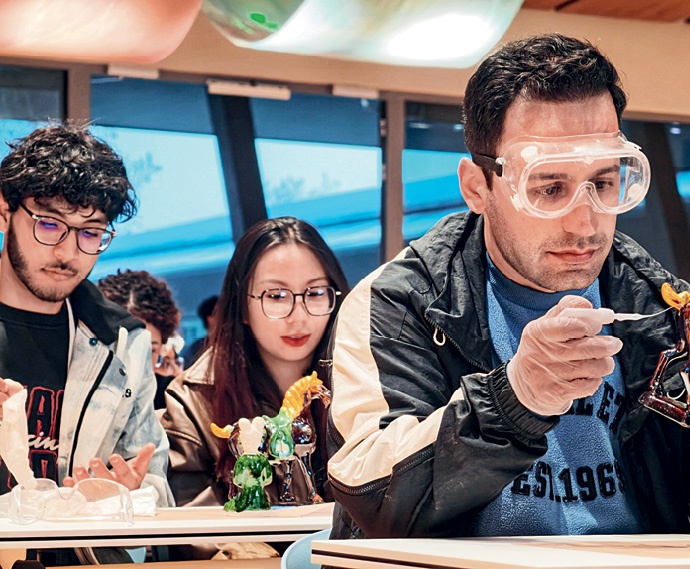
International visitors try their hands at repairing Tangsancai, tri-colored glazed pottery from the Tang Dynasty, at the Yi Ren Fang Camp in Luoyang, Henan Province, on April 8, 2026.
Providing Value Guidance and Building a Shared Foundation for AI Ethics
Technology is neutral in itself, but its application is always based on value judgments. President Xi’s proposal that “all countries should take a people-centered approach and develop AI for the positive and for good” aligns with the EU’s pursuit of AI risk classification and trustworthy AI, laying the groundwork for China-Europe consensus on AI ethics.
As inheritors and guardians of human civilization, universities should play a leading role in building the foundation for AI ethics. The AI professionals of the future will need more than technical proficiency; they will also need to understand humanistic concerns and be able to analyze issues from a global perspective. Their decisions about technology should be guided, first of all, by a commitment to human safety and development.
Peking University attaches high importance to AI ethics. We have established a center for AI safety and governance within the Institute for Artificial Intelligence. We have organized research by interdisciplinary teams on AI ethics, relevant laws, and social impacts. We have also included AI ethics in the general education curriculum to encourage more thinking on the relationship between technology and society among our students.
At a time when algorithmic bias, information cocoons, and the digital divide are becoming increasingly prominent, universities should serve as the vanguard of inter-civilizational dialogue and bulwark for rational thinking. Chinese and European universities should join hands to cultivate future leaders with global competence – leaders who can transcend cultural barriers and engage in constructive dialogue and cooperation on global issues such as AI governance, climate change, and public health. We must put science and technology, a shared treasure of humanity, to good use, and ensure that AI becomes an effective tool for promoting common development.
As human civilization now stands at another crossroads in its development, the mission of universities has become all the more important. Peking University is ready to work hand in hand with our European peers to uphold the true essence of education, deepen practical cooperation, advance common values, and cultivate a new generation of talents. Together, let us develop AI for the positive and good of humanity, and write a new chapter for higher education in the age of intelligence. 
GAO SONG is president of Peking University.