Genuine understanding is never achieved from a distance – it develops and grows only through firsthand experience and the human connections forged through people-to-people exchanges.

Emilio-José Fernández Herreros prepares a battery test in a climate chamber at the testing laboratory of Chinese battery manufacturer CATL in Arnstadt, Germany, on October 14, 2025.
For more than two decades, my work as a journalist and documentary filmmaker has taken me into some of the world’s most prominent conflict zones, from Afghanistan, Iraq, and Syria to Gaza and, more recently, Ukraine. Much of this work I did together with my father, Jürgen Todenhöfer, former member of the German parliament, author, and journalist, who became widely known in Germany for reporting from regions often viewed only through the lens of war, ideology or geopolitical rivalry. Together, we spoke not only with presidents, military officials, and political leaders, but also with ordinary families, refugees, workers, and young people trying to live normal lives amid extraordinary circumstances. Whenever possible, we tried to speak with people on all sides of a conflict.
My father taught me a simple principle very early in life: Go there. See for yourself. Talk to the people who actually live there. And if there is a conflict, listen to every side before forming a judgment.
Over the years, that principle has survived every journey. I always leave a country knowing it is much more complicated than I thought on arrival. This is usually because the people I met complicated it in the best possible way. And I learned to distrust one feeling in particular: the certainty that I already understood a place before ever setting foot there.
That does not mean that everything we hear from a distance is false. It means that even accurate information can leave us with an incomplete understanding.
While preparing for my first trip to China, I encountered a Chinese saying that immediately felt familiar: Bai wen bu ru yi jian – seeing something once is better than hearing about it a hundred times. Nearly 2,000 years ago, the Han Dynasty general Zhao Chongguo reportedly used these words when asked by the emperor to assess a military situation from afar. Zhao insisted that true judgment required firsthand observation. When I read that story, I smiled. My father would have appreciated Zhao Chongguo’s approach.
Today, those words feel more relevant than ever. For although China is geographically distant from Germany, it is already deeply woven into our everyday lives. China is present in the technology we use, the products we buy, the batteries powering electric vehicles on German roads, and the smartphones in our pockets. Millions of Germans use Chinese digital platforms. German companies depend heavily on the Chinese market, while Chinese brands and businesses are becoming increasingly visible across Europe.
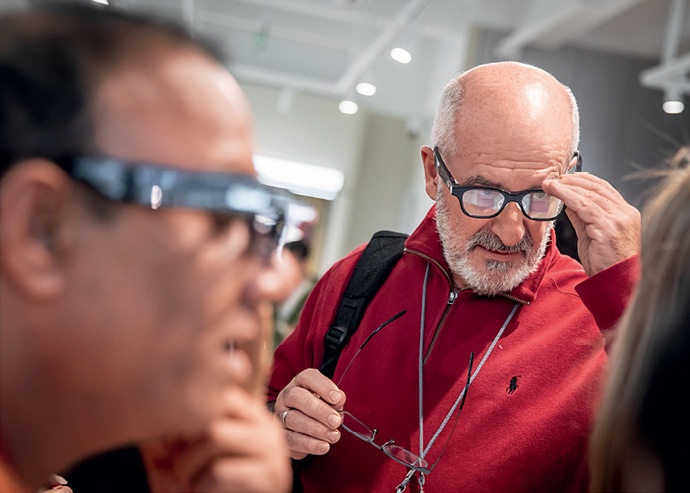
Foreign visitors try on Rokid AI-powered smart glasses at the company’s showroom in Hangzhou, Zhejiang Province on March 12, 2026.
And yet, for a country so closely connected to our daily lives, China itself can still feel surprisingly distant in European imagination.
In Germany, perceptions of China are often marked by contradiction. There is admiration for China’s remarkable economic transformation, technological innovation and infrastructure development. There is recognition of the deep economic interdependence between China and Europe. At the same time, there are concerns about competition, political differences, and strategic dependence. Public discussions about China in Germany frequently revolve around trade, electric vehicles, advanced technology, human rights, and geopolitical rivalry.
These are important topics, and they deserve serious discussion. But they are not a complete picture of a country. No country can be fully understood only through the language of economics, politics or security.
And perhaps that is the paradox: China is extraordinarily close to Germany in everyday life, and yet still feels remarkably distant for many people.
That realization led me to ask myself a simple question: Where did my own image of China actually come from?
Growing up in Germany, America was part of my imagination long before I ever visited the United States. Through films, television, and music, we became familiar with yellow school buses, the lockers in high schools, Thanksgiving dinners, New York apartments and small-town life. Of course, much of that image was fictional and incomplete. Yet America entered European homes not only through politics or economics, but through stories and everyday human experiences. Japan entered our imagination differently, through film, manga, anime, games, and design. More recently, South Korea reached global audiences through music, film, and television.
And that made me ask myself: What is the Chinese equivalent in my own cultural memory? What does an ordinary Sunday lunch in a Chinese household look like? What do parents and children argue about? What does a 20-year-old in Beijing, Chengdu or Qingdao laugh about with his friends? What does that young person dream about?
I realized that I knew surprisingly little. China can be all around us without necessarily feeling close to us.
My father and I have spent years trying to communicate distant societies and conflicts to people back home through books, documentaries, and social media. Some of our books became bestsellers in Germany and were translated into several languages. Today, through social media, we regularly reach millions of people across different countries.
And this work has taught me something important: facts matter, history matters, and statistics matter. But they are rarely what people remember most. They remember a person, a conversation, a face or a story.
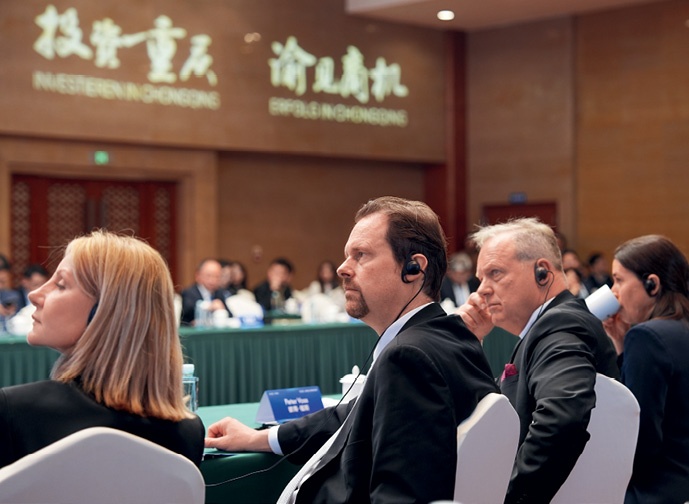
A delegation of more than 20 German CEOs attends a business matchmaking event in Chongqing on March 18, 2026.
A statistic can explain economic growth or demographic change, but it cannot show what a family discusses around the dinner table, what worries a university student, or what makes a child dream about the future. Stories create emotional proximity where geography creates distance.
Perhaps this is one of culture’s most remarkable powers.
A film cannot fully explain China. Neither can a novel, a song or a television series. But culture can allow us, even briefly, to enter another person’s world. It is easy to form rigid opinions about people we have never met. Human stories make such simplifications more difficult.
But stories, while not a substitute for human encounters, can be an invitation to it.
That is why people-to-people exchanges matter so much today. A German engineering student working alongside a Chinese classmate. Journalists speaking with one another across different media cultures. Researchers from Germany and China working on the same technological problem. Young entrepreneurs of the two countries discovering that, despite different political systems or cultural traditions, many of their concerns about work, family, and the future are surprisingly similar.
Personal exchange does something that information alone cannot do: it allows us to be surprised. And perhaps the most valuable moment in any genuine encounter is when the person standing before us does not fit the assumptions we brought with us.
That is not a failure of perception. It is the beginning of understanding.
I will soon be traveling to Qingdao. For a German visitor, that journey also carries historical weight. In 1897, German forces occupied Jiaozhou Bay, where Qingdao is located, and the following year the German Empire obtained a 99-year lease over the territory. More than a century later, another German will arrive in Qingdao under entirely different circumstances.
History cannot be undone. But history can be reflected upon with honesty and humility.
I came to China carrying information, impressions and, inevitably, some assumptions of my own. What interests me most is which of those assumptions I may no longer hold when I leave.
I cannot change how Germans arrived in Qingdao in the 19th century. But I can decide how this German arrives in China today: with curiosity, with openness, and with a willingness to listen.
Perhaps that is where rediscovery truly begins: not simply when we learn more about one another, but when we begin to genuinely know one another. 
FREDERIC TODENHÖFER is general secretary of the Justice Party – Team Todenhofer, a German author, political advisor, and journalist.