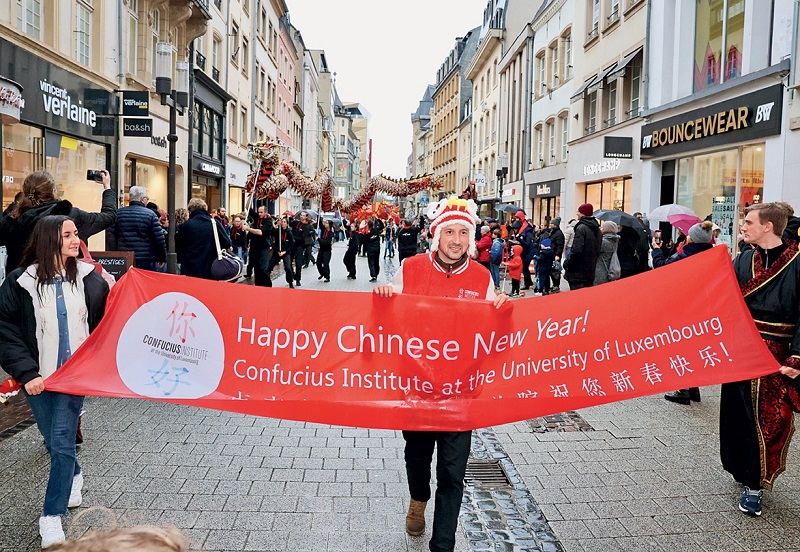
Major historical instances of intercultural and transcultural exchange can be traced back to the Silk Road in ancient China. They provide an early and particularly powerful example of how long-distance mobility created sustained contacts among peoples of different linguistic, ethnic, religious, and cultural backgrounds beginning in the Han Dynasty in the second century B.C. Contacts with Roman traders and envoys, for instance, reveal the multilayered ties these networks fostered. Silk itself, which the German geographer Ferdinand von Richthofen associated with this extensive network when he coined the term Seidenstraße (Silk Road) in the 19th century, was not merely a valuable commodity, but became a powerful cultural symbol of the connections these networks created. When Chinese President Xi Jinping launched the Belt and Road Initiative in 2013, he explicitly referred to this historical achievement and to the inter- and transcultural function of the Silk Road in his speech at Nazarbayev University in Kazakhstan on September 7, 2013.
A second major historical phase of intercultural contact developed with European expansion into the Americas and the encounters between European settlers and Indigenous peoples. The Indigenous peoples of the Americas have complex and diverse histories of migration and settlement, including ancient movements from Asia through Beringia. The European arrival, however, often transformed intercultural contact into relations structured by profound asymmetries of political, military, and epistemological power. European expansion was often accompanied by the assumption that European forms of knowledge, religion, and cultural organization were superior to those of the peoples they encountered. Similar patterns subsequently characterized European colonial expansion in Africa and Asia. Rather than creating reciprocal exchange, many colonial encounters involved the imposition of European political, cultural, and epistemological norms upon Indigenous and colonized populations. These processes became closely connected with settler colonialism, imperialism, the expansion of capitalism, and the emergence of an increasingly interconnected global economy.
We are now living through a third major phase of inter- and transcultural exchange, triggered by migrations to countries in the Americas and Australia, which has accelerated in recent decades with mass displacement to the European Union driven by regional conflicts, economic precarity, political persecution, and adverse climate conditions. Given the long history of Eurocentric assumptions, many European countries were initially unprepared for the increasing visibility of ethnic and cultural differences in terms of race, class, and gender. These developments have also fueled debates about what Samuel Huntington famously described as the “clash of civilizations.” While the former colonial powers such as Great Britain and France had more experience of dealing with migration from their former colonies, countries with a more recent history of large-scale immigration – such as Germany – were confronted with new forms of cultural and social pluralism.

The Confucius Institute jointly established by China’s Huazhong University of Science and Technology and Brazil’s Federal University of Minas Gerais introduces a “tea-coffee” specialty drink to Brazilian teachers and students in Belo Horizonte, Brazil, on April 22, 2026.
 Against this backdrop, the timing of the Global Civilization Initiative (GCI) is profoundly significant. The post-World War II international order, reshaped during the Cold War, has undergone fundamental transformations. Nationalist and protectionist tendencies have gained renewed traction, while political polarization and the reassertion of national borders have challenged earlier expectations of increasing global integration. In the United States, the return of nationalist political agendas has been accompanied by a retreat from some diversity, equity, and inclusion initiatives. In this context, the principles of mutual respect, mutual learning, and peaceful coexistence articulated in the GCI become more significant. The question remains, however, what cultural and intellectual symbol might embody such a third phase of global exchange?
Confucius offers a powerful answer. His ideas have traveled far beyond China’s borders for centuries, most notably during the European Enlightenment. German philosopher Gottfried Wilhelm Leibniz responded enthusiastically to reports and translations from China and regarded Chinese philosophy as a valuable resource for European intellectual self-reflection. In his writings on China, he argued for a reciprocal exchange between European and Chinese scholars. Europe, he suggested, could learn from Chinese approaches to ethics, social organization, and the relationship between philosophical reflection and practical life. Confucianism thus became more than an object of European curiosity: it offered European thinkers an opportunity to relativize their own cultural assumptions.
This intellectual legacy also reached the early United States. Founding Fathers, including Benjamin Franklin, John Adams, Thomas Jefferson, and James Madison, engaged with European discussions of Confucian thought. Although the precise nature and extent of Confucian influence on American political thought remain matters of scholarly debate, these encounters contributed to a wider intellectual environment in which European and American thinkers could consider moral and political ideas independently of the European monarchy and established religious authority. The establishment of direct commercial relations between the new American republic and China, symbolized by the voyage of the sailing ship Empress of China from New York in 1784, provides a parallel example of the new connections developing between the United States and China.
A final and particularly striking example of the transcultural role of Confucius is his representation carved into the marble of the Eastern Pediment of the Supreme Court of the United States, completed in 1935. Confucius appears there alongside Moses, Solon, and other historical lawgivers as part of a larger symbolic representation of the global history of law. His inclusion in the architectural program of the Supreme Court represents an important recognition of a Chinese intellectual tradition within one of the central institutions of American democracy. This recognition entered high-level political discourse for the first time when U.S. President Donald Trump referenced this Confucian heritage during a state banquet speech in Beijing on May 14, 2026.
The intellectual legacies of Confucius and the Enlightenment can be further connected with the work of Alexander von Humboldt. Humboldt’s Cosmos: A Sketch of a Physical Description of the Universe (1845-1862) sought to understand nature as an interconnected whole, in which the physical and intellectual dimensions of human experience were inseparable. His five-year expedition across Latin America (1799-1804), followed by his journey through Russia to the Chinese border in 1829, exemplified a combination of empirical observation, scientific investigation, intercultural encounter, and theoretical reflection. Humboldt’s work challenged narrow national conceptions of knowledge and contributed to a vision of the world as a network of interconnected natural and human systems.
Like Confucius, Humboldt combined theory and practice. His extensive travels required linguistic and cultural communication, and his scientific work depended upon exchanges with local communities, scholars, and observers. His understanding of nature was therefore inseparable from an understanding of human societies and their environments. In this respect, Humboldt offers an important model for a contemporary form of transcultural scholarship that combines scientific knowledge with ethical responsibility and an awareness of the interdependence of human and nonhuman life.
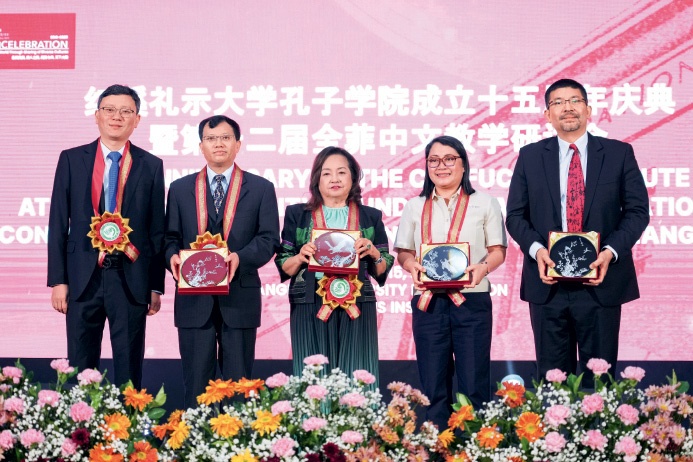
Fujian Normal University presents gifts to former Philippine President Gloria Macapagal Arroyo (center) and other guests at a ceremony marking the 15th anniversary of the Confucius Institute at Angeles University Foundation on January 15, 2026.
For scholars and educators today, the task is to build on these precedents. Institutions of higher education should create sustained opportunities for students and faculties to encounter other linguistic, cultural, and intellectual environments. Foreign-language education examples remain foundational. Achieving a high level of linguistic and cultural competence generally requires extended engagement with the language and society in which it is spoken. The same principle, however, applies across all disciplines – contemporary research is inherently international and increasingly transdisciplinary.
Exchange can take many forms: short-term visits by students and faculty, visiting professorships, joint seminars, summer schools, alternating programs at different campuses, and collaborative field research. Common research projects can lead to joint conferences, field trips, theses and dissertations, and collaborative publications. Digital technologies have opened additional possibilities by allowing students and scholars in different countries to participate in shared courses and research projects without always requiring physical mobility. Ideally, however, digital exchange should complement rather than replace sustained interpersonal engagement.
Cultural institutions play a vital supporting role. The Confucius Institutes, established from 2004 onward, were conceived as institutions for the teaching of Chinese language and the promotion of Chinese culture. Their political status and activities have become controversial in several Western countries. Nevertheless, the underlying principle of creating institutional platforms for cultural and linguistic exchange remains important. Confucius Institutes could be understood within a broader international network of cultural institutions, comparable in certain respects to Italian, Portuguese and German institutions associated with Dante, Camões, Goethe, or the Alliance Française and the British Council.
These institutions can partner with universities and research organizations to build exchange networks and identify funding streams, including programs offered by the German Academic Exchange Service (DAAD), the European Research Council, and other international research organizations. The objective should not be one-directional cultural representation but reciprocal learning: students and scholars from different parts of the world should have opportunities to teach, learn, research, and create together.
The ancient Silk Road demonstrates that economic exchange can foster cultural encounters; the history of colonialism warns us of the dangers of exchange structured by hierarchy and domination; and contemporary migration makes clear the urgent need for more equitable intercultural communication. A genuinely transcultural future requires moving beyond the assumption that cultures exist as isolated and internally homogeneous entities. Confucius, Leibniz, Franklin, and Humboldt provide different historical examples of intellectual encounters in which learning from another culture could also transform one’s understanding of one’s own.
The defining challenge of 21st-century international exchange, then, is not merely to expand its scale, but to improve its quality and deepen its reciprocity – moving from transactional interaction to genuine mutual transformation. The legacy of the Silk Road, understood not merely as a network of trade but as a historical space of human encounter, can serve as a model. What is needed today is a new form of exchange in which economic, intellectual, scientific, and cultural relationships reinforce rather than undermine one another. Such an approach could provide a foundation for a genuinely transcultural understanding of global governance. 
ALFRED HORNUNG is research professor and director of the Obama Institute for Transnational American Studies, Johannes Gutenberg University, Mainz, Germany.