The Global Governance Initiative constitutes a major theoretical contribution that offers Chinese wisdom and Chinese solutions to world peace and development challenges.
Humankind has never before possessed such formidable capacity to solve problems, yet never has it seemed as powerless as it does today. While globalization has integrated the world into a single entity, it has also woven a series of risks across the globe. Peace, development, security, and governance deficits have all emerged concurrently. Wars persist in some regions, poverty remains entrenched, and extreme weather events triggered by climate change keep occurring. And although humanity may have attained unprecedented prowess in wealth creation, its wisdom in distributing wealth and maintaining order lags noticeably behind.
Chinese President Xi Jinping delivered a keynote speech entitled “Work Together to Build a Community of Shared Future for Mankind” at the United Nations Office in Geneva in January 2017, posing a question to the international community: “What has happened to the world and how should we respond?” This is both a question of our times and a question for the world. When peace cannot be sustained, conflicts will prevail, and fairness faces an uphill battle. We must, therefore, ask the question: what kind of philosophy do we truly need to build a stable and just world order?
Marking the 80th anniversary of the United Nations, President Xi proposed the Global Governance Initiative (GGI) at the Shanghai Cooperation Organization Plus Meeting in Tianjin on September 1, 2025.
Over the past year, the GGI has gained support from nearly 160 countries and international organizations. The Group of Friends of Global Governance has been successively established in New York, Geneva, and Vienna, with a membership of more than 60 countries. A white paper titled More Just and Equitable Global Governance: China’s Principles, Proposals and Actions was released in June 2026, which systematically elaborates on the country’s philosophy and practices for global governance.
The GGI is not an isolated proposition. It follows the same philosophical vein as the Global Development Initiative (2021), the Global Security Initiative (2022), and the Global Civilization Initiative (2023), all serving the overarching goal of building a community with a shared future for humanity. Its fundamental distinction from previous governance theories lies in its deep connection with China’s traditional culture, its prioritization of the well-being of all humanity, and its transcendence of regional and national boundaries through an inclusive mindset.
The GGI is first and foremost a global vision. It seeks the good of the world rather than the interests of a single nation. This notion originates from China’s age-old concept of “all under heaven.” Ancient Chinese people did not regard “governing the state” as their supreme ideal; instead, they took “bringing peace to all under heaven” as their ultimate goal.
In the Confucian tradition, the ultimate aim of governance is not the prosperity and strength of one single state, but order and peace for all under heaven. This broad perspective has ensured that the Chinese civilization is never confined to one region or one ethnic group, which forms the essence of the GGI.
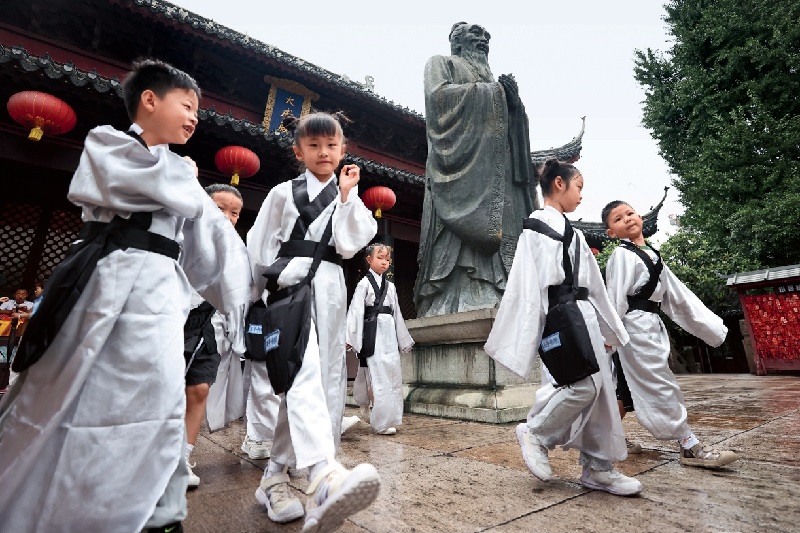
Children dressed in traditional Chinese costumes walk past the statue of Confucius to attend a ceremony at Fuzimiao Primary School in Nanjing, Jiangsu Province, on August 31, 2026.
Putting People at the Center
At its core, governance is about managing relationships between people. Some governance models uphold the supremacy of power and money. Others stress that those in power should set an example and lead by example, advocating that “governance should be based on virtue,” and that “a state should be governed by propriety,” as written in The Analects of Confucius. By listing “putting people at the center” as one of its five core tenets, the GGI establishes the value foundation for its answer to the world’s fundamental questions.
“Putting people at the center,” a cherished traditional Chinese idea, forms a cornerstone of Confucian thought. Yet who are these “people”? A common misunderstanding claims Confucian thought centers first on the self before extending care to others. This misreading contradicts core Confucian tenets. As “cultivate oneself so as to bring peace to others” in The Analects of Confucius tells us, the “people” Confucius refers to are others rather than the self. Hence, the benevolent love others, not themselves. This insight unlocks the meaning of benevolence, Confucianism’s core value.
Dong Zhongshu, the great Confucian scholar of the Han Dynasty (202 B.C.-220 A.D.), wrote in Luxuriant Gems of the Spring and Autumn (Chunqiu Fanlu): “The rule of benevolence lies in loving others, not oneself; the rule of righteousness lies in rectifying oneself, not rectifying others.” Past misunderstandings of the Confucian idea of “people-centeredness” stemmed partly from misinterpretations of “benevolence.” As the core value of Confucius and Confucianism, benevolence serves as the cornerstone of Confucian culture. A close reading of references to “benevolence” in Confucian classics such as The Analects of Confucius and The Doctrine of the Mean makes it clear that the value orientation of benevolence is not private self-interest, but universal love for all.
The Analects of Confucius offers many descriptions of benevolent people. “The benevolent undertake hardships first before reaping rewards”: a benevolent person is a responsible individual who cultivates moral character, practices self-discipline, and shoulders heavy responsibilities. “Restrain oneself and restore propriety, that is benevolence:” the benevolent is a practitioner who curbs private desires and consciously abides by public order. “When upholding benevolence, one does not yield even to one’s teacher:” the benevolent is an upholder of truth who stands firm against pressure. “Only the benevolent know how to rightly love and dislike others:” the benevolent is a wise person with clear distinctions between right and wrong, refusing to gloss over conflicts. “Sacrifice one’s life to preserve benevolence:” the benevolent is a brave soul who fears no violence and marches forward resolutely.
It follows that “people-centeredness” does not mean centering on the self. It denotes love for others, selflessness, and dedication. Only the benevolent can truly uphold people-centeredness. And only by adhering to people-centeredness can we embrace the vision of “pursuing common good for all” and advance the building of a community with a shared future for humanity.
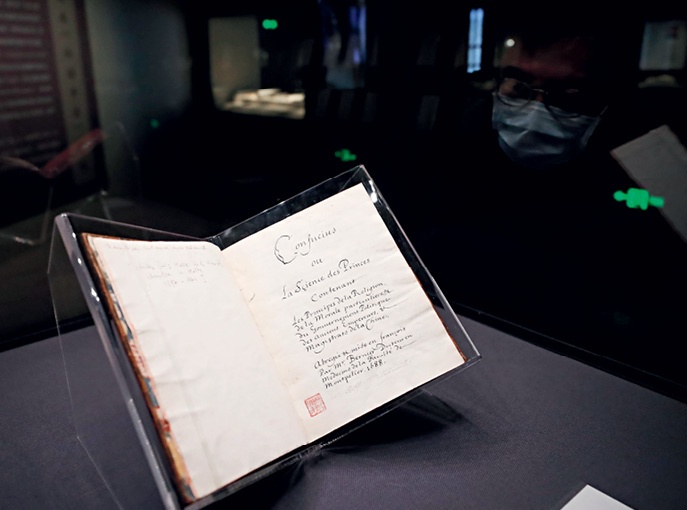
A French-language version of An Introduction to The Analects of Confucius collected by the National Library of China goes on display on November 4, 2020.
The Whole World as One Community
Building a community with a shared future for humanity embodies the profound aspiration rooted in traditional Chinese culture. “Canon of Yao,” the opening chapter of The Book of Documents – China’s earliest compilation of historical texts – puts forward the idea of “harmony among all states.” From The Analects of Confucius and The Great Learning to The Book of Rites, these classics continuously interpret how people of virtue set social examples, take social responsibilities with benevolence, and extend the community of shared destiny for families and nations to a community embracing all under heaven.
The ideal of “the whole world as one community” can only take shape with a global vision and a people-centered approach. The Book of Rites elaborates on a beautiful vision of human society featuring equality, mutual assistance, fraternity, and harmony. This vision shares intrinsic value alignment with the communist ideal upheld by the Communist Party of China. This ancient ideal of Confucianism, however, lacked conditions for realization in its time.
From the perspective of humanity’s shared future, President Xi, with a vision that connects the past and present and embraces the world, has inherited and developed the Confucian value of people-centeredness and the social ideal of “pursuing common good for all.” Drawing modern insights from the wisdom of classical Confucianism, Xi has identified underlying trends amid the great changes unseen in a century. Reflecting on the turmoil and crises inflicted on the world by the hegemonism and unilateralism long pursued by certain countries, he has explored solutions and proposed the GGI. This constitutes a major theoretical contribution that offers Chinese wisdom and Chinese solutions to the issues affecting world peace and development.
Chinese civilization has endured for thousands of years. Rooted in agrarian civilization, it has nurtured the national character of being generous and inclusive and constantly striving for self-improvement, and forged cultural genes that cherish benevolence and peace. It has also kept making contributions to the exchange and development of human civilizations.
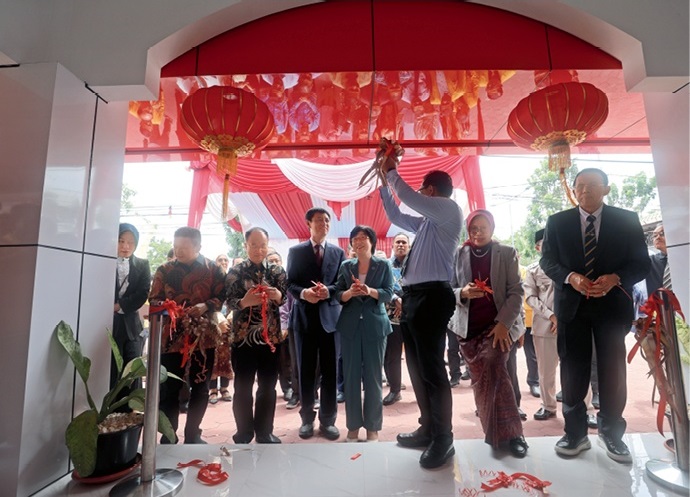
The inauguration ceremony of the Confucius Institute at Universitas Negeri Padang, Indonesia, held in Padang, capital of West Sumatra, on October 23, 2025.
Exchange between Civilizations
To implement the GGI, it is imperative to advance exchange and mutual learning between civilizations, enhance people-to-people and cultural engagements between China and the rest of the world, further expand the depth and breadth of non-governmental diplomacy, and consolidate the cultural foundation for mutual understanding among peoples. Based in Confucius’ hometown of Qufu, in Shandong Province, the China Confucius Research Institute undertakes this very mission in its international engagement. Through dialogues with diverse civilizations, it facilitates exchanges with scholars worldwide on the values and philosophies of Confucianism and Chinese civilization.
Founded in 1996, the China Confucius Research Institute is the only state-approved specialized institution devoted to the study of Confucius and Confucianism. In recent years, while carrying out fundamental textual and theoretical research on Confucianism, it has continuously deepened academic and cultural exchanges with international scholars.
The Institute hosts international scholars for in-residence research, who get to visit sites across Shandong and other regions of China to gain an in-depth understanding of contemporary China’s social transformation, cultural heritage, and local customs. The scholars develop a deeper grasp and stronger recognition of what Chinese wisdom and Chinese solutions mean to the world during their stay.
Professor Fillah Ferial from the Algerian Academy of the Arabic Language believes that from traditional China to tech-driven modern China, Confucius’ wisdom has remained an important driving force behind China’s social development. Meanwhile, Professor Teodora Peneva from the Institute for Economic Research at the Bulgarian Academy of Sciences has previously conducted social research on Confucian values in Qufu. This experience has given her firsthand insight into the continuous inheritance and development of Confucian civilization in the birthplace of Confucius.
The Institute’s practices in advancing exchange and mutual learning among civilizations serve as a vivid example for implementing the Global Civilization Initiative. They also represent concrete measures to advance the delivery of the GGI through cross-civilizational exchange and mutual learning. Working through non-governmental diplomatic channels such as academic salons and informal discussions, the Institute continues to strengthen academic and cultural exchanges with foreign experts. This helps them understand the lifestyle and mindset of the Chinese people and grasp the true contemporary China.
The future of humanity hinges on our ability to understand one another amid differences and build consensus amid diversity. Only by steadily strengthening exchange and mutual learning between civilizations and people-to-people exchanges can we deepen mutual understanding and recognition, and gain a fuller grasp of the GGI through comparing different approaches. These efforts will continuously consolidate the value foundation of a community with a shared future for humanity, enable all countries to jointly tackle global challenges, and usher in a brighter future for humanity. 
KONG DELI is director of the China Confucius Research Institute.