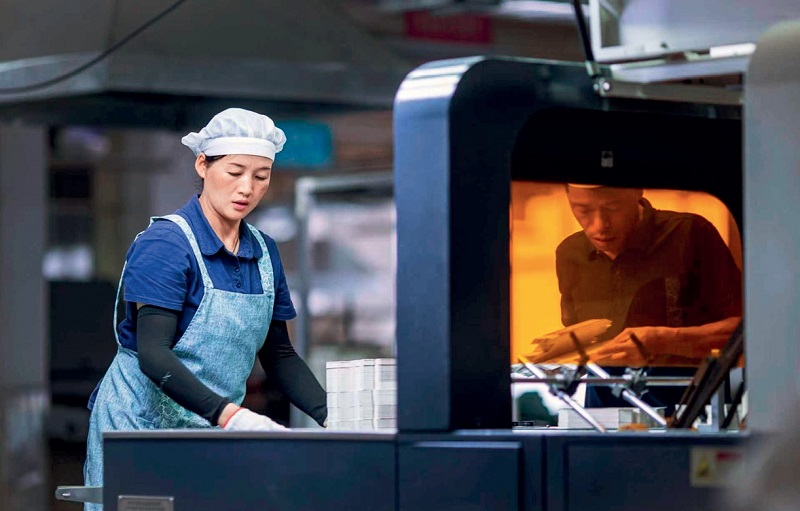
Improved policy support and targeted assistance have provided sustained momentum for Yunnan Province’s combination of poverty alleviation and rural revitalization, helping people with disabilities move from mere survival toward long-term development.
Across China, provinces and municipalities have adopted a range of initiatives, based on local conditions to facilitate employment for people with disabilities. In southwest China’s Yunnan Province, home to many ethnic minorities, efforts have focused on integrating employment for disabled people with rural revitalization. Through policy guidance, employment for disabled people has been included in the provincial government’s livelihood initiatives, and a comprehensive support system for employment and entrepreneurship has been established.
An innovative model combining intangible cultural heritage and employment has been developed for specialty industries such as the Yi ethnic group’s embroidery, wood carving, and silver-inlaid black copper making. Yi embroidery in Yunnan’s Chuxiong Yi Autonomous Prefecture has created jobs for female embroiderers with disabilities, and their creations have appeared at international fashion weeks.
Since 2020, Yunnan has provided skills training to more than 70,000 people, built 15 national-level training bases, and created over 30,000 jobs through targeted outreach. In doing so, Yunnan has explored an effective pathway to common prosperity for people with disabilities through promoting employment, injecting strong momentum into rural revitalization.
From Stumbling Novice to Expert Trainer
On October 13, 2025, on the runway of the third Chuxiong Fashion Week, Zhang Huazhi, a disabled Yi embroiderer standing only 105 centimeters tall, slowly walked into the spotlight wearing a red embroidered outfit. The silk threads on the garment shimmered under the lights, reflecting her journey from a remote mountain village to the international stage.
“When I was little, I lived in the mountains, and I didn’t feel our family was poor. Every household in the village lived in thatched houses, and there was only one dirt road leading to the town,” Zhang recalled. As a child, the most beautiful things she could see were the flowers and birds embroidered by her grandmother, who told her, “You must learn a craft, and that will support your livelihood.”
When Zhang began learning Yi embroidery, she could only practice on coarse linen. Stitches gone awry were undone and redone, again and again. Only when thin calluses formed on Zhang’s fingertips did her grandmother nod in approval and hand over her treasured cotton threads. Zhang sold her first embroidered ribbon for RMB 0.5, and used the money to buy more thread and fabric, continuing to learn embroidery to support herself, and contribute to her family’s income.
After 2012, as poverty alleviation and rural revitalization initiatives reached the mountainous areas, the Chuxiong prefectural government, drawing on ethnic cultural resources, vigorously promoted Yi cultural industries and decided to train 100,000 female embroiderers to boost rural revitalization. The Chuxiong Disabled Persons’ Federation integrated resources from multiple stakeholders to establish a Yi embroidery training base, the first in Yunnan that taps into local intangible cultural heritage to help people with disabilities. It also launched the Female Embroiderers Training Program, which has helped create jobs for 2,000 disabled female embroiderers.
Through collaboration between the Disabled Persons’ Federation and the training base, Chuxiong has supported disability-assistance initiatives and cultivated a large number of skilled female embroiderers with disabilities who are able to engage in flexible, home-based employment. After her participation in the Female Embroiderers Training Program, Zhang has mastered traditional needlework that graces exquisite garments through her hands.
With the support of the prefectural Disabled Persons’ Federation, Zhang established a Yi embroidery business in Nanhua County, creating jobs and increasing incomes for 16 female embroiderers with disabilities. Four of her employees were selected as leading embroiderers, and Zhang herself was recognized as a model in creating employment and promoting entrepreneurship for people with disabilities. She was invited to serve as an intangible cultural heritage inheritance mentor at Yunnan Technician College, where she has trained more than 800 students.
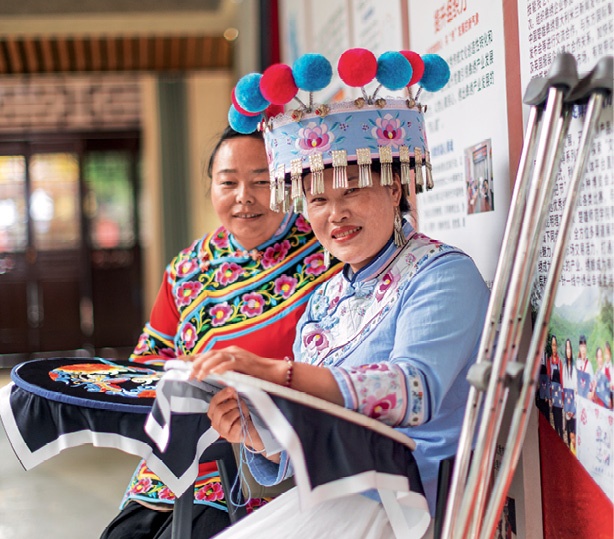
Across China, the China Disabled Persons’ Federation and its local branches have helped bring 991,000 disabled individuals from falling back into poverty under dynamic monitoring and assistance program. Photos by Chen Xi
Earning a Livelihood and Respect
Wang Guangliang, an inheritor of the intangible cultural heritage of the silver-inlaid black copper craft, was born in the mountainous area of Dongchuan District, Kunming City, Yunnan Province.
Living with the disability caused by polio, Wang left the mountains for the first time at the age of 18. After taking three different vehicles, he reached downtown Dongchuan and found a performance job at an eco-resort in Kunming.
Looking for other opportunities, he decided to try his luck at the Kunming Disabled Persons’ Employment Service Center. A week later, he received a call from the Disabled Persons’ Federation telling him that a master craftsman was willing to take on an apprentice in silver-inlaid black copper craft. He was cautioned that the craft was very difficult to learn and that he should think it through before making the decision. This master craftsman was a national-level inheritor of this intangible cultural heritage craft and had never taken on a disabled apprentice before.
“I’ll learn the craft. No matter how hard it is, I’ll do it!” Wang decided, and in 2011 he arrived at the training hall with a suitcase and all his savings. Learning the craft proved far more difficult than he had imagined. The most challenging process was hammering, using a small hammer to strike the copper sheet with precision, creating smooth and evenly spaced grooves. The seemingly simple requirement of “accurate and uniform strikes” demanded long hours of repeated practice. Every day, Wang was the first to pick up his tools and the last to put them down.
As his craftsmanship matured, Wang was recognized as a Kunming Gold Medal Worker. In 2019, he became a district-level representative inheritor of intangible cultural heritage, and in 2025, he was promoted to a municipal-level inheritor. What makes him even prouder is that he was able to purchase a home in Kunming through his craftsmanship, achieving both a stable living and rewarding work.
“The craft has given me more than financial security. It has given me confidence in life,” he said. Today, more people with disabilities come to the silver-inlaid black copper training hall to learn this intangible cultural heritage. Wang patiently guides new trainees, sharing his experience without reservation. “I hope that, like me, they can learn a skill here that enables them to make a living and earn respect from others,” he said.
A Carving Knife and a Handful of Clay
The carving knife of Yang Yuansong, a woodcarver in Jianchuan County in northwest Yunnan, glides across a plank of highland Chinese catalpa wood, while Ge Shang’en, a ceramic artist in Weishan Yi and Hui Autonomous County in west Yunnan, shapes handfuls of clay into earthen forms. Wood shavings scatter in the morning light, revealing scenes of the ancient Tea-Horse Trail, while clay spins on the wheel, molded into the Bai ethnic totem of Wamao, or tile cats.
“One person’s prosperity does not count as true prosperity; only when people prosper together does it count,” believes Yang Yuansong. He returned to his hometown in 2015, skilled at the intangible cultural heritage craft of Jianchuan wood carving, and founded a woodcarving factory. A member of the Bai ethnic minority, he was driven by a deep commitment to supporting people with disabilities and revitalizing rural areas. Yang has provided free training to a total of 208 people, including 64 with disabilities. Using knives as pens and wood as scrolls, Yang and his apprentices carry forward Jianchuan’s millennium-old woodcarving culture.
The factory is both a workshop and a warm home where people with and without disabilities work together. Some apprentices have grown into skilled woodcarvers and been recognized as inheritors of intangible cultural heritage. Others have opened their own studios and started their own businesses with Yang’s support.
The factory has developed its own painted woodcarving techniques, using mineral pigments to create cultural and tourism products that combine artistic value with practicality. An initiative that links business with households has involved nearby villagers in supply chain activities such as raw material provision, turning intangible cultural heritage into a powerful engine for rural revitalization.
Two hundred kilometers from Jianchuan, in Liuhe Village, Weishan Yi and Hui Autonomous County, lives Ge Shang’en, an intangible cultural heritage inheritor of earthenware craftsmanship. Although Yang and Ge, both rural artisans, have never met, they are engaged in the same endeavor, which is transforming intangible cultural heritage into a pathway for people with disabilities to pursue a fuller life.
Ge said fate brought him to the field of intangible cultural heritage. In 2004, shortly after turning 30, he was injured in a traffic accident that left him disabled. Unable to work away from home, he began learning earthenware-making from his father. After learning of his situation, the local Disabled Persons’ Federation visited him many times and provided assistance. In 2018, Ge was designated a provincial-level model for entrepreneurship among people with disabilities and received RMB 10,000 in financial support. The federation also introduced him to e-commerce training, helping to fast track him into the world of online marketing. Today, Ge’s pottery workshop focuses on the Bai traditional earthenware Wamao, producing more than 20 types of ceramic products, and employing 13 workers, including people with disabilities, thus leading fellow villagers toward common prosperity. 
CHEN XI is a reporter with the Disability in China magazine.