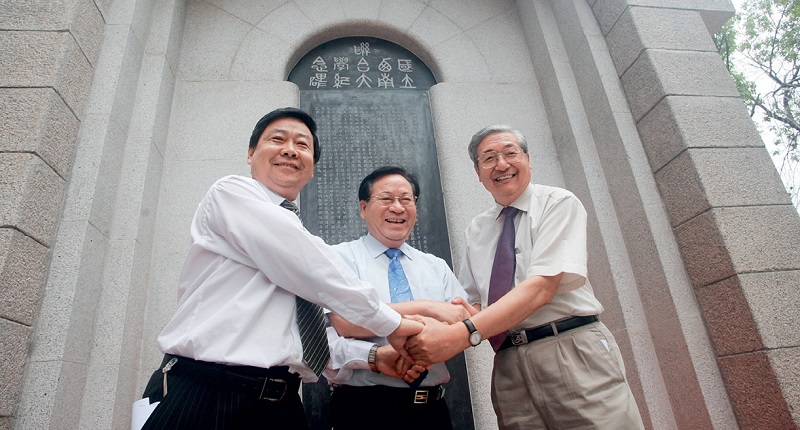
Rao Zihe (left), then president of Nankai University, Gu Binglin (center), then president of Tsinghua University, and Xu Zhihong (right), then president of Peking University, stand in front of the newly-unveiled Southwest Associated University Memorial Monument on the Nankai University campus on September 13, 2003. Li Xingjiao
Over the past 40 years, one man has distinguished himself through a deep commitment to researching protein structures of high pathogenic viruses, and published numerous significant works in top international scientific journals. He is Rao Zihe, a professor at Tsinghua University, an academician of the Chinese Academy of Sciences (CAS), and a preeminent figure in the field of structural biology. Throughout his illustrious career, he also served as director of the Institute of Biophysics of the CAS and president of Nankai University.
On the global stage, Rao made history as the first Chinese scientist to be appointed president of the International Union of Pure and Applied Biophysics. In recognition of his contributions to biophysics, Asteroid 505906 was named “Raozihe Star” in 2022. Yet, despite his many achievements and accolades, he has never ceased to venture into the unknown frontiers of life sciences.
Precise Understanding
“Deciphering the structure of a protein is not the end; rather, it is the beginning. Understanding its function, uncovering the governing rules, and ultimately serving human health is the true mission of structural biology,” said Rao. To fulfill this mission, he has led his teams in making one breakthrough after another, which has resulted in the continuous expansion of the understanding of life.
After nearly two decades of work on Mycobacterium tuberculosis, Rao and his team identified the structures of several key drug-target proteins. Their innovative works have provided novel drug targets in the global fight against tuberculosis, one of the most severe infectious diseases worldwide.
When unknown viruses emerge, Rao is always among the frontline scientists who provide the necessary research to confront these “invisible enemies.” For example, in response to the SARS coronavirus, H5N1, H1N1, the African swine fever virus, and the recent COVID-19, Rao led a team to decipher the structures and functions of proteins encoded in these viruses in the shortest possible time.
During the SARS outbreak in 2003, Rao’s team determined the first three-dimensional structure of the SARS coronavirus (CoV) main protease worldwide within only three months and developed broad-spectrum anti-CoV inhibitors. These findings provided essential information for the development of antiviral drugs and remain crucial even today for developing drugs to fight against COVID-19.
After the outbreak of SARS-CoV, there was a sharp decline in global academic interest in coronavirus research. Yet Rao encouraged his team to keep exploring this field. As a result of this foundational research, the team became the first to resolve the two most critical drug-target structures of COVID-19 17 years later in 2020. The findings which they released immediately to the international community helped accelerate vaccine and drug development worldwide and won precious time for saving lives.
Performing in-depth study on scientific subjects has been the ethos of Rao and his team. In October 2025, the team under the direction of Rao and another scientist Lou Zhiyong published a landmark paper on RNA viruses in a top international journal. The study reshaped scientific understanding of the coronavirus transcription-replication process, settling a 25-year-long debate over helicase polarity and capping mechanisms.
Today, their research on the coronavirus transcription-replication complex has formed a comprehensive and systematic body of work – one of the most complete and most cited in the world, thus establishing the team as a global leader in this area.
A Visionary Leader
In advancing China’s scientific progress, Rao Zihe always aims for a “long term” goal.
In 1995, when China proposed the national strategy of “revitalizing the country through science and education,” Rao, who was then in the U.K., immediately submitted suggestions to China’s Ministry of Science and Technology and Ministry of Education on the development of structural biology in the country. He hoped to help China rapidly close the gaps in this critical scientific field.
The following year, after many years of research at the University of Oxford, Rao made a life-changing decision to return to China and join Tsinghua University. He recalled, “China was entering a period of rapid development, and the country’s emphasis on science, technology, and talent development was unprecedented. I felt that China needed me more, and my academic roots belonged there.” His return not only boosted the rapid rise of structural biology research in China, but also inspired a new generation of young scientists to enter the field.
Due to a nationwide educational reform back in the 1950s, Tsinghua University did not provide academic programs in biology from 1952-1983. However, the blank space coincided with a boom of remarkable biological discoveries globally. To catch up with its domestic and international counterparts, this top institution faced numerous challenges following the resumption of the related academic programs in 1984. After Rao joined the academic team, the school soon ranked top in China, and under his leadership, Tsinghua’s Laboratory of Structural Biology grew into a world-class research center and trained a cohort of leading scientists.
Rao created many “firsts” for the reestablished Department of Life Sciences at Tsinghua. He is the first chief scientist of the 973 Program (a national basic research program of China) and the first chief scientist for basic research. He also produced the first academic paper in Cell authored by a Chinese scholar since the 1980s, became one of the first recipients of the restored Tan Kah Kee Science Award, and received the first C.C. Tan Life Science Award and the Qiushi Outstanding Scientist Prize in Life Sciences, among others.
He has a great vision for cutting-edge technologies. During his tenure as director of the Institute of Biophysics of the CAS (2003-2007), he vigorously promoted the development of platforms for researching macro-molecular structures and their functions by cryo-electron microscopy (cryo-EM). Perceiving early the revolutionary potential of cryo-EM, he guided the transition of structural biology research from traditional X-ray-crystallography-based to cryo-EM-based in both the Institute of Biophysics and China. The cryo-EM platform he spearheaded at the Institute of Biophysics is the first world-class platform of its kind in China. This has enabled Chinese scientists to secure an early edge in the new round of technological competition.
Rao also helped chart China’s planning for protein science (focusing on structural biology). He has served on the expert panel of the 973 Program and Major New Drug Development program. He has chaired the expert panels of the Protein Research Project as well as the Protein Machines and Regulations of Life Processes program. He promoted the establishment of the National Facility for Protein Sciences and other major national scientific facilities.
Today, he focuses much of his attention on analyzing the paradigm shifts brought about by artificial intelligence technology such as AlphaFold. He believes that these changes are accelerating the advancement of research on structural biology from the relatively “static, molecular-level” studies toward investigation of “dynamic, cellular-level supramolecular complexes.” A deeper understanding of the structure and function of proteins and other biomacromolecules, he argued, will drive revolutionary breakthroughs in the research and development of new drugs and biotechnology.
Talent Cultivation
Driven by the conviction that talent defines a nation’s future, Rao has made cultivating young scientists the cornerstone of his policy advocacy throughout his career.
He has proposed building a pyramid-shaped talent structure: one that comprises world-class strategic scientists at the top, a large cohort of senior researchers in the middle, and emerging talent at the base. He recommends that China must accelerate the development of its national strategic talents through coordinated efforts on multiple fronts to support its scientific and technological independence. Specific measures include: deepening comprehensive educational reforms and strengthening creativity-oriented training; improving the talent ecosystem by removing institutional barriers to unleash innovation potential; adopting a demand-driven approach in key strategic areas; and fostering a scientific culture to inspire younger generations.
He has not only proposed those ideas but also taken action to realize them. During his presidency at Nankai University, he actively promoted global cooperation through organizing overseas visits as well as joint programs, faculty and student exchanges, and collaborative laboratory initiatives with overseas institutions; he launched the 100 Young Faculty Training Program, selecting 100 graduates each year from various disciplines to pursue further study at world-renowned universities as a strategic reserve of future faculty; and he organized international conferences and summer schools to provide high-level academic platforms for young scholars.
He places great emphasis on the quality of undergraduate teaching and students’ engagement in scientific research. He personally teaches undergraduate courses, imparting frontier knowledge in the life science field, and has inspired a growing number of highly qualified and academically accomplished faculty to actively engage in teaching. He has also facilitated the drawing up of the proposals of major projects, securing research funding, and building alumni networks. As he often says, “Our work is to build bridges and pave the way for the future generation, so that they can stand taller and go farther than we have gone.”
In 2022, Rao co-initiated the Tengchong Scientists Forum together with academicians Gu Binglin, former president of Tsinghua University, and Xu Zhihong, former president of Peking University. The forum has now been held for four consecutive years. These three institutions share a profound historical connection. During the Chinese People’s War of Resistance against Japanese Aggression (1931-1945), Tsinghua University, Peking University, and Nankai University were forced to move to Yunnan and formed the National Southwestern Associated University together. The three universities’ former presidents aimed to honor and carry forward the legacy of the National Southwestern Associated University, while further advancing the country’s scientific development.
As co-chair of the forum, Rao has played an active role in organizing thematic events such as the Life Sciences and Health Forum and the Young Scientists Forum, and was the first to advocate establishing the Tengchong Outstanding Young Scientists Award, which was presented for the first time at the 2025 Tengchong Scientists Forum, recognizing excellent scientists under the age of 40 across various disciplines.
Today, even in his 70s, Rao’s schedule remains packed, traveling to universities, laboratories, and scientific meetings both at home and abroad, doing all he can to advance the progress of modern science. 
CHEN WENXIN is communication manager of the Tengchong Scientists Forum.