The living and nursing allowances provided by the Chinese government for people with disabilities who are unable to work are not only important components of China’s social security system which provide for the needs of its disabled, but also show China’s ability to guarantee the basic living standard and social fairness and justice for this group of people.
During the past five years, Hebei Province has incorporated targeted services for people with disabilities into livelihood projects, upgrading the quality and efficiency of support services for disadvantaged groups. The Disabled Persons’ Federation of Julu County, Xingtai City in Hebei, has implemented various measures based on local conditions, including establishing a three-tier county-township-village service network, creating a model that combines long-term care insurance with medical and elderly care, and providing “menu-style” home-based care service. These measures ensure that the basic needs of people with disabilities are met.

Julu County optimizes its “menu-style” home care services for people with disabilities, enabling them to enjoy a fulfilling life without leaving their homes. Xu Junxing
Direct and Efficient
To keep improving the social security system for persons with disabilities and ensure that assistance policies are effectively implemented, Xingtai City has launched online services and proxy assistance.
Seventy-year-old Zhang Shunyou in Louzhangzhen Village, Julu County, suffered from cerebral thrombosis which left the right side of his body paralyzed. His children work away from home and thus are unable to give him sufficient care. As a result, when Li Weishuang, a staff member of the village Disabled Persons’ Association, learned that Zhang was applying for a disability certificate and relevant subsidies, he promptly submitted the application on his behalf through an app.
On the day an onsite assessment for the disability certification and qualification for proxy services was conducted, a small working group composed of Yu Guo, a member of the Party Leadership Group of the Julu County Disabled Persons’ Federation; Song Huaguang, chairman of the Sujiaying Town Disabled Persons’ Federation; Li Weishuang; and Zhang Bo, an orthopedic doctor at Julu County Hospital, visited Zhang Shunyou in his home. Zhang Bo conducted a medical evaluation based on the on-site examination results. Yu and Song recorded the data and completed the forms for disability certificate application and the disability evaluation.
The entire process took about an hour, at the end of which, Yu patted Zhang Shunyou on the shoulder and said with a smile, “Once the disability assessment is approved, we will follow up on the processing of your application throughout the entire process. Within no more than 10 working days, the Town Disabled Persons’ Federation will deliver the certificate to your home.” Song immediately added, “I also serve as the director of our town’s civil affairs office. Once the certificate is issued, I will apply for two subsidies and the minimum living allowance for you.” Upon hearing this, Zhang Shunyou was moved to tears and said, “I never expected that I could get everything done without leaving my home. Thank you so much.”
“As front-line workers serving people with disabilities, by continual study, visiting people in their homes, and communicating more with people that have disabilities, we will be able to reduce the trips they make to our offices to few or none. We will keep doing this work regardless of how hard it is – because it’s worth it!” said Yu.
Innovative Approaches
Many families who have a family member with a disability struggle with immense pressure. Such was the case for 73-year-old Huang Shuzhen and 88-year-old Lu Yuekun in Julu County. When recalling the period when his wife, Huang, became partially disabled after a stroke she suffered in 2021, Lu said, “My wife used to be extremely diligent, managing everything inside and outside the home. After she fell ill, I fell sick several times from taking care of her. Our monthly expenses for hospitalization were at least RMB 6,000, far beyond our retirement pensions. We really didn’t know what to do.”
Individuals with partial or complete disabilities, such as Huang, are precisely the groups that require special attention and extra assistance. To this end, the China Disabled Persons’ Federation makes sure that they have access to financial services and inclusive personal insurance, so that their families will not slip below the poverty line. Long-term care insurance, which funds basic living care and medical service for individuals with long-term disabilities, is one of the innovative elements of China’s social security system. It can effectively address the challenges of caring for severely disabled individuals while alleviating their financial pressure.
Julu County has actively implemented a long-term care insurance and elderly care service model, incorporating it into public welfare initiatives. Huang has become one of the many beneficiaries. In a ward at an elderly care center in the county, Huang is taking small steps with the support of head nurse Xie Cunbao. Though her pace is slow, it is already a miracle in Lu’s eyes. “Now, my wife is cared for by professional medical staff every day, and the long-term care insurance provides a monthly subsidy of RMB 1,500,” Lu said with a smile. “The pressure has lessened, and as a result, I feel my own health improving as well.”
For 79-year-old Zhang Liancun, who resides in the same elderly care center, long-term care insurance has prolonged her life. After two cerebral hemorrhages, Zhang lost all physical mobility, became incontinent, and relies entirely on a nasogastric tube for nutrition. “Without professional care, my wife could not have survived for long,” said 81-year-old Yao Yongchao, giving a thumbs-up to the medical staff. “She has been living here for almost eight years now, and she hasn’t developed a single pressure ulcer, thanks to you and our country’s support policies,” Yao emphasized.
“Taking into consideration the traditional belief still held firm in rural China, ‘not leaving one’s parents in their old age and providing care for them at home,’ we have collaborated with medical institutions through government procurement to provide home-based care services for disabled individuals in need,” explained Sun Lingshuang, director of the Julu County Medical Insurance Center.
To ensure service quality, Julu County has established a long-term care insurance smart medical and elderly care service platform and upgraded functions such as facial recognition, service recording, and electronic fencing to effectively monitor caregivers’ service frequency, items, and duration. Today, Julu County is providing care services for all local residents with severe and moderate disabilities, reducing their financial burdens by over RMB 90 million.
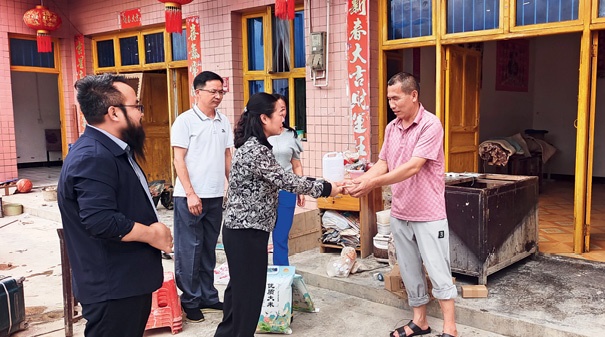
Local officials visit disadvantaged individuals with disabilities every month.
Home-Based Care
Individuals with intellectual, mental, and severe physical disabilities experience significant levels of functional impairment, making daily life more challenging. They and their families have an urgent need for foster care and support services.
Over the past five years, the China Disabled Persons’ Federation has implemented the Sunshine Home program, exploring diverse forms of care and support services for persons with disabilities. Xingtai City has developed a service model that is centered on home-based care, supplemented by residential care and daytime assistance. In Julu County, the Disabled Persons’ Federation has introduced government-purchased healthcare services in collaboration with professional institutions after extensive research and assessments. In this way, it has been able to provide home-based care services for 192 eligible individuals with disabilities.
On the 23rd day of every month, the home care service team visits the home of 53-year-old Li Caining in Xiaoliuzhuang Village, Julu County. Each visit creates an atmosphere as lively as the New Year: the team members chat warmly about news in the village while carrying out their assigned tasks; someone cleans the house, someone washes Li’s hair, and someone carefully trims her nails. Li suffers from osteogenesis imperfecta, which makes it difficult for her to even take a shower. After the Julu County Disabled Persons’ Federation launched the home care service in 2023, members of the service team have visited Li to provide her with regularly services every month.
“Because the needs of people with disabilities vary greatly, a ‘one-size-fits-all’ approach to service is not appropriate,” said Wang Jinghui, chairman of the Disabled Persons’ Federation. He explained that after conducting extensive research, they compiled a list of 65 service items across four major categories: daily care, home cleaning, social adaptation, and supportive services. Daily care services include assistance with bathing, meals, and purchasing medication; social adaptation training consists of handicrafts and psychological counseling; and supportive services includes helping people with disabilities handle medical insurance matters and accompany them to medical appointments.
“Services should both provide warmth and be professional,” said Meng Hui, the head of a cooperative care service organization. The service team under the guidance of the Disabled Persons’ Federation of Julu County is composed of medical professionals such as doctors, nurses, rehabilitation therapists, and caregivers. Team members are also required to regularly participate in home care service training organized by the Federation and cooperative organizations to ensure the service they provide is high quality. Each service item provided by the team is customized for the individual based on professional assessments as well as the preferences of the recipient. For instance, since Li Caining values cleanliness, the service focuses on daily care and room cleaning; whereas for Mr. Wang, a severely physically disabled elder living alone, the team provides additional assistance with purchasing daily necessities and safety checks of household appliances.
Behind every tangible and perceptible moment of happiness is the reassuring support of the national social welfare system and the coordinated efforts across multiple departments and sectors. When people join hands in a spirit of empathy and love, they can walk through the most difficult path, and society can have a much happier and healthier environment as a result. 
XU JUNXING is a reporter at China Press for Persons with Disability.