On April 18, the “Sharing Stories of the China-Laos Railway” event took place in Lao’s capital Vientiane, bringing together over 60 participants from both countries. Under the theme “Building a Golden Route to Serve the Peoples of China and Laos,” the gathering featured government officials, business leaders, journalists, academics, and railway staff who shared firsthand accounts of how this cross-border infrastructure project has transformed the lives of people living along the route.
The timing of the event coincided with two milestones: the third anniversary of international passenger services along the line and the 65th year of the establishment of diplomatic relations between China and Laos, also designated as the Year of China-Laos Friendship.
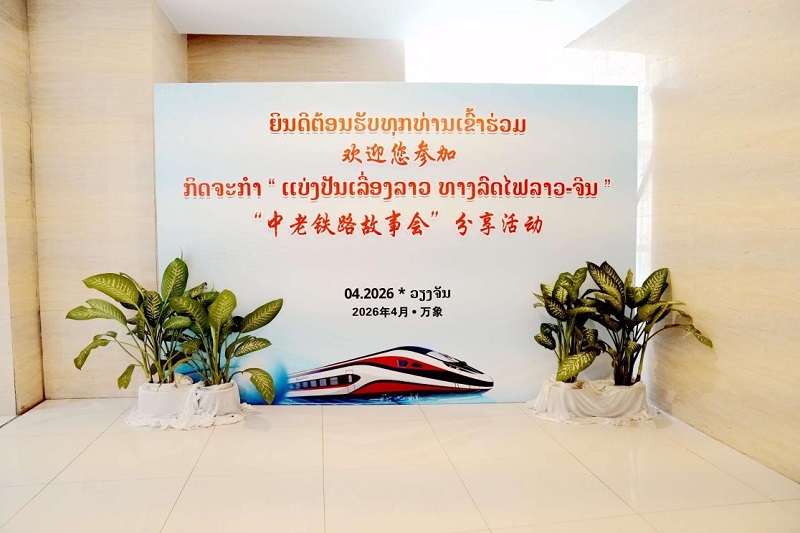
A sign expresses welcome to participants at the event held in Vientiane, on April 18, 2026.
The event came on the heels of a four-day media tour from April 15 to18, during which participants traveled by train through Luang Prabang Province and Vientiane and saw firsthand the railway’s impact.
Since the railway opened, the Fuxing and Lane Xang trains have been operating safely, efficiently, and comfortably. This has significantly shortened travel distances for countless people living in cities along the route.
Zhou Qiong, a reporter from People's Railway Daily, described the line as a “golden route” that is propelling regional development. Thanuthat of the Lao News Agency likened the railway to a “key” which is unlocking geographic barriers and connecting Laos more closely with neighboring markets, providing tangible benefits for his country.
Liu Yinneng, a driver at the Vientiane Operation Management Center, recalled piloting the inaugural train; while Bounyalith Khanthachack, director of the Lao Railway Vocational Technical College, highlighted the symbolic shift of the country from being “land-locked” to “land-linked.”
All speakers pledged to continue serving as storytellers, guardians, and chroniclers of the railway’s legacy, collectively polishing what they termed its “golden brand.”
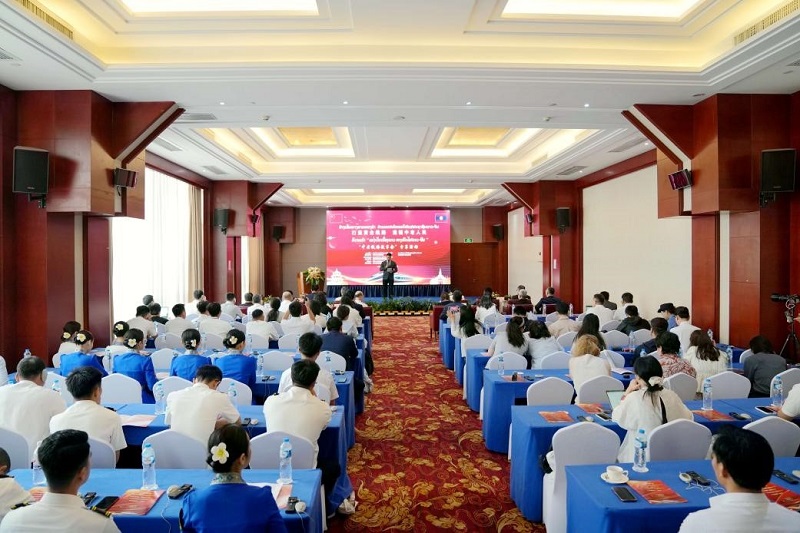
Over 60 participants from China and Laos attend the event in Vientiane, on April 18, 2026. (Photos by Lin Feiyi)
Fang Hong, Chinese ambassador to Laos, said that the China-Laos Railway is a landmark project of high-quality Belt and Road cooperation. Since it began operating, the railway has evolved from mere means of connectivity to a seamless flow of accelerated logistics and a line of shared prosperity. The ambassador stressed that personal narratives shared at the event demonstrated how the corridor deepens bilateral friendship and mutual understanding, establishing it as a pathway to development, happiness, and friendship for the peoples of both countries.
Somsavath Phongsa, director general of the Department of Mass Media under the Lao People’s Revolutionary Party Central Committee, reinforced this assessment, citing in his speech how job creation, convenient travel, surging trade and freight volumes, and growing international tourism are concrete outcomes of the railway. “This railway has truly become a 'golden line' benefiting our peoples,” he concluded.
The event was organized with guidance of the Publicity Department of the Central Committee of the Communist Party of China (CPC) and the Publicity Committee of the Lao People’s Revolutionary Party Central Committee. It was hosted by the Publicity Department of the CPC Committee of China State Railway Group and organized by Laos-China Railway Co., Ltd.