It’s a familiar sight on buses, subways, and park benches across China: Middle-aged and elderly readers are immersed in their phones, reading online novels, often with enlarged fonts, for failing sight. A quick glance reveals two dominant genres – female readers swoon over CEO romances, while male readers indulge their fantasies with tales of immortal heroes – or so big data suggests.
There has been more than 20 years of development in China’s online literature, now an important part of contemporary literature. With around 600 million readers, it has evolved into a national pastime – roughly half of all Chinese netizens now read these digital tales.
For readers, they’re more than entertainment; they’re portals to worlds where long-held dreams finally unfold, especially the middle-aged and elderly who finally get the chance to relive their youthful passions and rewrite the regrets of their past.
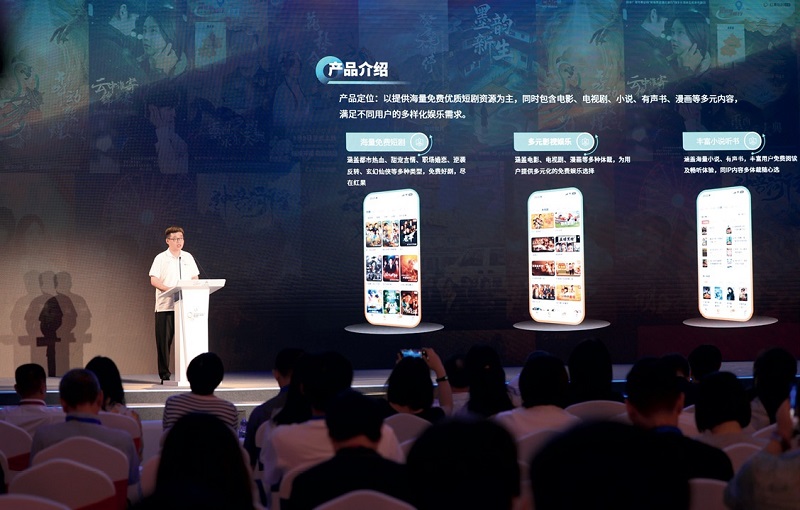
The eighth China Online Literature+ Conference kicks off in Beijing on July 17, 2025.
A Digital Sanctuary
For 53-year-old Quan Chunlan, online novels are a lifeline. Growing up in a village in Tianjin’s Jinghai District, she learned to drive in her 20s – rare for a rural woman at the time – and dreamed of becoming a taxi driver in the city. Her parents stopped her, calling the job “too dangerous.” After marrying a carpenter, she refused to be confined to housework and farming, opening a small village store and driving to stock goods herself. Yet caring for her son kept her from ever expanding it into the supermarket she once envisioned.
Now a housekeeper in Beijing, her monthly time-off is sacred. She locks herself in, retreats into solitude, and dives into romance novels.
“They let me forget life’s pressures,” she told China Today. “In those CEO-themed novels, an ordinary woman is always firmly chosen by a mature, wealthy man, who supports her whenever she needs it.” Apps like Tomato and Qimao cater to her needs: large-font modes ease eye strain, while audiobooks allow her to lie on the sofa, snack in hand, listening intently. These platforms aren’t entirely free however. Memberships offer ad-free reading and audio access, while non-paying users can exchange screen time for ads.
For many Chinese women in their 50s and above like Quan, CEO-themed romance novels often echo their own life pressures – marital strains, aging anxieties, and the longing for security. These stories offer more than escapism: they deliver fantasies of unconditional pampering and upward mobility – emotional support for daily stress.
Chinese men in middle adulthood and above, meanwhile, lean more toward immortal hero sagas. Here, through protagonists who defy fate, conquer beasts, and ascend to greatness, they channel heroic aspirations and unmet desires for power, finding solace in a virtual world. For them, having amazing skills, battling mythical beasts, and finding instant solutions feed a primal thrill absent from their mundane lives.
What fuels online literature’s popularity isn’t just the stories, but how they are read. Unlike traditional books – static, solitary experiences, online novels thrive on interaction. Readers unlock phones anywhere, anytime, to devour updates, subscribe to chapters, comment on plots, or debate characters’ evolution. Their feedback even shapes storylines, blurring lines between readers and writers.
Not Only Readers, But Also Writers
People over 50 aren’t just consuming these worlds – they’re building them. At present, China’s online literature ecosystem boasts over 30 million authors, and among them, authors over 50 are a distinctive group. Unlike millennial authors who often depend on writing for income, their motivation is rooted in value-driven passion, not survival. This cohort includes retired teachers, former factory workers, and business managers.
Online literature thrives on imagination, but writers over 50 bring a unique edge, as their stories are anchored in lived experience. Guo Yu, a 56-year-old online novelist who specializes in realistic themes, explained why this matters. “Many young writers steer clear of the genre of realism, fearing they’ll get it ‘wrong,’” he said. “But real life is messy, beautiful, and full of unsung heroes. That’s where the best stories hide.”
Guo, who co-authored a popular novel The Legend of Internet Heroes series, said that he and his partner chose to write entrepreneurial novels precisely because they both had successful business experience. Twenty-plus years of highs and lows in the business world have provided them with a wealth of creative material.
“When creating Legend of Internet Heroes I, we finished it in almost one go. We highly refined our over-two-decade business experience, shared its most crucial parts with readers, moved them with true stories,” Guo said.
According to him, many readers have called it a true record of entrepreneurship in Hangzhou, where the stories are set. Indeed, almost all the names and events in the book can find their real-life counterparts. In this 550,000-word novel, 95 percent of the stories are traceable, achieving non-fiction within “fiction.”
These writers see themselves as more than entertainers – they are cultural custodians. For Guo, their duty is to carry forward China’s literary heritage, raise the bar for online writing, and build bridges between generations.
Their presence is reshaping the industry. Platforms like Qidian and WebNovel now set up sections dedicated to their works, and publishers are scouting their works for print editions. More importantly, they are proving creativity has no expiration date.
Short Dramas: Love in a Hurry
Quan also watches micro-dramas adapted from online romance novels. With a few minutes per episode, hundreds of episodes per series, a twist every few seconds, and a cliffhanger at the end of each episode – they are a perfect pastime, bringing her lighthearted pleasure.
Data shows that the top three reasons middle and elderly people choose short dramas are precisely being easy to watch on mobile phones, creating a good mood, and meeting emotional needs.
However, this need often faces misunderstanding. Quan mentioned that whenever she sees young people mocking “middle-aged CEO dramas,” she always feels a pang of sadness.
“Young people have countless channels to fulfill romantic fantasies, but when it comes to middle-aged and elderly people talking about love, we are labeled as ‘tacky’ and ‘clichéd,’ as if we don’t deserve to have emotions,” said Quan. In her view, this prejudice stems from the lack of social attention to the inner world of people in their fifties and above in China – unfair distribution of resources in a high-efficiency society has long left the emotional needs of people over 50 marginalized, and the “CEO Love Me stories” in short dramas are precisely one of the few windows for them to project themselves.
In a world that often overlooks them, these pocket-sized online dramas are giving them something rare: a chance to see themselves as the heroes of their own stories. And in that, Quan has found a new kind of escape – not just from life’s pressures, but into a world where, at last, she is the main character.