
Most people rely on their two eyes to “see” the world. But for around 17 million visually impaired people in China, “seeing the world” often begins at the end of their fingers.
In the third year of junior high school, a sudden retinal detachment plunged the life of a boy named Bao Feng, into darkness. Young Bao, who hailed from Anhui Province, was an avid reader and often even read under his bed covers late into the night with a flashlight – until he lost his sight and his world came crashing down. Now an adult, he recalled that period, telling China Today, “My whole life collapsed. I couldn’t see anything, couldn’t leave the house alone, and couldn’t go to school.” Back then, he did not know that schools for the blind or braille books existed. Back in the 1990s, his only companion then was the intermittent voices he heard on the radio.
The enrollment rate then for blind children in China was only 2.7 percent – meaning that fewer than three out of every hundred children attended school. Bao was later enrolled in Wuhu School for the Blind in Wuhu City, Anhui Province, where he soon learned how to read braille.
Braille books at schools for the blind in those days mostly fell into two categories: textbooks and about 100 world classics. The only relative sources of “timely” information Bao recalls came from a few braille children’s books and some monthly magazines for the blind.
What really changed his life was one of these magazines called Literature of Chinese Blind Children. “The first time I read Literature of Chinese Blind Children, I was stunned,” Bao said. For him reading was not just acquiring information. By reading this special magazine, he came to realize that there were so many other blind people in the world who enjoyed different sports like gateball, could compete in sports competitions, do crafts, have pen pals, and even create magazines like the Literature of Chinese Blind Children, which was founded by a man who became blind at the age of 41.
“I suddenly realized that losing my sight wasn’t the end of the world. It was just a different way of living,” Bao said. For him, the ability to read books, as for all blind people, was the key to learning about and connecting with the rest of world.
Bao graduated with an associate’s degree in acupuncture and mesotherapy (a minimally invasive cosmetic treatment) and then went on to graduate from a special education school with another degree in rehabilitation techniques. His studies enabled him to work in a hospital and later open-up his own mesotherapy clinic.
For a girl named Liang Suju from a mountain village in Guilin City in Guangxi Zhuang Autonomous Region, this realization was even more tangible. The first formal road ever built in her village was in the year 2000. Having lost her sight to a fever when she was only nine months old, she spent her childhood auditing classes at the local school. In 2001, she received the first issue of Literature of Chinese Blind Children.
“I felt like a frog at the bottom of a well,” Liang told China Today. The magazine opened more than one window for her. Through its pages, she learned that schools for the blind existed. Through its pen-pal section, she established friendships with other children. Through its stories, she saw people with fates similar to her own but who overcame difficulties and lived a vibrant and successful life. “Reading those articles, I thought, ‘I can be like this too.’”
With assistance from the Golden Key Project in 1996, she enrolled in school, later attended university, and now works as a massage therapist. Liang’s life was rewritten by the world she discovered through reading.
When Fingers Touch Words, Ears Listen to the World
Today, reading for the visually impaired is no longer confined to braille. According to Bao, while some still use braille – especially for exams, where tactile impressions are stronger – the mainstream method is using screen readers to “listen” to e-books on phones or computers. In recent years, vividly narrated audiobooks have surged in popularity.
“Listening to Rickshaw Boy with an AI voice completely loses the Beijing flavor,” Bao said. He prefers human-narrated audiobooks because “they’re more vivid.” Liang, on the other hand, likes to chat with AI often after she finishes reading a book. “What do you think of this book? What did you think about the plot point?” she often asks AI. She finds that even though the AI doesn’t truly “think,” the very act of conversation is a form of deep reading.
Technology is rapidly transforming the reading landscape. WeChat reading, due to its relatively good accessibility, has become a top choice. Visually impaired users can flip through pages, search for terms, and take notes just like people who can see do. The Braille Library of China also offers a free mail-order service.
Though Bao is very thankful for the plethora of reading material blind people can enjoy today compared to his school days, he notes that many books lack digital or audio versions. Many public WeChat accounts present content in images or PDF format, making it difficult for the special group of people to process. Even on platforms touted as “accessible” to all users, the visually impaired still have challenges reading them.
Liang dreams of AI glasses that could read any physical book aloud. “I don’t want special help, I just want to live like a person who can see – be able to walk into a bookstore, pick up a book, and know what it says. That’s the best kind of accessibility,” she said.
Reading, More Than Just Gaining Information
For visually impaired readers, reading books goes far beyond “learning knowledge.” It is a reshaping of one’s worldview, a door to a diverse world.
Bao read the American writer Tara Westover’s memoir Educated, which follows a woman who escapes a rigid, isolated upbringing to pursue education. The book helped him realize that even in seemingly advanced, scientific America, there is ignorance and superstition. Even in oppressive circumstances, a person can choose their own life through hard work.
“The most important thing reading gives you isn’t knowledge – for that you can ask Doubao (an AI chatbot in China) and get an answer in a second,” Bao explains. “The most important thing you gain through reading is the discovery of different possibilities of life and the encounter with diverse thoughts and perspectives.”
Liang has reread Lu Yao’s classic novel Ordinary World several times. Each time, she learns something new. For her, the power of a classic is that everyone can see themselves or someone they know in its pages. Reading books like See India in India has also helped Liang understand other cultures and converse more confidently with her patients.
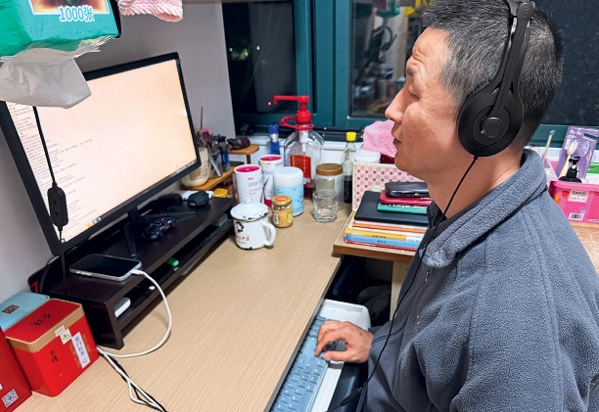
Bao Feng is reading a book on his computer.
Bringing Light into Darkness
In the exhibition hall of the Braille Library of China, there is a “Dark Room” to help visitors better understand the challenges people with vision impairment face. Once you enter the room, the door is closed, and you are asked to feel your way along the wall until you reach another door. For both Bao and Liang, a strong modern role model has been the life of Xu Bailun – affectionately known as “Grandpa Xu” to many visually impaired people in China. Born in 1930 Xu once enjoyed a successful life before losing his sight in 1971. After a struggle, he chose to see his blindness not as an end, but as the start of a new life dedicated to illuminating the lives of China’s blind. In 1985, he founded the Literature of Chinese Blind Children, the first extracurricular magazine for visually impaired children in China, which profoundly impacted countless lives, including Bao’s and Liang’s.
Over the past 40 years, renowned writers such as Gao Hongbo, Nie Zhenning, Liang Xiaosheng, Zhao Lihong, Xiao Fuxing, and Liang Heng have contributed inspiring literary pieces to the magazine, which has also published over 1,200 essays written by visually impaired children, giving them a platform for expression.
Xu’s work extended beyond publishing. In 1987, he designed the Golden Key Program, a public welfare initiative later promoted by the Golden Key Research Center of Education for the Visually Impaired. The program aimed to help visually impaired children in impoverished, remote, and ethnic minority regions of China gain access to quality education by promoting visual impairment education. It helped rural children to attend regular schools in their communities, thereby contributing to local sustainable development by establishing a three-tier provincial-municipal-county network based on existing special education resources.
Through those years, Xu together with his wife Ji Yuqin, traveled throughout China to help visually impaired children. Their work entered a new chapter when they retired in 2011. Even without an official role in promoting education program for visually impaired children, they remained actively involved in the lives of those they had previously helped.
In 2020, during the COVID-19 pandemic, many visually impaired people struggled to make an income as messages therapists due to a reduction in clients. Always ready to help the visually impaired community, Grandpa Xu and Grandma Ji, both in their 80s, set up a WeChat group called “Love One Another,” which grew into two groups with about 600 hundred visually impaired people – among whom Bao and Liang are two of the main managers of the groups.
Not Just Books, But Each Other
Now, with over 600 members, each of them donate at least RMB 10 a month, and as a result, they have helped 29 extremely disadvantaged families.
The platform offers more than just financial aid. It has a “Heart Station” for psychology, a “Massage Technique” section, a “Life Chats” column, and a monthly book club.
“Last time we discussed Moments We Shared, a novel written by Zhang Jiajia about hometown and nostalgia,” Liang told China Today.
Here, members are not just aid recipients but pillars of support for one another. Some record radio dramas, conduct interviews, and others help manage the platform. As Grandma Ji often tells her “children,” “You once received help from others. Today, you must share that love with those who share your affliction.”
From a 2.7 percent enrollment rate to accessing a vast ocean of information via screen readers, audiobooks, and AI; from just a single magazine to thousands of e-books available online – the reading environment for China’s visually impaired has witnessed a qualitative change. But the real transformation is in people’s lives.
Ahead of White Cane Safety Day in October 2025, China unveiled a series of tactile publications: China and World Maps, Touch Treasures of the Palace Museum and A Tactile Journey along the River during the Qingming Festival.
These are the nation’s first tactile maps in mass publication, and heritage touch-books published at the state level, designed especially for people with visual impairments.
“Maps are vital for national defense education; we can’t leave the visually impaired behind,” said Hao Gang, president of Star Map Press told reporters. “We wanted them to trace the contours of their own country with their hands, and to understand the meaning of China’s territory, airspace, and waters.”
The launch marks a major step in China’s ongoing push to make culture more inclusive and accessible.
Xu, Bao, and Liang’s stories show that for the visually impaired, reading is not merely “looking at books” or “listening to stories.” As Grandpa Xu often says, “Our children can do anything except see.” And reading is the first step they take to prove it.