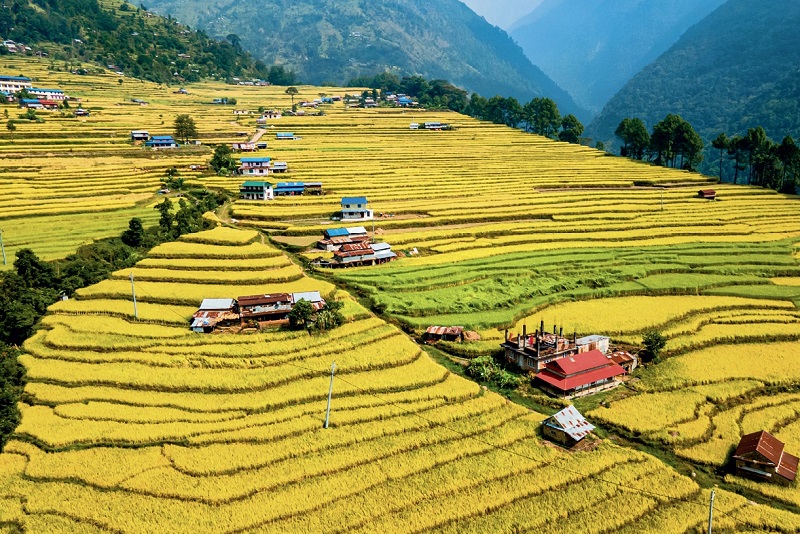
At dawn in the southern plains of Nepal, an elderly farmer scattered a handful of fertilizer over his rice paddy. Beneath his feet, the seedlings, yellowed and stunted from nutrient deficiency, drooped listlessly, untouched by his efforts.
He represents millions across Nepal who wrest their livelihood from harsh unyielding land.
“Is there still hope for these seedlings, Mr. Diwas?” he asked me. The helplessness in his eyes pressed against my chest like a stone.
I felt a profound sense of helplessness. As an agricultural officer who has worked in the government for 12 years, holding a master’s degree in agricultural economics and having taken part in shaping agricultural policies, I consider myself no stranger to determination. Yet all my efforts were constantly undermined by obstacles – they never reached the fields, never made a real difference, never changed the fate of impoverished farmers. I kept asking myself: Is there a resilient “seed” that could take root in Nepal and grow into a vision of hope and abundant harvests?
In 2019, I attended an agricultural seminar in China. The agenda covered high-yield hybrid rice, advanced agricultural machinery, and a production and sales chain linking farming, processing, and marketing. The experts spoke about sustainable development and urban-rural integration, discussing every aspect of these topics in detail. At the moment, I felt instinctively that China held the key to the vision I had been seeking. I eventually realized that wish in 2022, when I enrolled in the Institute of South-South Cooperation and Development at Peking University.
During my first class, the professor asked us to describe our country’s national conditions, comparative advantages, and development vision. When my turn came, I could only manage a wry smile before laying out the “negative list” of Nepali agriculture, a list that had been etched into my mind. Agriculture, though a pillar industry supporting 70 percent of the population, is beset by both natural and man-made calamities.
Nepal is known for its high mountains and hilly terrain, yet we grow rice as our staple food. In fact, only the southern Tarai lowlands, which accounts for just 17 percent of the national territory, have relatively fertile farmland. Moreover, the highly fragmented and steep terrain makes large-scale agricultural mechanization difficult across most of the country.
For Nepali farmers living near the Himalayas, climate change is neither a topic of international political maneuvering discussed by world leaders on the daily news, nor a set of formulas and data in scientific reports. For them, it is a stark and pressing reality: sudden cold snaps and heatwaves, increasingly depleted water sources, coupled with fragmented land ownership, disconnected markets, and a steady exodus of young adults seeking better opportunities abroad. The resources the government has invested in tackling these challenges are clearly far from sufficient.
International assistance has flowed into Nepal from organizations, nations, and individuals alike. While I am deeply moved by this goodwill – tangible in villages across our countryside – I must acknowledge an uncomfortable truth: much of this aid remains geographically scattered and has done little to strengthen national food security, agricultural sustainability, or balanced regional development.
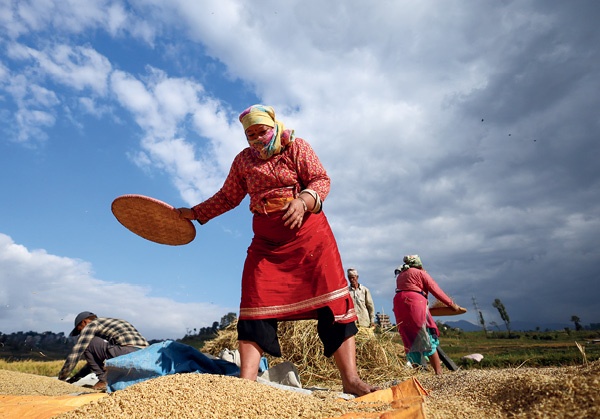
Nepali farmers winnow rice to separate the grain from the husks in a field in Patan, Nepal, on November 6, 2024.
These concerns also cast a shadow over Nepal-China agricultural cooperation and trade exchanges. A considerable number of Nepalis worry that once trade channels open, China’s high-quality, low-cost agricultural products might undermine our country’s already fragile agriculture.
Yet my perspective shifted fundamentally during my time in China. I have now returned to the Himalayan foothills with more than technical knowledge; I carried a new vision of possibility. In Bagmati Province, experts from China’s Yunnan Province are training local farmers in greenhouse seedling techniques, while researchers from Chongqing Academy of Agricultural Sciences are collaborating with our universities to develop new hybrid rice varieties adapted to our conditions.
What I found in China was not merely a seed that increases yield, but a seed of development itself — one, I believe, will take root and flourish on the southern slopes of the Himalayas, helping our agriculture forge its own unique path forward.
The courses at the Institute of South-South Cooperation and Development Institute offered me a different perspective. Professor Justin Yifu Lin, economist at Peking University, said that even the poorest countries can achieve significant progress by identifying and leveraging their comparative advantages.
This insight was an epiphany for me. I realized that perhaps I needed to re-examine Nepalese agriculture not as inherently deficient, but as underappreciated. What we lack is not potential, but rather an objective, incisive perspective to recognize it.
The Institute of South-South Cooperation and Development is unique, and I believe this is a consensus shared by every student who has studied there. Its uniqueness lies in the fact that the students are not passive recipients of knowledge, but practitioners seeking diagnostic tools for national development. Beyond theoretical frameworks, we value applicability; beyond lectures, we engage in vigorous debate, questioning, and probing assumptions.
During one memorable session, we spent hours arguing whether the “Chinese model” is replicable. The conclusion was unexpectedly clear: no one-size-fits-all development formula exists. What we learn from China are conceptual approaches and the wisdom of their application, not rigid templates.
At the Shenzhen Museum, standing before the “Pioneering Bull” sculpture, I gained visceral understanding of China’s developmental wisdom. In Nepal, we revere cattle as symbols of diligence and resilience. Gazing at that sculpture, I recognized the same spirit driving China’s development — the tenacity of sustained effort combined with the courage to break conventions and explore uncharted territory.
I also observed that even Shenzhen’s suburbs retain extensive high-standard modern farmland. Urban and rural, high technology and earthy tradition, do not oppose each other but form a symbiotic, mutually nurturing ecosystem.
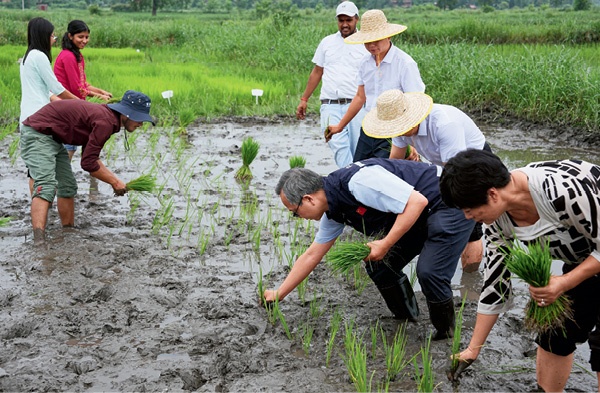
Chinese and Nepali agricultural experts transplant seedlings of hybrid rice in the Nepal Southern Agricultural Science and Technology Park in Chitwan, Nepal, on August 11, 2025.
 I further learned how agricultural cooperatives transform scattered individual farmers into cohesive collective, breaking the deadlock where farmers could neither afford equipment nor market their harvests effectively.
Now, I have resolved to move beyond anxiety and confusion. The path forward requires identifying critical leverage points, designing systematic, comprehensive support frameworks from an industry-wide perspective, and pursuing gradual, persistent progress. This is how Nepal will resolve its agricultural challenges.
Based on this, I determined the research topic of my doctoral dissertation: focusing on scientific fertilization.
However, decades of intensive cultivation have depleted essential nutrients from Nepal’s arable soils, making fertilizer application not merely beneficial but indispensable. While the government has sought to boost yields by increasing fertilizer subsidies and promoting scientific fertilization, these efforts have faltered at the farm level. Lacking adequate knowledge of recommended practices, farmers routinely apply either too much or too little. To address this gap, I designed a randomized controlled trial testing to see whether personalized educational interventions, grounded in soil testing, could improve fertilization practices.
The results of my experiment showed that educational interventions did improve farmers’ awareness of scientific fertilization. However, when it came to actually changing behavior, a single planting season of intervention was not enough to ensure that farmers strictly followed the recommended fertilizer amounts. A range of practical factors, such as farmers’ financial situations and market accessibility, influenced the outcomes. Beyond technology promotion, a comprehensive approach involving financial support, market access, and infrastructure development is necessary.
My dissertation supervisor at Peking University, Professor Xu Huayu, told me that my research had demonstrated the complexity of policy implementation — a very meaningful conclusion. My study can not only serve as a reference for Nepalese agriculture, but also offer insights for the agricultural modernization of other developing countries around the world.
This realization crystallized what I had been desperately seeking. The “seed” was never a specific variety of rice, nor a solitary policy fix. It is, instead, an entire system — the precise integration of technology, finance, markets, and infrastructure.
At my graduation ceremony last summer, I turned to my classmates and declared: “I have found it!”
A Chinese friend asked me, “With a Ph.D. from Peking University, won’t you join a more important ministry back home?” I answered without hesitation: “For Nepal, no sector is more vital than agriculture. That land is where I belong.” 
DIWAS RAJ BISTA is a Ph.D. graduate from the Institute of South-South Cooperation and Development at Peking University, who has nearly 16 years of experience working as an agricultural officer in the government of Nepal.