Zhang Aizhen, a Dong ethnic rural woman, is spearheading a group of Dong “aunties” revitalizing their once-impoverished village and improving their income in southwest China’s Guizhou Province, through livestreaming.
In 2022, Zhang Aizhen and her “auntie” colleagues embarked on a mission that would eventually change their lives. Dressed in the striking indigo traditional Dong ethnic attire, they faced a camera with apprehensive excitement about what was to come, and their livestreaming life began.
Coming from Yuezhai Village in Rongjiang County, one of the last areas in China that was lifted out of poverty, these Dong ethnic women hoped to sell their homegrown produce live online.
As the camera rolled, they greeted viewers awkwardly: “Hello… have you had dinner yet?” None of them knew what format a successful livestream was supposed to take, but they dived in bravely anyway. After three years of trial and error, their livestream room finally generated over RMB 1 million in sales in 2025, providing a vital income boost for many villagers and creating a proactive group of women in the process.
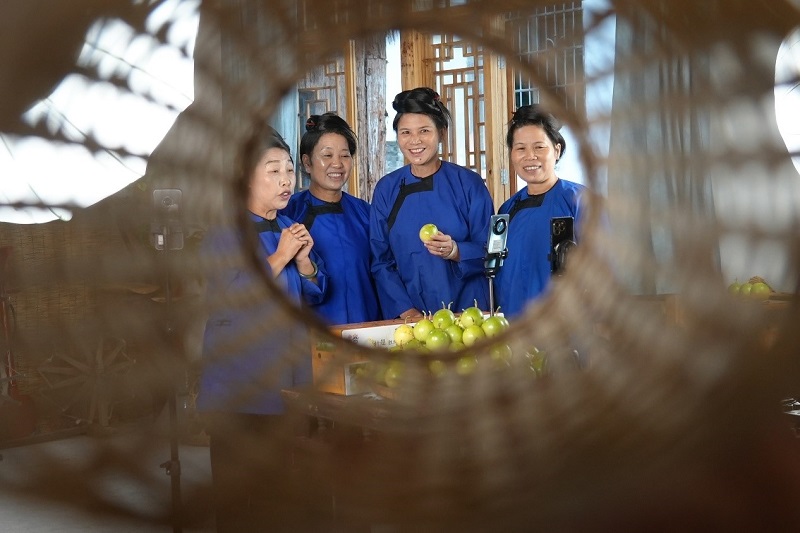
Members of the Yuezhai Anties Group are selling passion fruit online through livestreaming on September 25, 2025.
From Fields to Screens
In 2021, Zhang decided to get involved in livestreaming after hearing the local government’s call for turning smartphones into new farm tools, data into new farming supplies, and livestreaming into the new version of farm labor. To Zhang, livestreaming was not simply entertainment. She saw it as a new opportunity for rural women to promote their hometown and earn an income without leaving the village.
She initially recruited over 30 women, most of whom were middle-aged farmers and housewives with no livestreaming experience. The learning curve was steep. “It’s all Greek to me,” Zhang told China Today, struggling to grasp technical concepts like traffic algorithms and equipment names. Following an expert’s advice, they pivoted from hard-selling to storytelling, singing Dong songs, and sharing the daily rhythms of village life.
By day, the aunties labored in the fields — by night, they honed their livestreaming skills. For almost three years, they spent hours talking to empty livestream rooms, sometimes feeling as if they were speaking to themselves. Added stress came from caring for children while livestreaming, making the three-year journey ahead far from easy. There were arguments, tears, and moments when some of the women wanted to give up altogether. Only six of them persevered.
Zhang was instrumental in encouraging them to stick with it, reminding them that they were not livestreaming for fun; they were trying to create a better life together and bring more attention to their hometown. Last year, when morale was at its lowest, Zhang asked the group to persevere for six more months. “If we still can’t turn the tide after that,” she told them, “I won’t waste your time anymore.”
Deep down, Zhang never gave up on the idea of livestream e-commerce. One day, while serving watermelon to visitors at a village football match, a young woman from Beijing told her it was “the best watermelon” she had ever tasted. Zhang had an epiphany: if people in big cities struggled to find such fresh produce, why not sell their homegrown fruits online?
Still, Zhang refused to give up. After learning that Dong Lu, a famous Chinese football commentator and livestreamer, had been invited to serve as the honorary head of Yuezhai Village, she summoned the courage to leave him a message online.
“I want to sell my homegrown vegetables and fruits through livestreaming,” she wrote, “but I don’t know how. Can you teach me?” Zhang didn’t expect a reply.
But on August 26, 2025, while the women were livestreaming as usual, Dong joined their livestream room and began promoting their products. Within minutes, orders started flooding in. The women stared at the screen in disbelief as the sales figures soared.
That night alone, their sales topped 2,700 orders of passion fruit, something that had never before been achieved in the village. From August to October that year, they then helped more than 100 local growers sell their passion fruit online. After years of setbacks and persistence, their efforts had finally paid off.
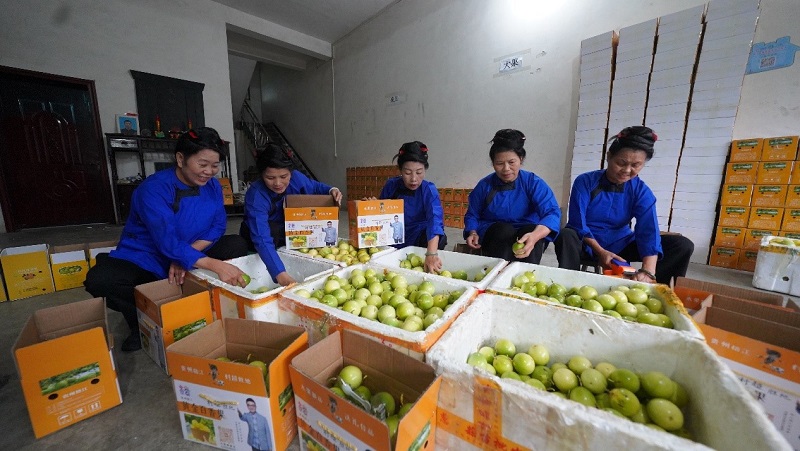
Members of the Yuezhai Anties Group are packaging up passion fruit for sale.
More Than Livestreamers
Wearing traditional Dong ethnic clothing, Zhang led her group of aunties, along with other women from Yuezhai Village to carry wooden trays filled with traditional Dong ethnic food, like sticky rice and pickled fish, as well as their homegrown cucumbers, tomatoes, and watermelons to share with visitors. Some even decorated themselves with whimsical vegetable necklaces and handmade aprons woven from beans and peppers. This became one of the most memorable scenes of the Village Super League.
During halftime, Zhang encouraged the women to dance despite having had no rehearsal. As music sounded, they casually danced the square dances they usually practiced in the village, instantly energizing the crowd. Videos of the aunties cheering, dancing, and serving food spread rapidly across social media, and netizens affectionately called them the Yuezhai Aunties Group.
What started as spontaneous cheering at football matches gradually gave the women a new sense of confidence and responsibility. As the Yuezhai Aunties Group became increasingly popular during the Village Super League, the women also became more deeply involved in village affairs. Whether welcoming visitors, organizing performances, or helping coordinate activities, they were no longer simply farmers appearing online occasionally. They had become one of the most active community groups in Yuezhai Village.
Their resilience was truly tested on June 24, 2025, when devastating floods struck the county. Zhang was one of the first people to step forward. At 6 a.m. the next morning, she gathered members of the Yuezhai Aunties Group and asked them to harvest vegetables from their own fields, such as eggplants, tomatoes, bitter melons, and watermelons. Within a single day, the women made more than 1,000 boxed meals for rescue workers and flood victims. In addition, that evening, they provided free accommodation for more than 200 frontline rescuers.
Over the following weeks, the women remained constantly involved in the disaster relief efforts. They cooked meals, delivered supplies, prepared cooling desserts for exhausted rescue workers in the summer heat, and joined cleanup operations in flooded neighborhoods. Spurred on by Zhang’s organization, villagers also donated vegetables, pork, and other daily necessities to support rescue teams working around the clock. Their actions soon inspired many more villagers to volunteer.
The group’s actions deeply moved rescuers who had traveled from across China to help Rongjiang. According to Zhang, some rescue workers later told her that during previous disaster missions, they often survived on instant noodles and dry food, but in Rongjiang, they received hot homemade meals prepared by local people.
When Rongjiang later invited rescue teams back for a thanksgiving event after floods had subsided and the county reopened, several teams specifically asked to return to Yuezhai Village. Some even arrived carrying banners reading, “Yuezhai Aunties Group, we came back as promised.” Rescue teams later sent handwritten letters and handmade commemorative plaques to thank the women, while many stayed connected through online chat groups named “One Loving Family.”
In the Dong culture, Sama, the Great Grandmother, is revered as a guardian figure who watches over the community. That ancient spirit lives on in Zhang and the Yuezhai Aunties Group. Whether in the muddy fields, the bustling football stadium, or the digital glow of a livestream, they have become a beacon of care, resilience, and devotion.