In February 2021, China announced its elimination of extreme poverty for the entire country. Seven counties in south China’s Guizhou Province were part of the last areas to be removed from the poverty list. Entire villages located in remote mountainous areas unsuitable for sustainable development were moved by the government into apartment complexes in suburban areas. Today, five years have passed, and many Western media reports express doubt about whether China’s program has been successful and propose that many people lapsed back into poverty. To better understand the lives of people who had been lifted out of poverty, I visited Congjiang and Rongjiang counties in southeast Guizhou to ascertain whether the doubts reported by Western media were valid.
What I found was more than just statistics, but rather a living tapestry of resilience, hope, culture, and unexpected opportunity.
Art Inheritors Passing on Ethnic Culture Heritage
In Rongjiang County, I met Wu Songtao, a resident at the Tehe Community relocation site. Wu is a fifth-generation inheritor of Dong ethnic embroidery, a craft known for its intricate animals and floral motifs. Before relocation, her family lived in the remote Piaozhai Village, Zhaihao Town, Rongjiang County. “We could only grow a few vegetables to make a meager living,” she told China Today. “We lived in poor, living conditions, and [to make matters] worse, our traditional art passed down from my mother was dying."
Then came the move. With the explosive rise of the Guizhou Village Super League, a popular grassroots football event, the massive influx of visitors brought enormous business opportunities to Rongjiang County. Due to Wu’s skill in Dong ethnic embroidery and batik making, she was soon recognized as a fifth-generation inheritor and is now able to translate her traditional craft into a source of income at the community’s Intangible Cultural Heritage Center workshop. The ethnic clothes she makes by hand, along with dolls, T-shirts, and scarves featuring Village Super League motifs, have become highly popular at the intangible cultural heritage stalls set up beside the football field.
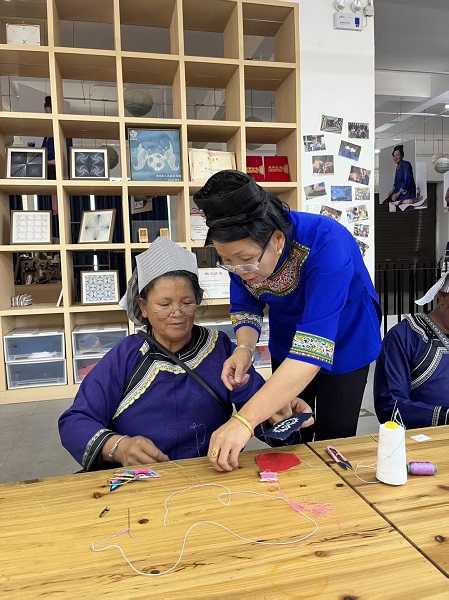
Wu Songtao (right) instructs a woman on how to make Dong ethnic hand crafts, preserving her family cultural tradition and as well as helping other people not return to poverty.
Wu’s family was given a bright, modern apartment in a new suburban community. Freed from the backbreaking labor of subsistence farming, she now has time and space to promote and pass on her family’s cultural heritage. During the 2023 Village Super League finals, she earned over RMB 8,000 in a single day. Inspired by her success, nearly 50 women in the community have joined her handicraft workshop.
Today, she has built a thriving business from Dong embroidery, training over 70 other women between the ages of 30 and 70 in the art of Dong embroidery, turning a dying family tradition into a collective enterprise. Using livestreaming, local stores, and online platforms, they now sell their cultural products across China. “Thanks to the subsidy from the government, my family is now living in a community of apartments provided for relocated villagers, where we enjoy convenient medical, educational, and employment services."
Young People Finding Passion in Life
The goal of relocation is not just to move bodies, but to change futures. Ouyang Ban is proof of that. Growing up in the mountainside Daxiu Village, a Zhuang ethnic community nestled deep in the mountains of Xiutang Township, Congjiang County, he had to travel three hours to and from school by foot. With seven family members, their annual net income was less than RMB 10,000. In 2019, his family voluntarily applied for relocation and moved into a 120-square-meter apartment at the Yinxin Community, at no cost to his family. Unlike his childhood, Ouyang’s children now attend a school that is just a few minutes’ walk from their home.
But Ouyang was not satisfied working in the city. With government support, Ouyang started up an agricultural company of farming passion fruit. Today, his company is an example of how the government has helped local people find a sustainable way of making a living. For Ouyang, his income has gone from a few thousand yuan a year to few hundred thousand yuan. More importantly, he actively helps university students, creating a virtuous cycle where relocation leads to local prosperity and directly benefiting society.
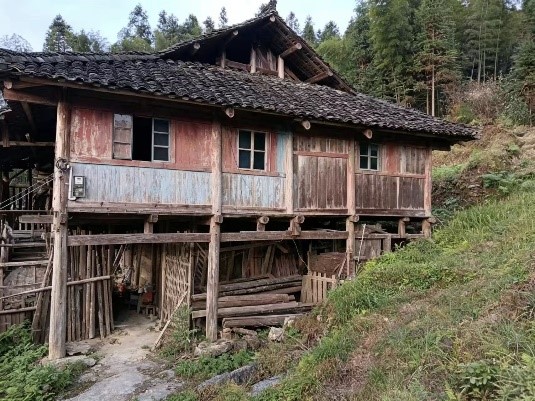
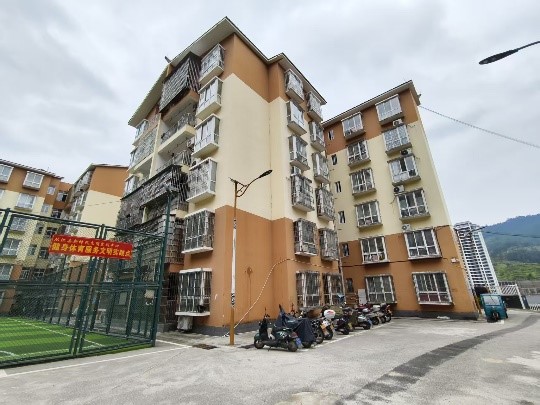
The contrast of Ouyang’s former family house in the mountainside Daxiu Village (left) and the newly built apartment complex (right) in the Yinxin Community, Rongjiang County reflect the improved life he has experienced after being relocated in 2019.
Children Thriving with Improved Education
For many, the change is less about entrepreneurship and more about the quiet dignity of stable daily life. Huang Dehua and his family are residents at the Yinxin Community relocation site in Congjiang County. His family was relocated from a village deep in the mountains, isolated by poor transportation and affected by barren land, where crop yields were meager. In 2019, Huang Dehua voluntarily applied for relocation and moved into an apartment complex equipped with elevators.
In April 2024, he founded Congjiang Huizhong Labor Service Co., Ltd, which focuses on addressing employment challenges for relocated residents by helping them find local job opportunities to ensure they have a sustainable source of income. The company has since enabled 60 relocated residents to secure steady employment.
One of the biggest changes after his family moved was his children’s education. “Their grades improved by leaps and bounds,” he said proudly. While talking to him, I noticed that the wall in his living room was covered with awards of excellence his two children had received for school grade results. When asked what had changed in his children’s attitude toward education, he said, “The quality of education received here, along with the improved living conditions, has greatly motivated my children to learn.”
Woman Enabled to Make Their Own Living
Wu Bangzhu is a mother from Rongjiang. Her story represents the most vulnerable demographic: women with young children. After she and her husband applied for relocation from the mountain region, she tried selling fruit on the street while taking care of her two young girls. It was exhausting and unsustainable.
She was then recruited to a new kind of workplace: a Mother-Friendly Workshop. This small workshop, specializing in Dong ethnic embroidery and cultural products, is designed specifically for women. It allows flexible hours, and woman can bring their children with them to work. After training, Wu, was accepted and began her career.
She now works as a floor manager, following up on orders and designing new products. “I not only earn a good salary,” she said, “but I get to help other women, young wives, and single mothers make a living. We come here, we work several hours, and those who need to can pick up their children from the kindergarten or return home to take care of their elderly relatives. This is the job security we never could have imagined in the mountains.”
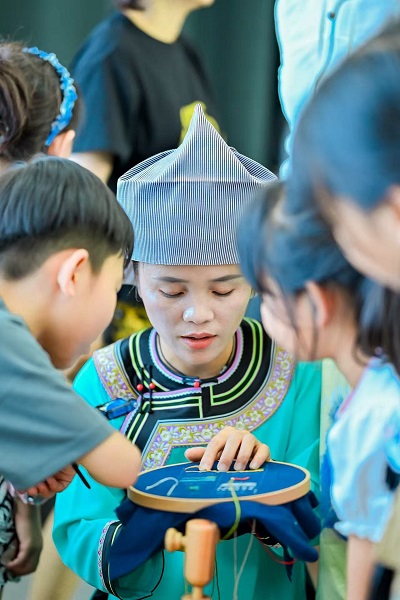
Wu uses her job make a living as well as teaches children how to better appreciate Dong ethnic hand crafts.
A Long-Term Strategy, Not a Short-Term Goal
To understand why China’s poverty alleviation through relocation program is a success, one must understand the government’s network of policies behind the newly built apartments and relocated communities. In an interview with Pan Shihua, director of the Human Resources and Social Security Bureau of Congjiang County, he told China Today how the local government achieved poverty alleviation and continues to maintain the goal of keeping people out of extreme poverty.
He detailed a three-pronged strategy that directly counters Western claims of “short-termism.” First, outward migration: they help relocatees find stable jobs in nearby cities, with legal protections and transport. Second, inward employment: they help relocated families find employment within local companies or institutions. Third, entrepreneurship: they provide micro-finance and subsidies for relocatees to start their own small businesses, from agriculture companies to centers for promoting traditional intangible culture heritage handcrafts of Miao, Dong, Yao and other ethnic minorities.
In addition to finding employment, the government provides free services for each community at their doorstep. According to Wei Lingyu, Secretary of the Party Branch of Yinxin Community, Binmei Street, there is a “One-Stop Community Service Center,” located conveniently on the main street outside the apartment complex. “The biggest fear of a relocatee is not just poverty,” she explained. “Our work is to provide free and convenient services to meet the basic needs of our community from medical to education."
At this center, everything is free, funded by a mix of employed staff and volunteers. There is medical care, and after-school childcare and tutoring. There are cultural activity rooms where members of different ethnic groups teach ethnic musical instruments, handcrafts, ethnic dances, and so on. This not only provides for the social and cultural needs of local people but also helps preserve and pass on their traditional traditions to the next generation. There is a kindergarten inside every apartment complex, and an elementary school minutes away. This safety net—health, education, employment, and social fabric—holds the whole relocation initiative together.
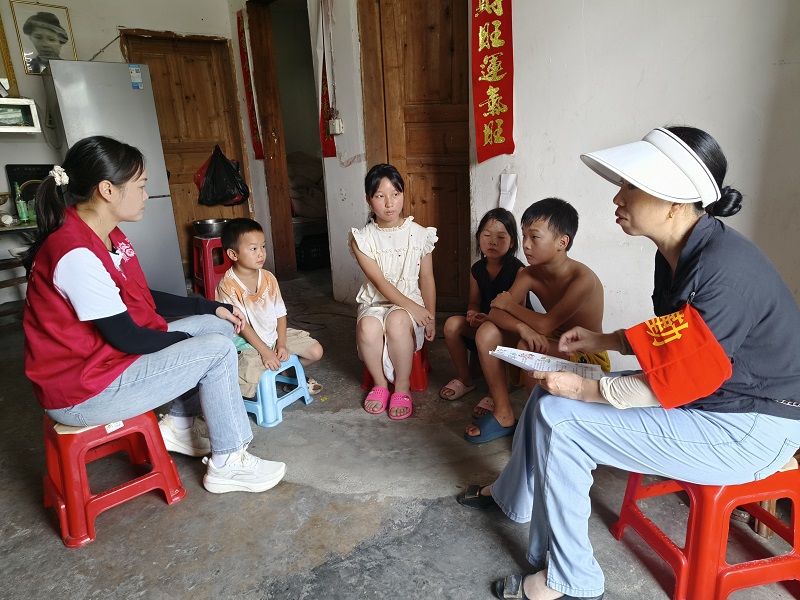
The grid community worker Liang Shaoyan and local Party village secretary Yang Jiuhong of the Toutang Village, Rongjiang County, visit children in their home to educate them about safe rules of living on July 30, 2025.
In addition to this, China’s government combines housing with grid-based management systems. Every relocated family is digitally tracked. A community grid attendant monitors each family lifted out of poverty to make sure their sustainable development needs are met. They contact each family and individual on a weekly basis to see how they are doing and whether they need assistance. Such detail and responsibility helps to guarantee the people who are lifted out of extreme poverty will not return to their former plight.
The Credibility of Concrete Evidence
Walking through communities in Rongjiang and Congjiang, the narrative of “failure” peddled by some Western media outlets could not be further from the truth. Though transition is never easy, not one person I spoke to would trade their present home, salary, and way of life for their previous life. The supposition of a “large-scale poverty relapse” by Western media simply has not happened.
This is not “campaign-style governance.” This is a systemic, long-term, data-driven maintenance—and it is working. The tradition of Dong embroidery is preserved, the passion fruit of Congjiang is feeding a new generation, and mothers like Wu Bangzhu can look forward to the future of her children with hope and confidence.
The doubt of Western media, when scrutinized against the clean and comfortable apartments, lively schoolchildren excelling in nearby schools, and happy employed adults providing for their family needs in Rongjiang and Congjiang, has no validity. The dark cloud of extreme poverty has been lifted from Guizhou Province and China is making sure it will not return.