Located in north China, the area of the present-day Inner Mongolia Autonomous Region – stretching over 2,400 kilometers east to west and 1,700 kilometers north to south – has been home to various ethnic groups throughout history. Today, numerous treasures that have endured through millennia stand as evidence of this history in the Inner Mongolia Museum.
With a total floor area of 147,000 square meters, the museum houses 209,000 pieces (sets) of historical artifacts, including 487 first-grade national treasures. Among its most prized exhibits are the Painted Wooden Coffin from the Liao Dynasty (916-1125), Gold Crown with Eagle-Shaped Ornament from the Warring States Period (475-221 B.C.), “Made by Xiao Song” Incense Burner from the Yuan Dynasty (1271-1368), and Gold Antler-Shaped Buyao from the Northern Wei Dynasty (386-534).
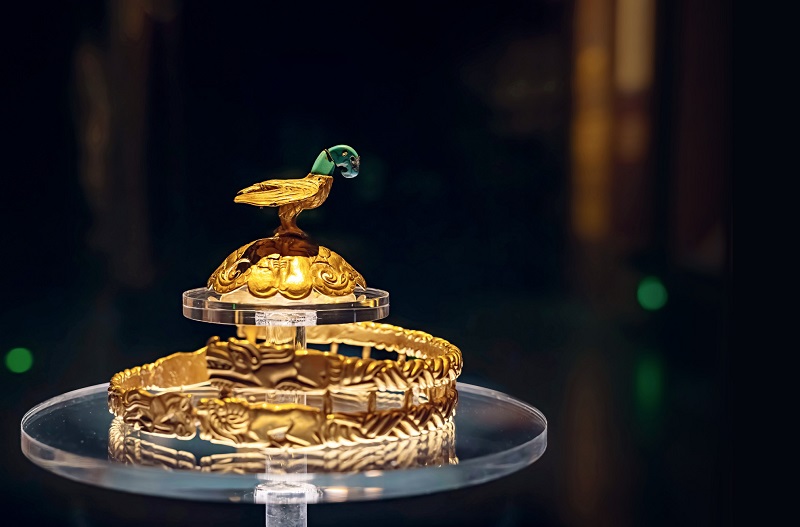
The Gold Crown with an Eagle-Shaped Ornament from the Warring States Period (475-221 B.C.) seen on display at the Inner Mongolia Museum.
An Exquisite Coffin
In 2003, an intact Khitan noble tomb of the early Liao Dynasty was unearthed at the foot of Mount Tuerqi in Tongliao City, Inner Mongolia. Remarkably well-preserved after more than 1,000 years, the most stunning discovery in the tomb was a painted wooden coffin, now on display at the Inner Mongolia Museum.
The Liao aristocracy practiced lavish burial customs, placing many treasures in graves to demonstrate wealth and power. This coffin consists of an outer container and inner container as well as a coffin platform, divided in eight sections. Painted mainly in red and black, it is richly adorned with motifs of cranes, phoenixes, peonies, and auspicious clouds. Details are ingeniously designed: one side of the outer coffin features a small door with a gilt bronze lock, flanked by painted guards holding weapons; in front of them, an arched bridge symbolically connect the coffin to the ground; bells hang on the edges; and the inner coffin lid is decorated with gilded dragons and flying phoenix patterns.
Experts concluded that the tomb’s owner died in her thirties, and traces of mercury found in her remains suggest possible poisoning. Although no epitaph was found, clues point to her noble status and religious role. A large number of bronze bells – tied around her feet and hung around the coffin – along with a gold circlet resembling a traditional shaman’s headdress, indicate that she was likely a high-ranking female shaman.
Historical records show that, like many northern ethnic groups of ancient China, the Khitan people practiced shamanism. Shamans, serving as mediators between humans and deities, were most often women. The religious identity of this tomb’s owner lends the coffin an air of mystery, which has inspired numerous references in films and novels, making this remarkable relic widely known to the Chinese public.
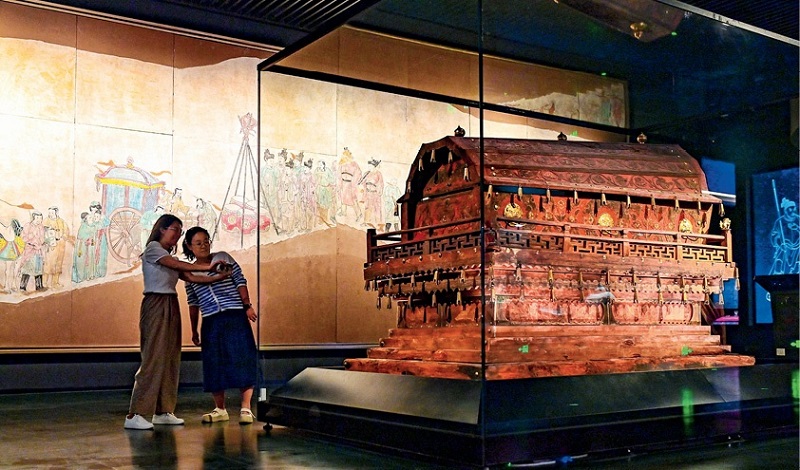
Visitors photograph the iconic Painted Wooden Coffin from the Liao Dynasty (916-1125) at the Inner Mongolia Museum.
Nomads’ Gold Crown
The Gold Crown with Eagle-Shaped Ornament from the Warring States Period is believed to have been the crown of a Xiongnu (nomadic people who inhibited the eastern Eurasian Steppe from the third century B.C. to the late first century A.D.) ruler. It was discovered by a herder in Inner Mongolia in 1972.
“It once sat atop the head of a Xiongnu tribal king as a symbol of supreme power, witnessing his command over the vast steppes,” said Zheng Chengyan, deputy director of the Inner Mongolia Museum.
Known for its distinctive design, this crown comprises three parts: a golden band, a hemispherical crown top, and an eagle-shaped ornament. The head of the gold eagle atop the crown is made of turquoise embellished with gold eyes, adding an extra air of vitality and artistry to the piece. The bird’s head, neck, and tail are connected by fine gold wires, allowing it to move side to side. It is not hard to imagine that when the wearer galloped across the grassland, the eagle would appear to come to life with motion.
Why an eagle on the crown? Nomadic peoples worshipped the sky, so the eagle dominating the skies naturally became a representative of this belief. Beneath the eagle’s talons, a dramatic scene unfolds – four wolves chase four sheep, capturing a moment of an intense hunt. Further down, the engraving on the golden band portrays another hunting scene featuring a tiger, a sheep, and a horse.
“This is the only known crown of any ethnic minority group found in China to date,” said Zheng. This extraordinary artifact, rooted in China’s grassland civilization, is a vivid expression of the nomads’ reverence for strength and admiration for nature.
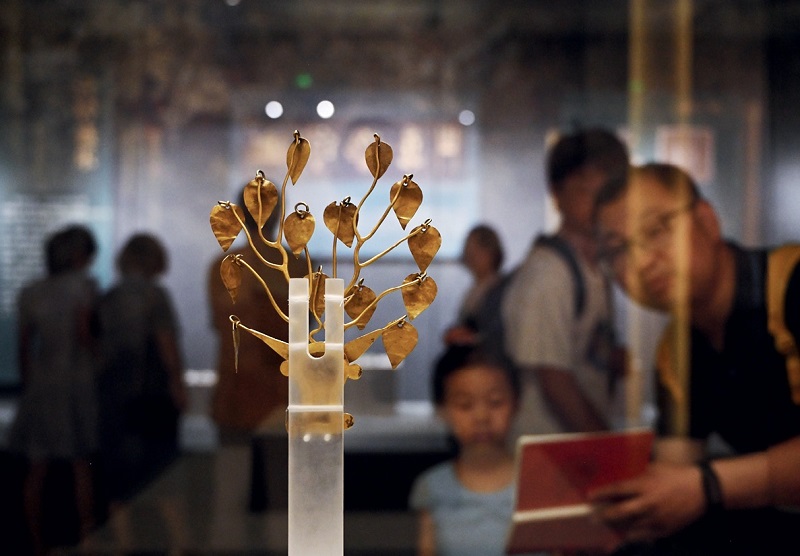
Visitors admire the Gold Antler-Shaped Buyao (hair pin with small dangling decorations) from the Northern Wei Dynasty (386-535) at the Inner Mongolia Museum.
 An Incense Burner
The “Made by Xiao Song” Incense Burner from the Yuan Dynasty is the largest, and most complete Jun ware incense burner ever discovered in China. It was thus recognized as a national treasure.
Many wonder why a crown jewel of Jun ware was unearthed in Inner Mongolia, hundreds of kilometers away from this porcelain genre’s crafting hub in the Central Plains. This piece was unearthed near Baita Village on the eastern outskirts of Hohhot City, Inner Mongolia’s capital. During the Liao Dynasty, this area was part of the Fengzhou City. Thanks to its geographical position and convenient transportation, Fengzhou was an economic and cultural center linking north and south China, and even the East and West. The region continued to thrive as a trade center during the Yuan Dynasty.
This item features a round belly, three animal-shaped legs, and a neck decorated with three qilin (the sacred Chinese unicorn). On the front is a square inscription that reads “Made by Xiao Song on the 15th day of the ninth month in Year Jiyou.” According to scholars, this object was likely a porcelain product made in the Central Plains for export, and “Xiao Song” is the name of the craftsman responsible for its creation.
Historical records indicate that during the Liao and Yuan dynasties, commercial and handicraft industries were the pillars of Fengzhou’s economy, with porcelain and silk as its primary goods. A mix of ethnic groups speaking different languages lived there in harmony, fostering a diverse culture. Standing 42.7 centimeters tall, the burner breaks the long-held Jun ware practice of “not exceeding one chi (approximately 33.3 centimeters).” Its design embodies the bold style of the Yuan Dynasty, while its glaze and craftsmanship continue the refined traditions of earlier Central Plains ceramics – a blend of Han culture and northern nomadic civilization.

A new facility of the Inner Mongolia Museum opens for trial operation to the public for free admission on June 20, 2025.
An Antler-Shaped Accessory
More than 1,500 years ago, the Xianbei people in today’s Inner Mongolia were known as a “people on horseback.” These brave, bold warriors appreciated beauty. The Gold Antler-Shaped Buyao (hair pin with small dangling decorations) from the Northern Wei Dynasty stands as an example of their artistic preferences and cultural identity.
Crafted entirely from gold, this exquisite ornament stands 16.2 centimeters tall and weighs about 70 grams. Its base is shaped like a horse’s head, from which branch out deer antlers whose curled tips hold thin gold leaves. The horse head and antlers are inlaid with beads, and the leaf-shaped pendants sway gracefully with each step of the wearer – hence the name buyao (which means “sway as you walk”).
This ornament embodies the typical northern nomadic aesthetic, featuring animals commonly seen on the grassland such as horses and deer, instead of the phoenix and floral motifs popular in the Central Plains at the time.
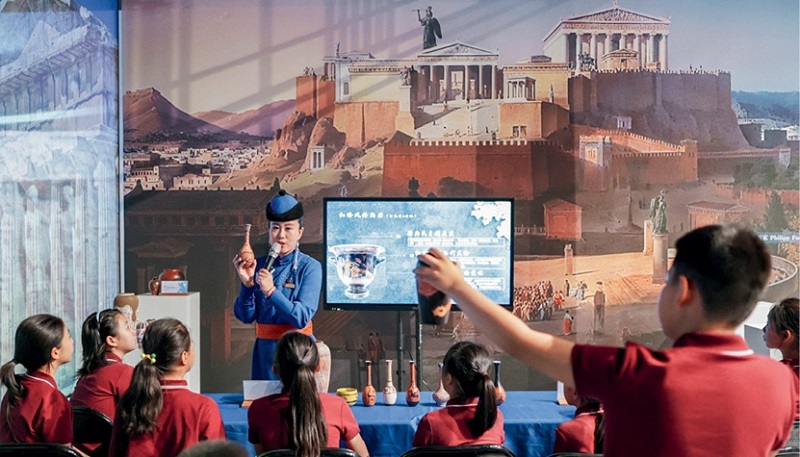
A museum staff member teaches a group of children about archaeology at an interactive zone in the Inner Mongolia Museum.
Educational Programs
As a public cultural institution, the Inner Mongolia Museum also carries out a wide range of educational activities throughout the year. Drawing on its rich exhibit resources, the museum engages the public through thematic exhibitions, guided tours, research-based learning programs, youth camps, and intangible cultural heritage workshops. These interactive experiences help more people gain a deeper understanding of grassland culture and the history of northern ethnic groups.
Earlier this year, the museum launched an outreach program, bringing courses into schools across Hohhot. In one example, at a jade-themed course students learned about the ancient jade-making techniques such as material selection, cutting, carving, and polishing through images, videos, and on-site demonstrations. Students are also encouraged to create their own works, discovering the cultural meaning behind the traditional Chinese saying, “A gentleman’s virtues are like jade.”
In addition, the museum hosts online lectures and exhibitions, expanding its reach through digital technology and attracting broader public engagement with regional cultural heritage. Through these initiatives, the Inner Mongolia Museum serves not only as a vital window into grassland culture, but also as an important platform for Chinese culture preservation.