In the early morning in Caoyang Xincun in Putuo, Shanghai, tree shadows sway along the banks of the Huanbang Brook. Old residents stroll and chat along the path, young tenants hurry through the alleys about their daily routines, and foreign visitors wander among the red-roofed old buildings, savoring the unique local charm and atmosphere of this neighborhood. It's hard to imagine that this vibrant community is already 75 years old. Rather than relying on large-scale demolition and reconstruction, the neighborhood has opted for in-situ organic renewal, creating a 15-minute living circle that is friendly to people of all ages, allowing historical memories and modern life to coexist harmoniously.
Glorious Memories
Caoyang Xincun, built in 1951, was the first workers' new village in the newly established People’s Republic of China. It was once home to model workers and advanced workers, and became well known as the "Model Workers’ New Village." At the time of its construction, these small Western-style houses, with red roofs, white walls, kitchens, and bathrooms, were considered luxurious by Shanghai standards. Being able to live here was a significant mark of honor and privilege at the time.
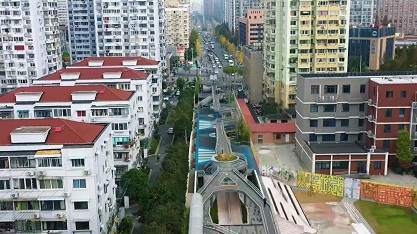
The revitalized Caoyang Xincun has transformed the former railway market into the popular Baixi Park
However, after more than half a century of use, the old residence has gradually failed to keep up with the demands of modern life. Hong Gang, a community resident in his seventies, recalled, "At that time, three families shared one large cooking stove. The bathroom was only about one square meter, and we had to use a big round bucket to bathe at home, which was very inconvenient." The original layout of the historic buildings has become increasingly unable to accommodate the needs of modern family life. Caoyang Xincun has pursued preservation and renovation through multiple rounds of minor updates, rejecting demolition and reconstruction while striving to protect its historical fabric and preserve the collective memories of a generation.
A Tailored Approach for Every Household
In 2019, Caoyang Xincun initiated a systematic renewal plan, with Zhou Haibo, Deputy Chief Engineer of Tongji Urban Planning and Design Institute in Shanghai, serving as the community planner. He noted, "Within the two-square-kilometer area of Caoyang Xincun, buildings are densely packed, leaving very little space for new construction." How to tap into underutilized spaces and genuinely address residents' needs became the core of the renewal effort.
To address this challenge, the team came up with an approach called "one household, one tailored plan." Designers develop customized renovation plans for each household based on its specific needs. When renovating Hong's house, special consideration was given to providing space for a washing machine and ensuring access for maintenance. The air well was set back to expand the kitchen and bathroom, addressing the longstanding problem of multiple households having to share these facilities.
The updates are not limited to indoor spaces; public areas are also being upgraded at the same time. The previously blocked Huanbang waterway has now been fully unblocked; the former railway market has been transformed into the popular Baixi Park; and the community also offers a range of public services, including a canteen, a health service station, and a childcare center. The subdistrict office regularly organizes street-walking workshops, where urban planners lead residents on walks through the community to collect their feedback. Zhu Jia, the head of the Community Service Office of Caoyang Xincun Subdistrict, explained: "Residents mentioned the lack of a cafeteria and the need for a walking path, so we have implemented these small but meaningful improvements one by one during the renewal process." In this way, residents have transformed from mere observers of the renovation into active participants in the renewal and governance of their community.
Everyday Warmth Brings New Friends Together
Beyond hardware upgrades, digital services expand the boundaries of community governance. The Caoyang community has launched a mobile app, providing an overview of 344 public service locations. Senior club reservations, meal assistance, medication delivery, registration, and other livelihood services can all be handled online, ensuring that the benefits of digitalization reach every group in the community.
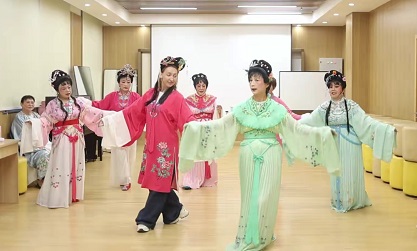
Foreign friends take part in traditional Chinese opera classes organized by the Caoyang Community.
The updated Caoyang not only retains its old residents but also attracts new faces. Shao Xiaolu, a young tenant, remarked, "The transportation here is convenient, and the living facilities are complete. If I don't feel like cooking, I can go to the community canteen. It's convenient to see a doctor at the nearby clinic, and in my free time, I can go to the park. The neighbors are also very warm-hearted." Yang Jingzhuo, an international student from France at Shanghai University of Finance and Economics, was drawn to the community's vibrant atmosphere. He said, "There is no hustle and bustle like in the busy downtown area. The locals are warm and friendly, and one can truly feel the blend of historical heritage and modern life."
The renewal of Caoyang Xincun is a practice woven with warmth and wisdom. It does not pursue dramatic, ground-up transformations, but instead employs meticulous craftsmanship, akin to "holding a dharma assembly in a snail's shell," respecting historical memories while balancing the practical needs of different age groups—elders, middle-aged people, youth, and children. This approach ensures that long-time residents can live comfortably and happily, while newcomers find a sense of belonging. Within the community, the daily lives and simple joys of ordinary people are harmoniously integrated, vividly portraying the well-being and prosperity of the people along China's path toward modernization.