Chinese President Xi Jinping’s frequent engagements with Spanish Prime Minister Pedro Sánchez underscores the value of cooperation that transcends differences.
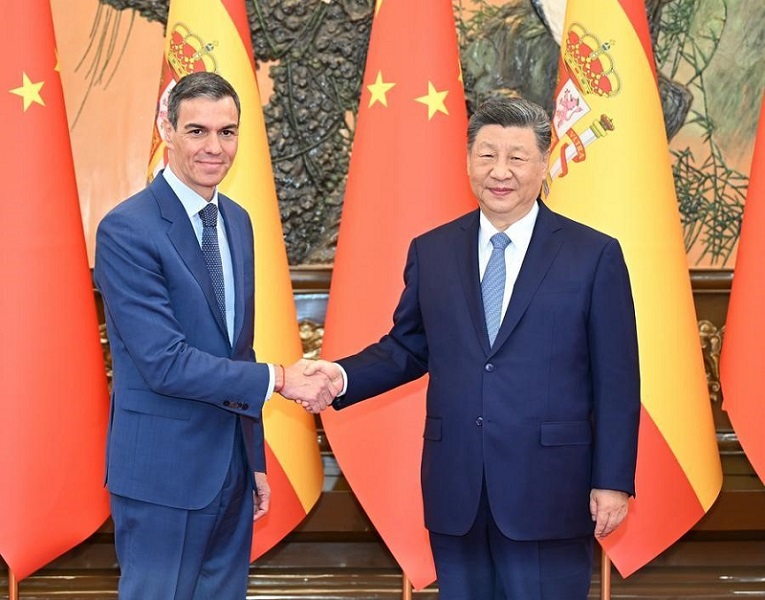
Chinese President Xi Jinping meets with Spanish Prime Minister Pedro Sanchez, who is on an official visit to China, at the Great Hall of the People in Beijing, capital of China, April 14, 2026. (Xinhua/Li Xiang)
In recent years, frequent high-level exchanges between Chinese and Spanish leaders have become a standout of China-Spain relations. On April 14, 2026, Chinese President Xi Jinping met with Spanish Prime Minister Pedro Sánchez, which marked Sánchez’s fourth visit to China in four years. Since Sánchez took office in 2018, the two leaders have maintained regular engagement through face-to-face meetings and phone conversations.
The two leaders have met every year since 2023, while sustaining dialogue via phone calls during the pandemic. That continuity reflects more than diplomatic routine – it points to a shared determination to deepen cooperation, sustain strategic communication, and keep bilateral ties moving forward in an increasingly uncertain world.
Xi has long attached great importance to fostering sound relations with Spain. During his visit to Spain in 2018, Xi told Sánchez that China always cherishes the traditional friendship with Spain and highly values Spain’s important role in international affairs. Last year, as the two sides marked the 20th anniversary of their comprehensive strategic partnership, Xi reaffirmed China’s readiness to work with Spain to build a more strategically resilient and dynamic comprehensive strategic partnership.
This April, Xi reiterated that the two sides should always prioritize the development of bilateral relations in their respective foreign policies. This commitment comes amid intensifying geopolitical volatility and economic uncertainty. “Despite the changing and turbulent international landscape, China–Spain relations have developed steadily, forging a relationship with strategic resolve,” said Xi.
As Xi summarized, an important aspect of such a relationship lies in the ability to make the right decisions based on common interests. This shared foundation has been steadily translated into practical cooperation, giving the bilateral relationship substance and durability beyond political rhetoric.
Economic interdependence remains the backbone of this relationship. China is Spain’s largest trading partner outside the European Union (EU), while Spain is China’s fifth-largest partner within the bloc. In 2025, the bilateral trade volume in goods between the two countries surpassed US $55 billion, up 9.8 percent year-on-year.
Beyond trade, industrial cooperation is moving into higher-value areas. The CATL-Stellantis battery project in Aragón and Chery’s new-energy vehicle production line in Barcelona reflect a broader shift in cooperation toward green industries, advanced manufacturing, and innovation-driven development. These projects are not only commercially significant, but also show that the two economies are finding common ground in sectors that will shape future growth.
However, the relationship is not defined by economic cooperation alone. People-to-people exchanges have also gained strong momentum, lending warmth and resilience to bilateral ties. Educational links are also expanding. China is home to two Cervantes Institute centers and over 100 universities offering Spanish majors, while Spain hosts 10 Confucius Institutes, with more than 60,000 students learning Chinese.
Cultural exchange has also become increasingly vibrant. The 2025 Spanish Arts Festival in Shanghai, staged across landmark venues on the Bund, offered Chinese audiences an immersive encounter with Spanish heritage and creativity. In Madrid, Spring Festival celebrations drew more than 100,000 participants, underscoring how cultural curiosity and mutual appreciation are deepening alongside economic ties.
Xi told Sánchez that the two sides should seize opportunities, jointly pursue innovation-driven development, strengthen cooperation in areas such as trade, new energy, and smart economy, and encourage exchanges in culture, education, scientific research, and sports, so as to bring about more outcomes in the comprehensive strategic partnership and deliver greater benefits to the two peoples.
Sánchez’s visit has delivered a substantive set of outcomes, turning political consensus into concrete cooperation. During the visit, Chinese Premier Li Qiang and Sánchez jointly witnessed the signing of 15 cooperation documents spanning economy and trade, education, agriculture and food, science and technology, and other areas. The agreements signal not only a broadening of bilateral cooperation but also a clearer direction for its future development.
More importantly, these agreements point to a more balanced and forward-looking collaboration. China has expressed its willingness to expand imports of high-quality Spanish products, particularly in the agri-food sectors, while encouraging capable Chinese enterprises to increase their investment in Spain. For both sides, this reflects an effort to address the trade gap through greater market access, deeper industrial collaboration, and more reciprocal engagement.
From Madrid’s perspective, cooperation with China is increasingly seen as strategically useful, especially in emerging sectors such as new energy, advanced manufacturing, and technological innovation. In a context of global economic uncertainty and supply chain restructuring, closer ties with China are expected not only to stimulate growth but also to enhance industrial resilience and improve the ability to respond to shared challenges.
Spain’s recent foreign policy choices have underscored this emphasis on principle and autonomy. On issues ranging from the Gaza conflict to defense spending and to the Iran war, Madrid has taken a posture that is often more independent of the influence of Washington, advocating greater European strategic autonomy and a more balanced engagement with emerging partners. Such positions suggest that Spain is increasingly willing to define its interests on its own terms.
Against this backdrop, Xi’s call for China and Spain to strengthen communication, consolidate mutual trust, and work closely together to reject any backslide into the law of the jungle, carries broader significance. Both countries see value in resisting a drift toward power politics and in safeguarding a rules-based international order anchored in the United Nations and international law. Their shared support for multilateralism, inclusive globalization, and a more balanced multipolar system reflects converging strategic instincts in an era marked by fragmentation and uncertainty.
Sánchez’s response was consistent with this outlook. He told Xi that, faced with a complex and challenging international situation and multiple recurring conflicts and disputes, only by adhering to multilateralism and fostering a multipolar world can lasting peace be achieved for humanity.
In a meeting with King Felipe VI of Spain on November 12, 2025, Xi said that China values the traditional friendship with Spain and its unique role in international and regional affairs. He emphasized China’s readiness to work with Spain to forge a comprehensive strategic partnership with greater strategic determination, dynamism, and global influence.
Taken together with the frequent high-level engagements between leaders on both sides, these interactions point to a relationship that is steadily maturing. At a time of shifting global alignments, China–Spain cooperation is increasingly becoming a bridge between China and the EU as well as a stabilizing force for the world, demonstrating the enduring value of dialogue, cooperation, and mutually beneficial partnership.