In 1959, a democratic reform began in Xizang, leading to the emancipation of millions of serfs. This was a landmark event in the anti-slavery history in China and the world at large.
In the spring 67 years ago, an earthshaking reform unfolded in southwest China’s Xizang. On March 28, 1959, China’s State Council assembled a committee to prepare for the establishment of the Xizang Autonomous Region. It marked the beginning of democratic reform of the region. Millions threw off the shackles of serfdom and for the first time, stood tall as a human being in the land where they had lived for generations.
We honor this period of history for millions who were emancipated from the whip of serfdom. The remembrance also carries contemporary significance – to reclaim the true meaning of human rights often misconstrued in the international community.
From Talking Livestock to Dignified Citizens
Prior to 1959, Xizang had languished in unfathomable darkness governed by a theocratic system of feudal serfdom. About 95 percent of its population were serfs and slaves, who were deprived of all basic rights including the rights to life, liberty, property, and dignity. By that time, even though the Universal Declaration of Human Rights had been accepted by the international community for over a decade, serfs in Xizang could not enjoy the most fundamental right to survival. They were treated as “talking livestock” which could be sold, mortgaged, or transferred anywhere at the will of their masters.
Things began to change after the region’s peaceful liberation in 1951. The rights of Chinese citizens were enshrined in the Constitution in 1954. Then in 1959, a democratic reform began in Xizang, leading to the emancipation of millions of serfs. This was a landmark event in the anti-slavery history in China and the world at large. As masters of their own, people in Xizang were able to contribute unprecedented creativity and enthusiasm to local development, transforming Xizang’s economy and society with each passing day.
The significance of this reform extends far beyond China’s borders. It stands as another milestone in human civilization following the abolitionist movements in Europe and the United States, as well as exemplifies the Enlightenment ideal, which says all human beings are born free.
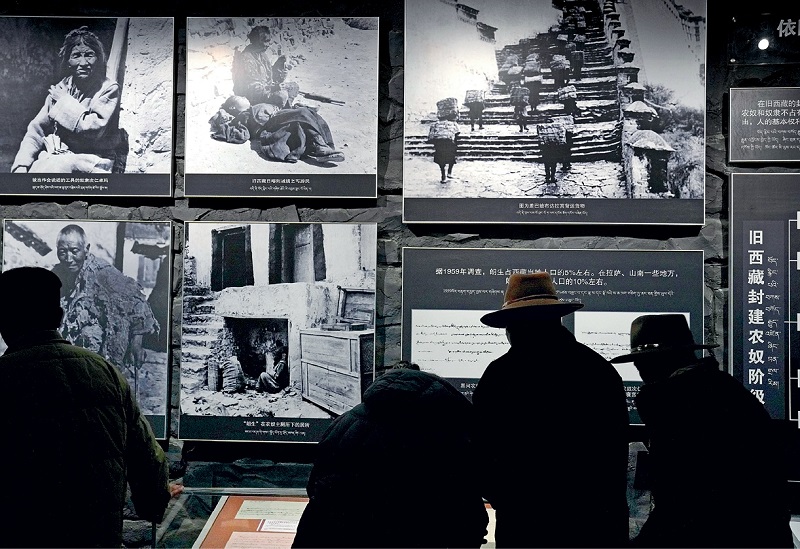
Visitors at an exhibition in the Memorial Hall for the Emancipation of One Million Serfs in Xizang on March 28, 2026, which is the 18th Serfs’ Emancipation Day.
Echoes of History
Sixty-seven years after the start of the democratic reform in China’s Xizang, the United Nations adopted a historic resolution on the enslavement of Africans. On March 25, 2026, the UN General Assembly passed a resolution declaring the transatlantic slave trade the gravest crime against humanity.
The resolution declares the trafficking of enslaved Africans and racialized chattel enslavement of Africans as the gravest crime against humanity by reason of the definitive break in world history, scale, duration, systemic nature, brutality and enduring consequences that continue to structure the lives of all people through racialized regimes of labor, property, and capital. It emphasizes that claims for reparations represent a concrete step toward remedy.
The resolution spearheaded by Ghana received 123 positive votes. Three countries – Argentina, Israel, and the United States – voted against it and 52 abstained, including the U.K. and all the 27 European Union member countries.
“Today, we come together in solemn solidarity to affirm truth and pursue a route to healing and reparative justice,” said Ghana’s President John Dramani Mahama ahead of the vote on behalf of the 54-member African Group, the largest regional bloc at the UN.
Esther Phillips, the Poet Laureate of Barbados, challenged the international community to act on reparations for the consequences of the transatlantic slave trade and slavery with two poems. “There are spirits of the victims of slavery present in this room at this moment, and they are listening for one word only: justice,” Ms. Philips told delegates. “Because for them and for the world, there can be no peace without justice – reparatory justice.”
By contrast, the U.S. representative said in his speech, “The United States also does not recognize a legal right to reparations for historical wrongs that were not illegal under international law at the time they occurred…The United States strongly objects to the cynical usage of historical wrongs as a leverage point in an attempt to reallocate modern resources to people and nations who are distantly related to the historical victims.”
The British representative also justified his country’s opposition by saying, “The U.K. is firmly of the view that we must not create a hierarchy of historical atrocities…No single set of atrocities should be regarded as more or less significant than another.”
The remarks by the U.S. and U.K. are utterly hypocritical. Some Western countries have dodged, downplayed, or even outright denied their involvement in African slave trade — the gravest violation of human rights in history. At the same time, they pose as “human rights defenders,” pointing fingers at other countries regarding human rights. In the case of China’s Xizang, some Western people turn a blind eye to the emancipation of millions of serfs and the ensuing remarkable progress of the economy, society, and human rights in the region, while at the same time, they distort facts to smear China.
Truth Vs. Fallacy
In its preamble, the UN Charter states, “We the peoples of the United Nations determined…to reaffirm faith in fundamental human rights, in the dignity and worth of the human person, in the equal rights of men and women and of nations large and small…” The Universal Declaration of Human Rights, adopted in 1948, further outlines fundamental rights and freedoms for all individuals.
When some Western countries refuse to take responsibility for slavery, the most heinous crime against humanity in history, how can they retain any credibility on the issue of human rights?
When the anti-China forces in the West work together with the Dalai clique to persistently undermine China’s national unity, economic growth, ethnic solidarity, and development in Xizang, how can they brazenly harangue about human rights?
The Chinese people have learned from its century-long history of foreign invasion and oppression: there is no guarantee for human rights protection without national unity, ethnic solidarity, and social stability. In 1888 and 1903-1904, British forces invaded Xizang on two occasions, severely violating local people’s rights to life, freedom, and dignity.
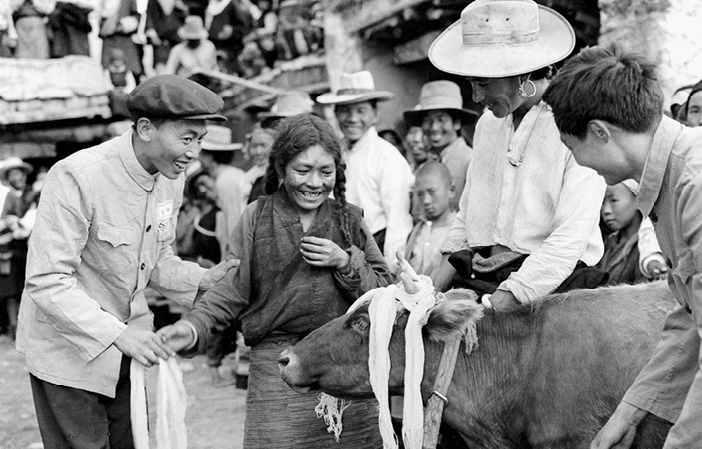
Newly freed serfs receive means of production from the government during the democratic reform. Chen Zonglie
Indisputable Facts
Facts speak louder than words. Sixty-seven years after the democratic reform, Xizang has made tremendous progress in human rights protection, which has translated into tangible improvements in all aspects of society.
As of 2025, the total mileage of operating highways in the region had reached 125,200 kilometers. The Golmud-Lhasa section of the Qinghai-Xizang Railway was expanded and renovated, and the Fuxing high-speed train now reaches Lhasa. Four electricity transmission routes were built, forming a power grid that covers the entire plateau. At the end of 2019, Xizang eradicated once and for all absolute poverty, which had plagued it for centuries. Since 2015, its growth rate in per capita disposable income has ranked first nationwide for 10 consecutive years. The average life expectancy of local people also more than doubled from 35.5 years in 1959 to 72.5 years in 2025.
These statistics show a life of fulfillment, happiness, and security, which is the very essence of human rights progress.
Even more noteworthy is how the development in China’s Xizang presents a unique development approach from which other developing countries can learn. During each session of the Forum on the Development of Xizang, the reality that participants from all over the world including political leaders, scholars, and journalists witness for themselves the region’s socioeconomic development and human rights achievements shatter the biased perceptions of Xizang forged by Western media. Those from Asia, Africa, and Latin America are particularly eager to learn about the formula of Xizang’s success, believing it is highly valuable for addressing the challenges facing underdeveloped regions.
Seeking Justice
Sixty-seven years ago, the liberation of millions of serfs in Xizang marked a historical advancement in the fight against slavery in the world. This year, the UN resolution that declares transatlantic slave trade the gravest crime against humanity is a historic, though belated, step toward justice. Yet the pursuit of justice should not stop here.
If the slave trade is recognized as a crime against humanity, should not feudal serfdom be seen as equally evil? If European colonizers must be held accountable for the historical crimes they committed, should not the serf-owners in Xizang also be required to face the judgement of history? If looted artifacts should be returned to their countries of origin, should not we restore the historical memory and cultural dignity once denied to Tibetan people? These questions press for answers as we celebrate the 67th anniversary of the emancipation of Tibetan serfs.
The democratic reform ushered in a new era for human rights on the plateau 67 years ago. Today, Xizang stands proudly as a living testament to true, meaningful human rights progress. No slander or distortion can change the history or obscure the truth. 
The Chinese version of this article was first published in the Potala magazine.