Strategic planning and development of future industries have far-reaching impact on national economic and social development, national security, and international competitiveness.
Chinese Premier Li Qiang delivered the government work report on March 5, 2026, which not only set out specific requirements for the cultivation and expansion of future industries, but also specifically indicated the need to develop new professions for the development of such industries. Policy orientations in areas such as manufacturing, rural revitalization, people's livelihood, and green transition also show the opportunities available in future industries.
Currently, rapid technological revolution and industrial transformation have reached unprecedented levels. Chinese President Xi Jinping emphasized the necessity to promote breakthroughs in the development of China’s future industries from the perspective of building a strong country and pursuing national rejuvenation.
At the dawn of the 15th Five-Year Plan period (2026-2030), while facing a complex international competitive landscape and the internal demands of high-quality domestic development, it is imperative to plan scientifically and coordinate comprehensively. This will help to understand the development patterns of future industries, build on China's industrial foundation and comparative advantages, and pool the efforts of all stakeholders from the government to research institutions, in order to steadily advance the high-quality development of future industries. This is a crucial step in accelerating the formation of new quality productive forces and seizing future development opportunities.
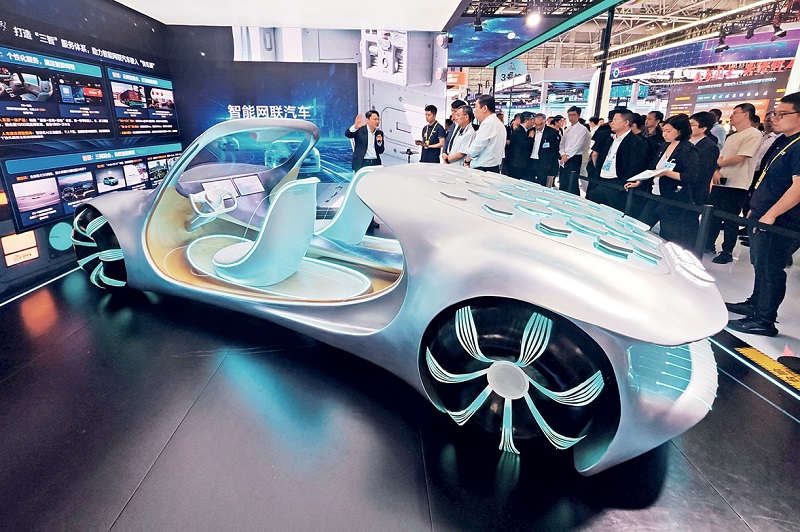
A concept car is exhibited at the 8th Digital China Summit in Fuzhou, Fujian Province, on April 28, 2025.
Strategic Significance
Future industries are forward-looking industries driven by cutting-edge technologies, currently in the early stages of industrialization, and possessing the potential to develop into leading or pillar industries. Being disruptive, they can break existing technological dependencies, give rise to new products, new business forms, and new models, and trigger deep industrial restructuring. As the technical routes and business models of future industries are still evolving, the country needs to move away from short-term profit thinking and adopt long-term planning. Given the higher level of uncertainty concerning technological breakthroughs, market expansion, and policy environments, their cultivation requires a clear understanding of risks and prudent responses.
The strategic planning and development of future industries in the current era will have a major impact on China’s economic and social development, national security, and international competitiveness.
New quality productive forces, with technological innovation as the core element, are breaking away from traditional modes of economic growth and paths of productivity development. Future industries, meanwhile, serve as the primary application platforms for frontier and disruptive technologies, and will be key to cultivating and developing new quality productive forces. By accelerating breakthroughs and integrating underlying technologies such as quantum computing, artificial intelligence, and synthetic biology, future industries will help upgrade total factor productivity. This will inject new momentum into China's steady transition beyond the middle-income trap and its pursuit of high-quality development.
Major-country competition is currently focused on elements underpinning technology and industry. Whoever can master core cutting-edge technologies and lead the pack in building future industrial ecosystems will be able to dominate global rule-making, standard-setting, and value chain division. Future industries are becoming the strategic high ground for reshaping new global competition. A forward-looking layout of future industries not only helps China to progress from “following” to “leading” in international competition, but also overcomes external technological barriers, boosting national development and security.
Industrial evolution has continuity. Future industries will not only create entirely new economic opportunities but also exert a strong technology spillover effect. The next generation of information technology, new materials, and biotechnology, nurtured by future industries, will enter manufacturing and agriculture, effectively driving them toward high-end, intelligent, and green development. Consequently, China’s industrial and supply chains will become more resilient, accelerating the construction of an autonomous, controllable, safe, and efficient modern industrial system. In essence, future industries are the engine driving a modern industrial system.
Practical Verification
China's future industries are at a critical stage of transitioning from laboratory research to industrialization, and from “separate breakthroughs” to “chain collaboration.” Their development will be determined by the speed, breadth, and depth of technological breakthroughs.
China's future industry development exhibits three notable characteristics. First, there is a high reliance on innovation and interdisciplinary integration, resulting in a significantly shortened technology iteration cycle. Second, the supporting role of scientific and technological infrastructure is increasingly evident, with large-scale scientific facilities becoming incubation cradles for future industries. Third, regional agglomeration effects are beginning to emerge, with regions possessing strong research capabilities and complete manufacturing bases leading the way. The exploration and practice in the Guangdong-Hong Kong-Macao Greater Bay Area clearly illustrate this evolutionary trend.
As one of the most economically vibrant and innovative regions, the Greater Bay Area has shown strong momentum in future industries, and provides valuable replicable experience for the whole country. Taking the synthetic biology industry as an example, the Greater Bay Area has explored an original innovation transformation model centered on “large-scale scientific applications plus industrial parks.”
Synthetic biology is regarded as the third biotechnology revolution, and the industry is facing extensive technical barriers. The Guangming Science City in Shenzhen, Guangdong Province, has established the world's first major sci-tech infrastructure for synthetic biology, promoting deep integration of information technology and biotechnology. This government-led infrastructure significantly reduces research and development costs for research teams and startups.
Based on this, local innovation has created an “innovation and entrepreneurship complex” model — researchers focus on innovation, while enterprises focus on engineering technology breakthroughs and commercial incubation. This model bridges the institutional boundaries between science and industry, effectively resolving the dual challenges of future industries, namely achieving original breakthroughs and engineering transformation.
Taking the humanoid robot industry as an example, the Greater Bay Area has demonstrated the accelerator effect of the “complete manufacturing base and abundant application scenarios” on future industries. As the carriers of embodied intelligence, humanoid robots not only rely on breakthroughs in large language models and audiovisual algorithms but also require support from high-performance micro motors, reducers, high-precision sensors, and other core components.
The Pearl River Delta region, meanwhile, possesses the world's most complete supply chain for electronic information and electromechanical manufacturing. This means that once cutting-edge algorithms or core components achieve laboratory breakthroughs, they can be quickly applied by suppliers in the Greater Bay Area, enabling low-cost, high-quality prototype manufacturing and small-batch trial production.
In addition, the Greater Bay Area’s advanced manufacturing, modern logistics, and specialized operation demands provide humanoid robots with abundant early trial-and-error opportunities and application scenarios. This highly efficient loop of “algorithm iteration-hardware prototyping-scenario validation” demonstrates China's unique competitive advantage in the future industrial race that comes from its strong manufacturing foundation.
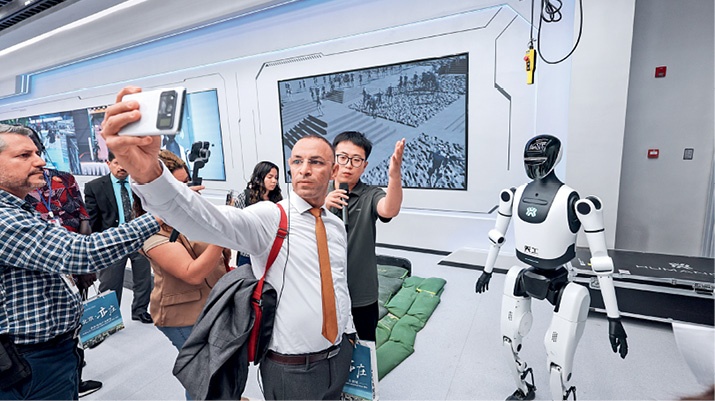
A foreign journalist takes a selfie with a humanoid robot in the exhibition hall at the Beijing Economic-Technological Development Area on September 29, 2025.
Scientific Deployment
The 2026 government work report has mapped out a blueprint for cultivating and expanding emerging and future industries this year. China possesses the world’s most complete industrial system, a super-large domestic market, a vast and multi-tiered pool of scientists and technicians, as well as the advantage of the new system for mobilizing resources nationwide to tackle major tasks, which provide fertile ground for the growth of future industries. However, shortcomings still exist in the depth of basic research, the self-reliance rate of fundamental core technologies, the sci-tech evaluation system, and the supply of "patient capital.” Some areas also face the risk of blind following and homogeneous competition.
To accomplish the tasks set for the 15th Five-Year Plan period and promote high-quality development of future industries, it is necessary to not only adhere to scientific demonstration and cater to local conditions but also strengthen the technological foundation. Future industries will have diverse paths and directions, so development should be tailored to the industrial foundation and resource conditions of each region. In this way development will become differentiated and supplementary across the country. Moreover, basic research underpins all technical issues, so it is essential to systematically deploying major sci-tech projects to enhance the strategic foresight of frontier technologies. To build a sustainable long-term mechanism for future industries, I have the following policy recommendations:
First, strengthening systematic planning and institutional supply, optimizing the industrial ecosystem, and enhancing top-level design and differentiated layout. At the national level, coordination and overall planning should be strengthened, and the future industrial development roadmap should be dynamically updated. Local governments need to maintain strategic resolve, focus on local advantages and characteristics, and concentrate on cultivating one or two niche sectors. This will create internationally competitive future industry pilot zones, and accelerate the formation of industrial clusters.
Meanwhile, “patient capital” should be expanded and the fault-tolerance mechanism improved. In view of the large investment, long cycle, and high risks of future industries, government funds should be used to guide social capital to invest in emerging sectors, in small businesses, over the long term, and in key technologies. A sound institutional environment that encourages innovation and tolerates failure should be established, along with an inclusive and prudent regulatory model.
The government should lead the construction of online platforms for the release of achievements and trading of products in future industries. In doing so, the government opens early application scenarios to innovative enterprises in public sectors such as transportation, healthcare, and government services, hence assisting new technologies in achieving preliminary market validation.
Second, it is necessary to focus on breakthroughs at the grassroots level and institutional reform, clearing the bottlenecks in the application of innovation results and facilitating original breakthroughs. Universities and research institutes should take their responsibility as the main force in basic research, break down disciplinary barriers, and produce original results with global impact in cutting-edge fields such as quantum science, life sciences, and deep-sea and deep-space exploration.
Deeper reform should be conducted for the sci-tech evaluation system. This includes incorporating the disruptive impact, industrialization prospects, and market application value of scientific and technological achievements into core evaluation indicators, to stimulate the motivation of researchers.
Collaborative innovation platforms should be built integrating industry, academia, and research and establishing innovation consortiums with leading enterprises. This can ensure the balance between basic research and industrial demand and connect laboratories with production lines.
Third, it is necessary to leverage the role of leading enterprises. State-owned large enterprises and leading technology companies should be forward-looking, launch future industry initiatives, and proactively plan for the future by securing corporate venture capital and building open-source ecosystems. This can facilitate collaboration among upstream and downstream enterprises to construct self-controlled industrial ecosystems.
Small and medium-sized enterprises should be guided to follow a “specialized, refined, distinctive, and innovative” path. Emerging technology startups should precisely identify niche fields within a broad landscape and focus on key materials, core components, or specific algorithms to become champions in their respective fields, gaining a footing in the supply chain of leading enterprises with their strong technological capabilities.
Efforts should be intensified to translate technological advances into products and innovate business models. Enterprises must firmly establish a market-oriented approach, converting technological advantages into leading product experience. While promoting cutting-edge technologies, they should also explore suitable new business models, continuously iterate through rapid market feedback, and achieve the dual goal of technological breakthroughs in future industries and commercial application.
QU SHENNING is a researcher at the Institute of Industrial Economics, Chinese Academy of Social Sciences.