In the five years since China’s eradication of absolute poverty, the steady transformation of Guizhou’s formerly destitute counties showcase how strategic relocation, thriving signature industries, and responsive governance can propel communities toward an undreamed of future.
In March 2026, Financial Times correspondent William Langley dusted off a hackneyed trope in his article titled, “China said it ended poverty. Did it?” By zooming in on the austere lifestyle of an elderly Dong woman in southwest China’s Guizhou Province, the piece implied that China’s victory over absolute poverty was little more than a statistical sleight of hand.
Yet, upon venturing into the heart of Guizhou’s mountainous interior, our reporters discovered a totally different reality.
Formerly marooned and destitute in the highlands of Congjiang County – one of the last in China to shake off poverty – we found formerly impoverished villager Chen Yanmei now sitting and weaving handicrafts in the spacious living room of her modern apartment at Yinxin Community, a relocation site in the county seat. Thanks to the flexibility of the local “Queyi Employment Workshop,” whereby work may be done at home, Chen earns around RMB 3,000 a month. She receives another RMB 5,000 from her husband, who works in Huizhou, Guangdong Province. This is a world away from the days when “mountains were high, roads were long, and children had to scale two peaks just to reach school.” Best of all, this 100-square-meter apartment was provided, free of charge, by the state.
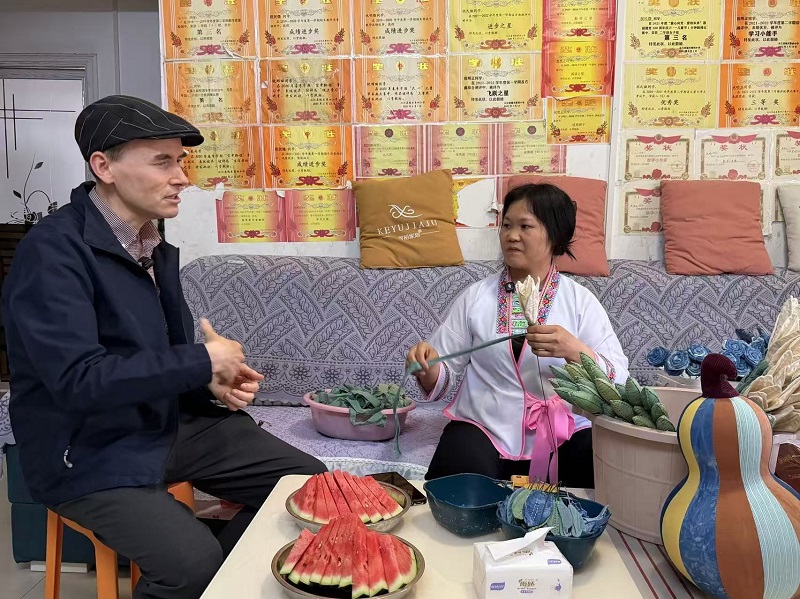
Chen Yanmei is interviewed at home by China Today reporter Zachary G. Lundquist on May 8, 2026. Having formerly dwelt amid Rongjiang’s remote mountains, Chen relocated to Yinxin Community of the county seat, Guizhou Province, in 2019.
As veteran journalist Bai Yun of Guizhou Radio TV Station put it: “The relocation of millions of people out of isolated mountain depths, from land that could not sustain its people, to a reality where people could move out, settle down, and get rich, is nothing short of a miracle.” China spent eight years (2012-2020) waging the largest poverty alleviation campaign in human history. Much more than just an economic achievement, it constituted a profound advance toward securing people’s rights to survival and development.
Bai still remembers his 2019 reporting trip to Huishui County and the deep impression left on him at seeing portraits of President Xi Jinping and Chairman Mao Zedong hanging – unbidden – on the walls of relocated families’ homes. “It was spontaneous,” Bai told China Today. “The relocation policy fundamentally altered the fate of these people. Their gratitude is hence straight from the heart.”
Beyond Relocation: The Architecture of Lasting Support
But moving impoverished people out of remote mountains was only the first step. Could they build stable lives in towns and cities? And would those who escaped poverty achieve sustainable income streams? These were the focal points of Western skepticism, as well as the questions China had to answer.
Li Yongqing, deputy director of the Bureau of Agriculture and Rural Affairs in Rongjiang County, another latecomer to the poverty-exit list, outlined the county’s multi-pronged employment-boosting policy. “Every spring, we organize charter transport for local able-bodied workers to partner cities like Guangdong’s Foshan and Sichuan’s Chengdu, so that they aren’t alone in migrating,” he explained. “For those who need to care for family, we offer public welfare jobs, like street cleaning, river patrols, and forest ranger roles – so that they can earn locally.” Li then highlighted the transitional policy (2021–2025) of allocating annual industrial subsidies of up to RMB 20,000 per household. “Whether you want to raise pigs, chickens, or grow crops, this money goes directly to the household. It solves the ‘capital shortage’ problem.”
For ethnic communities, Rongjiang found another path: that of linking enterprises to artisanship. Wu Songtao is a prime example. Since moving from a deeply mountainous village to the county seat, her traditional Dong embroidery and batik skills have, thanks to the irresistible popularity of the “Village Super League” (Cun Chao), been much sought-after. Wu crafts ethnic clothing and Cun Chao-themed dolls at the Intangible Cultural Heritage Center in her community. On the day of the 2023 finals alone, she earned over RMB 8,000 through sales to visitors of her hand-made products. Today, nearly 50 women work alongside her, so converting heritage into a paycheck.
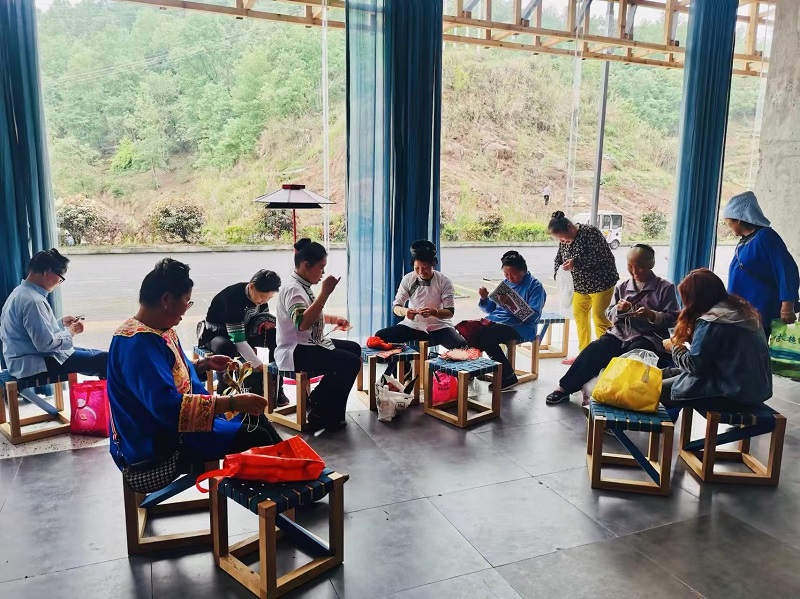
Wu Songtao (Center) works with fellow artisans at the Intangible Cultural Heritage Center in Rongjiang’s Tehe Community.
Neighboring Congjiang County has pioneered its distinctive approach to boosting employment and stabilizing incomes. By leveraging a network of “community service stations” and “village-level employment coordinators,” the county meticulously gathers data on labor availability and job preferences. It then mobilizes resources – including community casual work hubs, village working teams, and external liaison offices – to deliver precise job placement services and vocational training.
A robust package of subsidies backs these efforts. For example, migrant workers who secure stable employment for three or more months outside the province each receive a one-off travel grant of RMB 500 per person. Meanwhile, college graduates (within two years of graduation), people experiencing employment difficulties, migrant workers, and demobilized military personnel that establish micro-enterprises which maintain operations for a year or more are eligible for a RMB 5,000 start-up subsidy.
“Congjiang’s focus encompasses the building of such prefecture-level labor brands as ‘Yao Medicinal Bath Therapists,’ ‘Congjiang Construction Technicians,’ and ‘Congjiang Passion Fruit Growers.’ We also foster county-level brands – such as ‘Dong Folk Singers’ and ‘Rural Artisans’ – to give local workers greater leverage in salary negotiations,” Pan Shihua, director of Congjiang’s Human Resources and Social Security Bureau, told China Today.
Ouyang Ban’s story testifies to the effectiveness of these systemic support efforts. His seven-member household formerly scraped by on less than RMB 10,000 a year. Post-relocation, he started a passion fruit plantation business. His annual income now ranges between RMB 200,000 and RMB 300,000. “Life has changed dramatically,” he affirmed. “Children are near schools, and elderly folk have easy access to clinics.”
The experiences of such erstwhile impoverished households reflect the core logic of China’s anti-poverty campaign: that of a systematic endeavor to relocate people from inhospitable areas, transform their livelihoods, and eliminate the roots of poverty. During the 13th Five-Year Plan period (2016-2020), China invested approximately RMB 600 billion to relocate over 9.6 million registered impoverished residents from uninhabitable areas, and the newly established resettlement zones saw a rapid expansion of supporting infrastructure. More than 6,100 primary and secondary schools and kindergartens were newly built or renovated, alongside over 12,000 hospitals and community health service centers. Congjiang’s rural per capita disposable income has grown from RMB 11,100 to RMB 16,300 in the last five years.
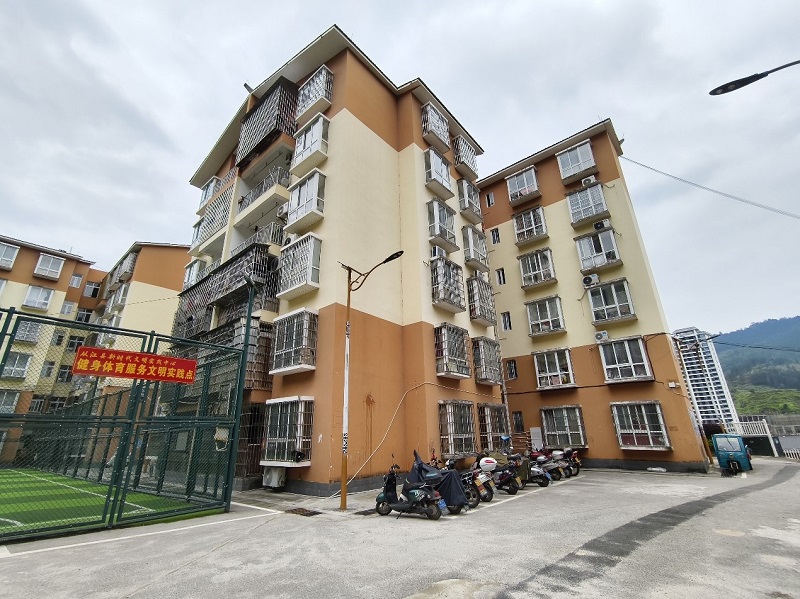
Yinxin Community in Congjiang County, a poverty alleviation relocation site.
Underpinning this is a “grid management” system. Every 30 households are allocated a grid officer, who every five days updates data on their living conditions. Medical and educational databases are linked, whereby the system triggers an automatic alert if a family’s out-of-pocket expenses exceed a certain threshold. The mechanism involving different tiers of governance and sectors minimizes the risk of relapse into poverty.
The poverty alleviation and rural revitalization process has strengthened the bond between local cadres and villagers, and created countless heartwarming moments.
Last year, Rongjiang County was struck by a catastrophic flood. “As the waters rose, and before officials could even finish giving directions, the villagers had already sprang into action – clearing silt, draining floodwater, and even volunteering to cook boxed lunches for the rescue teams,” director of the County Party Committee Office Li Hongchang told China Today.
During those days of power and water outages, when the county was completely cut off from the outside world, this united front of officials and civilians became Rongjiang’s most impenetrable dike. It was a sight to behold – one that many out‑of‑town visitors and rescue workers found deeply moving. As one observed, “The locals weren’t just waiting to be rescued – they were right there, helping with the disaster relief. This kind of solidarity is truly inspiring.”
But it was not a scene that appeared out of nowhere. It was rather an outpouring of profound connections forged over eight years of poverty alleviation, when countless government cadres stationed in villages worked shoulder‑to‑shoulder with local people on the anti-poverty frontline.
Signature Industries Power Rural Revitalization
If relocation and grid-based monitoring have acted as a safety net for formerly impoverished households, it is the development of distinctive industrial clusters that offer them a springboard to wealth. Rongjiang’s “Village Super League” (Cun Chao) and Congjiang’s Yao medicinal bath have become the twin gold calling cards propelling local rural revitalization.
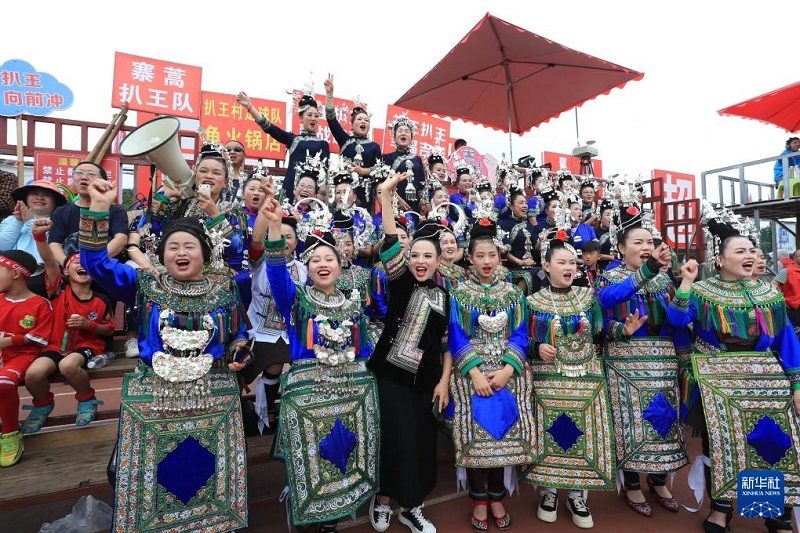
On May 4, 2024, local ethnic cheerleaders cheer for their village teams at the “Village Super League” stadium in Rongjiang County, Qiandongnan Miao and Dong Autonomous Prefecture, Guizhou. [Photo by Yang Chengli / Xinhua]
Since its all-encompassing descent on Rongjiang in May 2023, Cun Chao has transformed the county. What began as a locally organized grassroots football tournament is rapidly becoming a major engine of county-level economic growth and a “super engine” for rural revitalization. The county has logged over 27 million tourist visits and RMB 31 billion in tourism revenue since May 2023. Over 9,000 new businesses have been registered, while accommodation beds have doubled and agricultural sales surged.
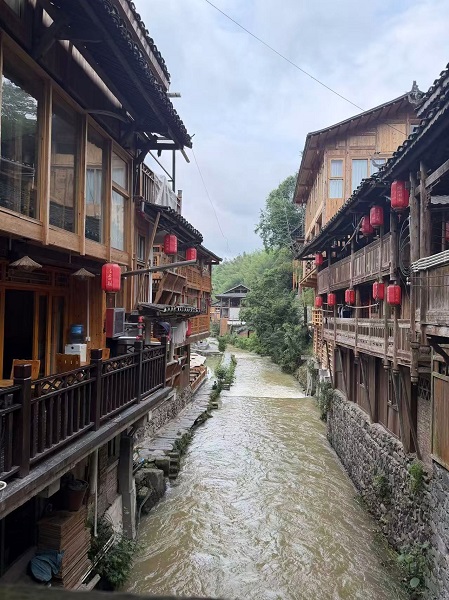
The Dali Dong Village in Rongjiang County, featuring a large number of traditional Dong-style buildings dating back to the Ming and Qing dynasties.
But beyond the numbers, it’s a story of community uplift. In Dali Dong Village, Rongjiang County, the number of homestays has skyrocketed from 7 to 58. Per capita income has nearly doubled, and village collective assets have expanded twenty-fold.
The county is executing a three-step strategy: “First Guizhou plays, then China, and then the world.” With 137 teams now competing, Cun Chao has hosted 1,750 domestic teams and 64 international squads. The ripple effect extends to youth, with nearly 40,000 students playing football in a county with a 385,000 population, compared to just hundreds before the boom.
Cun Chao has also incubated a wave of returning entrepreneurs. Liu Qinlan, known as “Miao Sister Lanlan,” is one such representative. Liu is a post-95 generation woman, originally a kindergarten teacher in Guiyang, capital city of the province. Sensing the vast market potential of intangible cultural heritage products in her hometown, ensuing from the popularity of Cun Chao, she returned home in 2023 to start a business. Focusing on batik artistry, she established village workshops and opened stores in the county seat, so creating jobs for over 100 local artisans and achieving an annual income of millions of yuan.
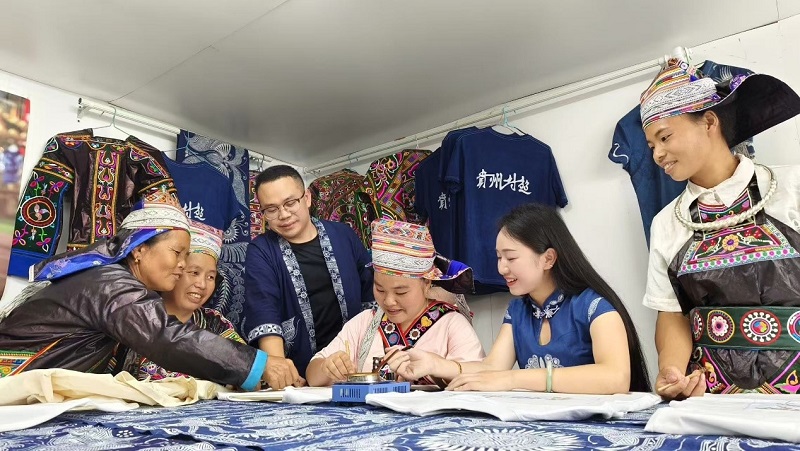
“Miao Sister Lanlan” Liu Qinlan and her husband discuss product designs with artisans at their workshop.
Meanwhile, Congjiang is leveraging its ancient Yao medicinal bath traditions with a view to distilling prosperity. Once a cultural treasure, this intangible heritage has evolved into a booming industry in the county. In 2025, the planting area for Yao medicinal herbs in Congjiang reached 82,000 mu (approx. 5,467 hectares), supported by 47 registered enterprises. The related industrial output value surpassed RMB 150 million, while the comprehensive output value (spanning primary, secondary, and tertiary industries) exceeded RMB 1.5 billion. That same year, Congjiang was named among China’s Top 100 Wellness Counties.
The Yao medicinal bath industry operates as a complete ecosystem: from standardized planting and deep processing into shampoos and essential oils, to a network of rural experience stores. Having created over 3,000 jobs, Congjiang has set its sights on building a RMB 10 billion industrial cluster, strategically positioning itself as the “Birthplace of Chinese Yao Medicinal Baths.”
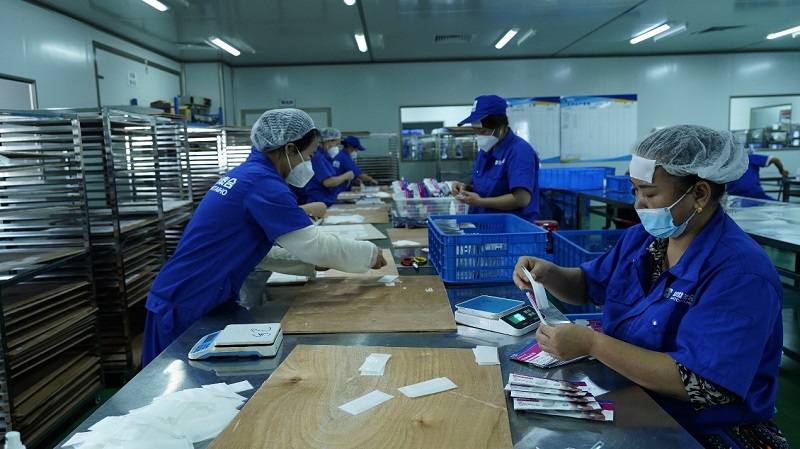
Workers at Guizhou Shengshi Taihe Pharmaceutical Technology Co., Ltd. package Yao medicinal bath products.
From Mountain Treks to School Buses: Breaking the Poverty Cycle
Relocation having raised the question: “Where is home?” education counters with that of “Where does the future lie?”
Mo Xuan, young entrepreneur and general manager of Guizhou Yansuantang Brand Management Co., still remembers what school was like in his Dushan County hometown.
“We had to walk for hours every day up and down mountain paths,” he recalled. “Many students ate only two meals a day.”
When Mo Xuan graduated from university in 2019, he was the sole college graduate his village had ever produced. Today the situation is dramatically different.
“Now nearly a hundred students from nearby villages have gone on to university,” Mo said.
This transformation is driven by the school merging and boarding initiative. When Mo returned to his hometown to volunteer as a teacher in 2017 and 2018, he still had to walk its mountain paths with his students. By 2019, however, many small remote schools had been merged to create boarding schools with more effective teaching resources. School buses now pick pupils up directly from their homes. They do not pay boarding fees and receive subsidized nutritious meals.
“Children go back home once a week,” Mo said. “They no longer have to spend hours every day climbing mountains.”
Improved nutrition is also transforming students’ lives. Provincial guidelines ensure that rural students receive balanced meals – at least one egg, a portion of meat, and a piece of fruit each day, along with milk several times a week.
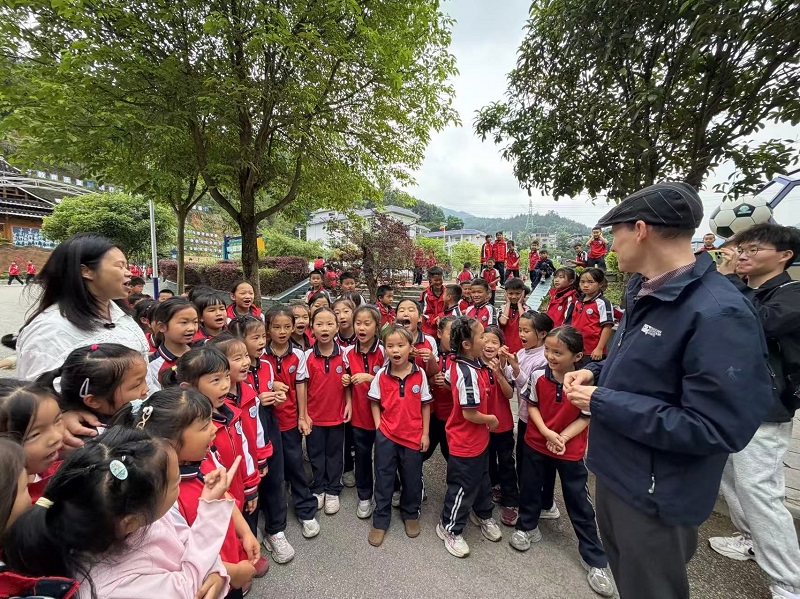
Students at Chengguan No. 4 Primary School in Congjiang County spontaneously sing “Without the Communist Party, There Would Be No New China” while interacting with China Today’s visiting reporters.
These measures have dramatically improved children’s health while sharply reducing dropout rates. For the children of relocated families, the impact is especially profound.
Reflecting on the changes he has witnessed, Mo Xuan voices a simple but powerful conclusion: “More than any economic indicator, the dozens of college students who have come out of my village are one of the clearest signs of our country’s success in poverty alleviation and rural revitalization. Because in addition to improving the quality of individual lives, it enhances the future and confidence of an entire nation.”