Sixteen centuries before large language models, a Chinese woman wove a poem that can be read in thousands of ways – a parable for how the world governs itself now, and for what artificial intelligence is doing to the fabric of fact.
In the fourth century, while Europe was torn apart by the collapse of the Roman Empire, a Chinese woman did something that would not be fully understood for more than sixteen hundred years. Working in silk, Su Hui created a literary machine – one that anticipated today’s artificial intelligence (AI), its algorithms and its large language models. As a love letter to her husband, who had been sent to the far northwest, Su Hui took 841 characters and arranged them on silk in a square of twenty-nine rows by twenty-nine. She called the composition Xuanji Tu, the Star Gauge (The Map of the Armillary Sphere). It can be read vertically, horizontally, diagonally, backward, or around its borders, each route releasing another poem.
During the Ming dynasty, scholars counted 4,206 possible readings. In reality, the paths of reading seem infinite. At the center sits a single character xin, heart, mind. Look at the Star Gauge today and it resembles a computer screen produced before computers even existed. It contains a database, an algorithm and an interface. The words remain fixed; the reader activates them. Eventually meaning comes from the roaming devised by Su Hui.
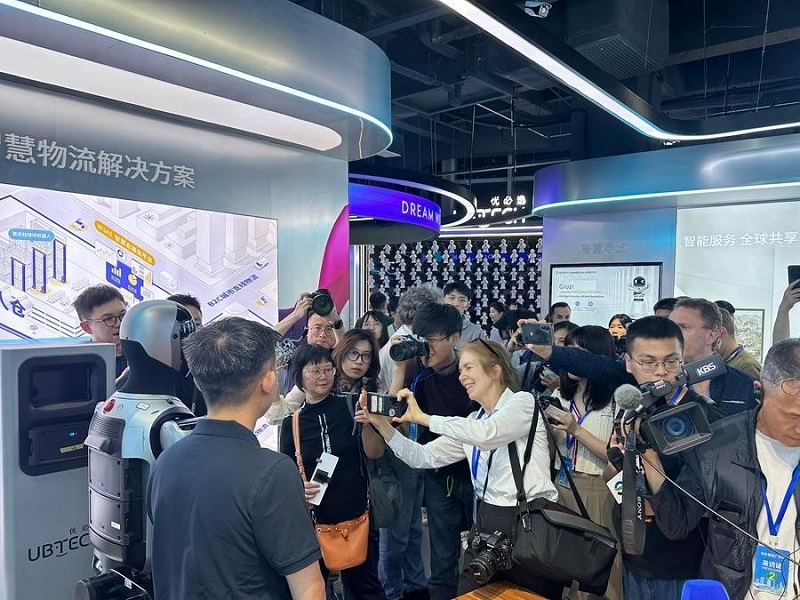
Journalists work at the exhibition hall of UBTECH, one of China's leading robotics companies, in Shenzhen, south China's Guangdong Province, April 16, 2026. (Xinhua/Lu Zhiyi)
Su Hui was not composing the way AI writes today. She chose every character and designed every passage. Yet she anticipated the central idea of digital literature that a text is not a straight road from first word to last, but a field of possibilities, as the Italian writer Italo Calvino forecast in his 1967 lecture “Cybernetics and Ghosts.” Generative artificial intelligence now performs such recombination on a planetary scale. Large language models can indeed produce a sonnet, a diplomatic communiqué, a campaign slogan and a conspiracy theory before a human writer has touched the keyboard. They do not move through Su Hui’s 841 characters; they move through billions of linguistic traces left by humans, as we ourselves were moved by noble ideals or sordid plots.
This is an extraordinary cultural achievement igniting a political emergency. Global governance depends on shared accounts of reality. A government acts because it tells a story about danger. A nation accepts a sacrifice because it believes a story about its common future. A war begins when one narrative erases reality. Peace becomes possible when adversaries find a common language to negotiate.
The Global Governance Initiative (GGI), proposed by Chinese President Xi Jinping in Tianjin on September 1, 2025, is anchored in five core concepts: sovereign equality, international rule of law, multilateralism, a people-centered approach and action orientation. At a meeting of the GGI Group of Friends at United Nations headquarters in May 2026, Chinese Foreign Minister Wang Yi said the initiative had received support from nearly 160 countries and international organizations, an impressive reach, now facing a hard test. Can nations maintain different histories while agreeing on the facts needed to act together? Su Hui suggests that while the text is open, the fabric is shared.
Our information system, alas, seems to move in the opposite direction. The global fabric of international relations is being torn, in America, Asia, Africa, and Europe. The Reuters Institute for the Study of Journalism reported in 2025 that 58 percent of people surveyed across its markets worried about distinguishing real information from false information online. Another global survey, the 2025 Edelman Trust Barometer, covering 33,000 respondents in 28 countries, found that four in 10 considered at least one form of hostile action acceptable as an instrument of change. The list included deliberately spreading disinformation.
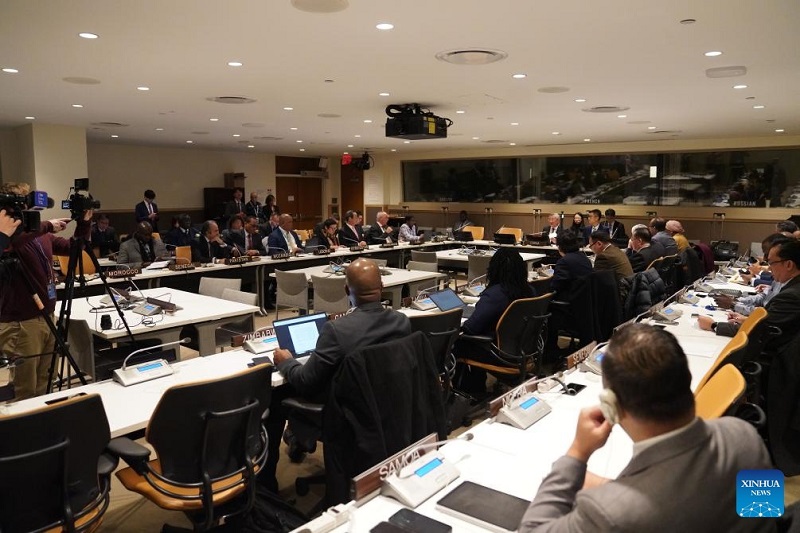
Representatives from nearly 40 founding member states attend a meeting to launch the Group of Friends of Global Governance at the UN headquarters in New York, on Dec. 9, 2025. (Xinhua/Zhang Fengguo)
A fabricated video can easily acquire subtitles in twenty languages within minutes, at the hands of a high-school student. A false quotation can travel from an anonymous account to television, as Italian Deputy Prime Minister Antonio Tajani and Minister of Defense Guido Crosetto have recently warned. An authentic photograph can be dismissed as synthetic. Proof is becoming a matter of tribal allegiance on TikTok, X or Instagram.
This is why journalism, despite the turbulent business cycle, remains crucial to any serious discussion of global governance. Independent journalism loses its value by becoming crass advertisement. Journalists must establish what is happening, show who benefits, and include voices excluded from official accounts, while correcting their own errors in public.
Sovereign equality should also have an informational dimension. A small country should not appear in international news only after a coup, cyclone or terrorist attack. Africa should not be presented as a single political subject. Asia should not be reduced to cliches. China should not be reduced to its government. Europe should frankly examine its own weaknesses: agriculture subsidies and tariffs, lagging AI labs, and so on.
Multilateralism fails when only powerful states deploy the cameras, correspondents, platforms and datasets through which the world becomes visible. People-to-people exchange can correct that imbalance, but only if people are allowed to surprise one another. A carefully managed delegation, repeating prepared remarks before a group photograph, produces no serious knowledge beyond the posturing. The valuable moment comes when the sharp opinions are shared and the intellectual friction begins to generate wisdom.
Chinese international-relations scholar Qin Yaqing argues that political actors are shaped through relationships. They do not enter world affairs with identities sealed in advance, because contact changes the participants. Western philosopher Kwame Anthony Appiah adds a compatible rule for cosmopolitan conversation: it need not produce consensus; it can teach strangers how to live beside one another.
Yet, in our troubled times, even these measured proposals seem impossible to implement. Universities should create joint laboratories where Chinese, European, African, Asian and American researchers examine the same public data, and social media platforms should be allowed access to their inner system. News organizations should establish verification channels for wars, epidemics, climate disasters and synthetic media. Journalism schools may exchange young reporters for allotted periods, welcoming them in newsrooms to train in the local language. Editors should publish parallel accounts of a disputed event, and then annotate where the evidence agrees, where it conflicts and what remains unknown.
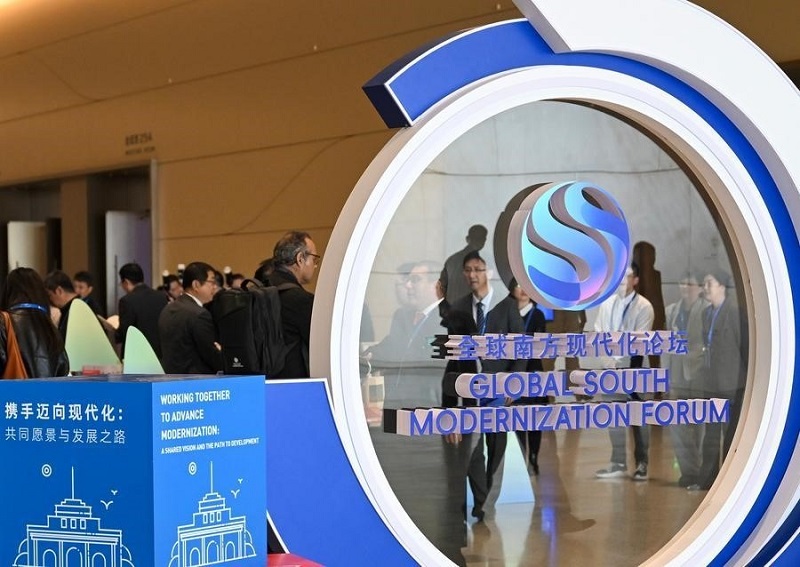
This photo taken on Nov. 21, 2025 shows a scene at the exhibition area for achievements at the Global South Modernization Forum in Beijing, capital of China. (Xinhua/Jin Liangkuai)
Artificial Intelligence could help. It can compare thousands of documents, expose coordinated linguistic patterns and make archives searchable across languages. It can reveal that two hostile narratives are quoting the same corrupted source, if the technology remain auditable. Readers should know when AI has written, translated or altered material. Training data should be examined for political and cultural bias. Synthetic images must be watermarked. Human editors must remain accountable.
The American scholar N. Katherine Hayles has described human and machine cognition as an assemblage, arguing it is a fashionable waste of time to ask if the machine is secretly human, while it is important to fathom what humans and machines are doing together. Are they widening knowledge or automating brutal prejudices?
A people-centered order cannot treat people as passive audiences for competing national, or ideological, narratives. Citizens must be able to inspect claims, cross borders intellectually and answer power with evidence, keeping the “people” in “people-centered.” Sixteen centuries ago, Su Hui devised an elegant set of disciplined plurality. Her poem does not impose one compulsory reading but offers freedom inside a common structure. While differences expand, the characters endure.
Our wounded world also needs a Star Gauge of its own – many readings, one fabric. No nation, culture, ideology, oligopoly or brand should claim ownership of the entire design, while we defend the verifiable facts, reciprocal access, honest translation, international law and the right to question authority.
Su Hui imagined readers free to roam across her combinatory love letter, while many political authorities and techno-billionaires are now plotting to force people through their labyrinth of disinformation, obliterating xin – our human heart and soul.
(The article reflects the author’s opinions, and not necessarily those of China Today.)
---------------------
GIANNI RIOTTA is dean of the Master in Journalism and Digital Communication at LUISS University, Italy, a visiting professor at Princeton University, the United States, and former editor-in-chief of TG1 RAI and Il Sole 24 Ore.