Three Spanish mayors share their plans to collaborate with China and develop mutually beneficial opportunities.
On October 6, 2026, the Palacio de Santoña, also known as the Palace of the Dukes of Santoña, hosted a readers’ exchange in Madrid themed “Dialogue Among Civilizations as a Driver of Shared Progress: Opportunities and Prospects for China-Spain Exchange.” Focusing on the fifth volume of Xi Jinping: The Governance of China, a series of roundtables were held for discussions on cooperation in specific fields. At the “Mayors’ Roundtable,” three local leaders from Spain’s Toledo Province – Sagrario Gutiérrez, mayor of Guadamur; Manuel Guillermo Fernández Lázaro-Carrasco, mayor of Gálvez; and Emilio Bravo Peña, mayor of Mora – aligned the development plans of their towns with modern development in China.
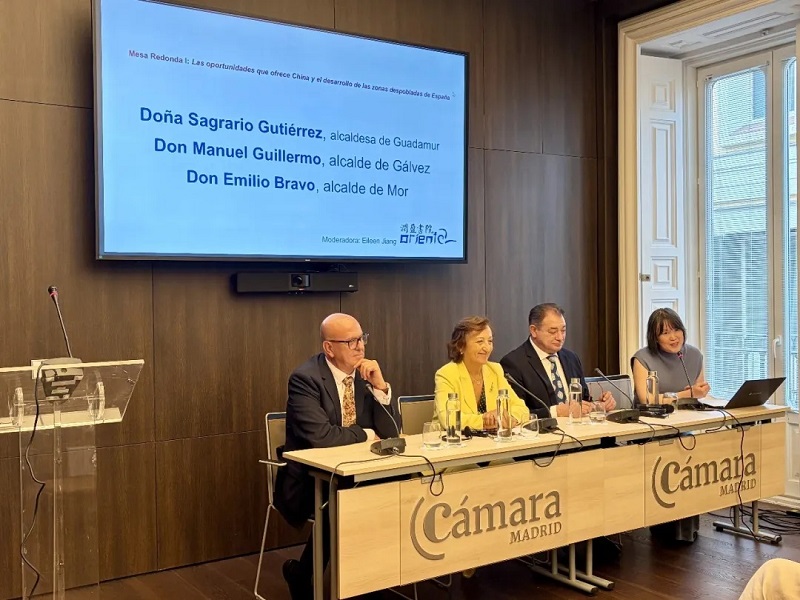
Spanish mayors at the readers’ exchange on the Spanish edition of Xi Jinping: The Governance of China (Volume V) in Madrid on October 6, 2026.
Local Governors’ “China Answer”
The High-Resolution Report on Spain’s Population, released in 2026 by the BBVA Foundation and the Valencian Institute of Economic Research (Ivie), reveals a striking reality: measured on a 100-meter grid, more than 90 percent of the country’s permanent residents live in areas that account for just 2.6 percent of its total land area. Population is heavily concentrated in a handful of metropolitan areas and coastal belts, while vast inland regions are extremely sparsely populated. Yet it is precisely these small and medium-sized towns with modest populations, but brimming with vitality, that hold the key to highly resilient local economies.
During the roundtable, the three mayors’ remarks debunked some Europeans’ stereotypes of China as “distant and abstract,” sketching cooperative scenarios that were at once realistic and innovative.
“China is not a mysterious image glimpsed through a gauze curtain, but a real partner that brings tangible opportunities,” Gutiérrez said. Having led Guadamur for many years, she is an old friend of China. Her town of just 1,800 residents boasts splendid Visigothic heritage and ancient castles, and is adjacent to the world-renowned immersive historical theme park Puy du Fou España.
Building on its cultural tourism development plan, Gutiérrez extended an invitation to Chinese investors: “The municipal government will give our Chinese friends as much support and assistance as possible.” She traveled to Hangzhou last year to explore practical avenues for China-Spain local cooperation. Guadamur maintains close sister-city ties with Jinshan District of Shanghai. The two sides are also discussing the possibility of investment in science and technology, traditional Chinese medicine and other fields, while working to gain access for Guadamur’s high-quality olive oil and other agricultural products to China’s vast market, and to make the town an attractive destination for more Chinese tourists.
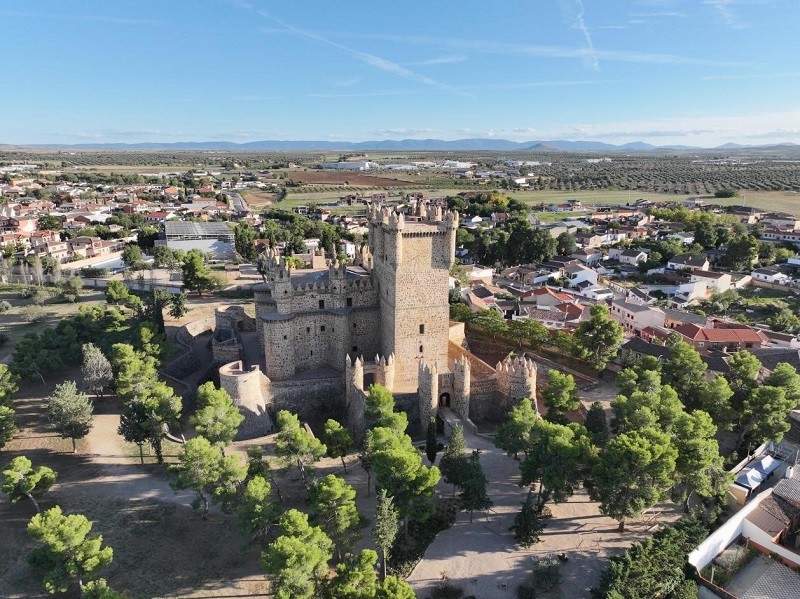
Guadamur is a historic municipality in the province of Toledo, Castile-La Mancha, a landlocked autonomous community in central Spain.
If Guadamur’s mayor has her eye on culture-and-tourism integration, Gálvez’s Mayor Fernández is focused on green transition. A veteran mayor with more than 30 years of experience, he has turned his attention to recovering resources from pig-farming waste. “Turning waste into energy not only eases environmental and water-supply pressures, but also attracts new companies and brings new economic activity to the locality,” he said. His plan resonates with China’s green development philosophy.
Meanwhile, Mora’s Mayor Peña is championing a more futuristic mega-project: the DC Malpica AI data center park, involving U.S. firm EdgeMode Inc. This town, known across Europe for its fine olive oil and home to some 8,000 residents, is seeking to leverage a €3 billion investment into 5,000 jobs, with Peña hinting that he is keen to expand digital cooperation with China and attract diversified investment.
A New Logic for Local Cooperation
The ambitions of small towns need the support of macro-level strategy and institutional safeguards. As Xie Gang, vice president of China International Communications Group, noted in his address to the readers’ exchange, the Spanish edition of Volume V of Xi Jinping: The Governance of China opens an important intellectual window for Spanish-speaking readers to understand China in the new era and gain insights about Chinese modernization.
That resonance of ideas is fast being translated into practical action. Xie pointed out that since the two countries established diplomatic relations, and especially since the forging of a comprehensive strategic partnership in 2005, their economic and trade ties have grown exponentially, and the Action Plan for Strengthening the Comprehensive Strategic Partnership Between the People’s Republic of China and the Kingdom of Spain (2025–2028) has further defined the path and priorities for future cooperation. He stressed that the two sides should turn consensus in thinking into action, deepen cooperation in trade, environmental protection, the digital economy and people-to-people exchanges, and deliver more outcomes that benefit both peoples.
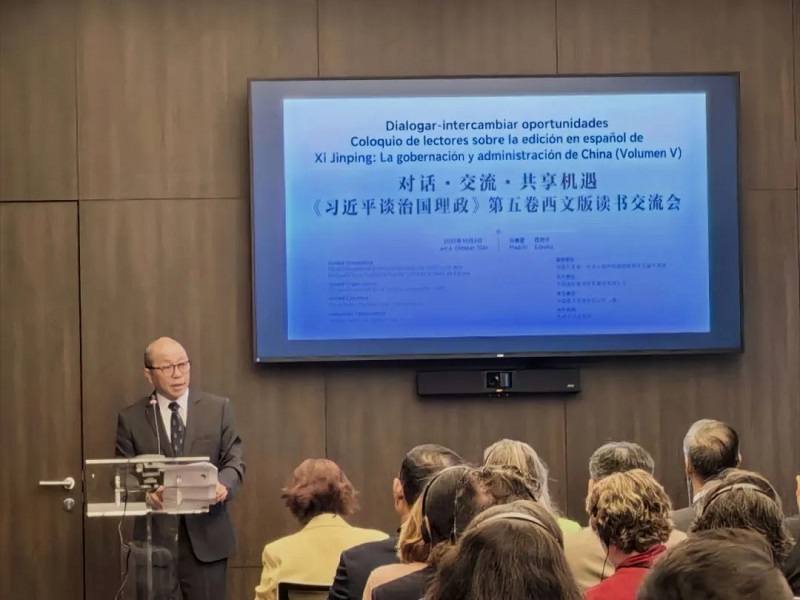
Xie Gang, vice president of CICG, addresses the readers’ exchange.
The top-level cooperation blueprint between the two countries clearly answers the three mayors’ needs: Guadamur’s cultural tourism infrastructure, Gálvez’s green energy, and Mora’s digital development are all microcosms of an expanding China-Spain cooperation in new energy, digital economy and agricultural technology.
Yao Jing, Chinese ambassador to Spain, further elaborated the modern rationale behind such cooperation. Yao said that by leveraging Chinese modernization to respond to some common global issues and high-standard opening up as a driver of shared prosperity, China’s continued pursuit of high-quality development is creating broader cooperation opportunities for all countries, Spain included. He emphasized that deeper mutually beneficial cooperation addresses the shared expectations of both peoples and adds stability to global economic growth.
In Yao’s view, the two sides should seize the current favorable momentum in bilateral relations, steadily expand common interests and build broader consensus. By linking national macro-strategy with local micro-projects, the readers’ exchange clarified how Spain’s small and medium-sized towns can expand cooperation with China and integrate into global industrial chains.
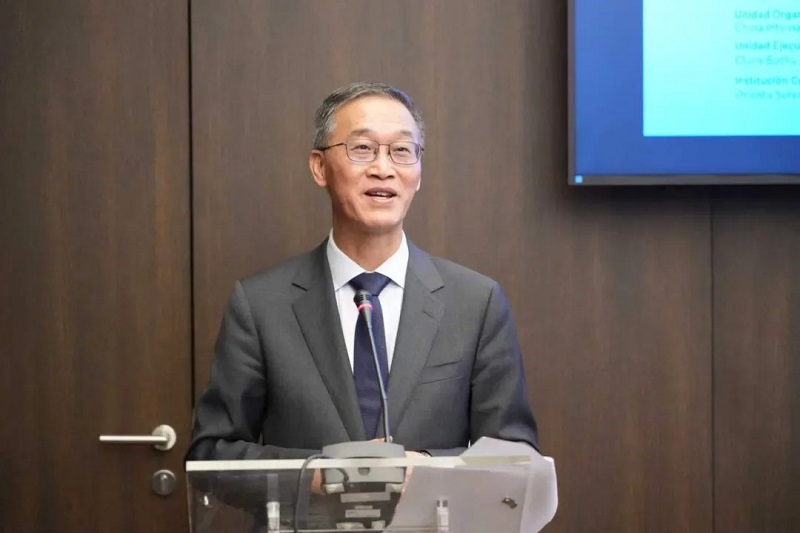
Yao Jing, Chinese Ambassador to Spain, addresses the readers' exchange.
Turning Differences into Opportunities
Economic cooperation is invariably accompanied by mutual understanding among civilizations and cultural inclusiveness. Marta Montoro, executive president of the Cátedra China Foundation, noted that while today’s global environment is fraught with uncertainty, division and suspicion, differences need not lead to confrontation. Modernization, she argued, does not mean Westernization, and moving toward the future requires no deviation from one’s own cultural identity. Spain and China need not agree on every idea in order to work together; what matters is exchanging thoughts, listening and understanding, so as to find cooperative space in which differences become opportunities.
This view was fully borne out at the mayors’ roundtable and in the media and youth dialogues that followed.
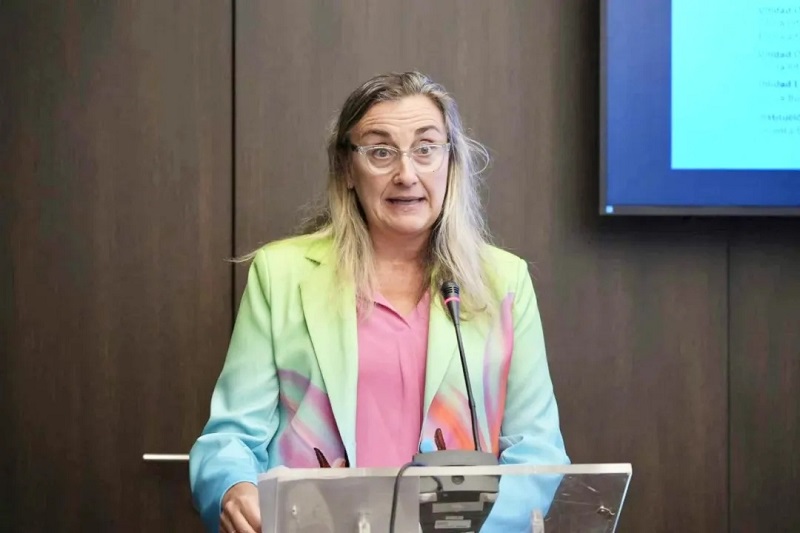
Marta Montoro, executive president of Cátedra China Foundation, addresses the readers' exchange.
The vision of building a community with a shared future for humanity conveyed in Volume V of Xi Jinping: The Governance of China is becoming a spiritual bond that transcends differences in systems and geography.
Ambassador Yao Jing noted that the Chinese and Spanish civilizations, though rooted at opposite ends of the Eurasian landmass, have always upheld a symbiotic way of coexistence based on equality, inclusiveness and the shared appreciation of diversity.
Through mutual respect and mutual learning, the two sides can complement and enhance each other on the basis of equality. At the readers’ exchange, the Chinese side presented the Spanish edition of Volume V of Xi Jinping: The Governance of China to Spanish participants not only as a transfer of knowledge, but also an expression of mutual learning among civilizations.
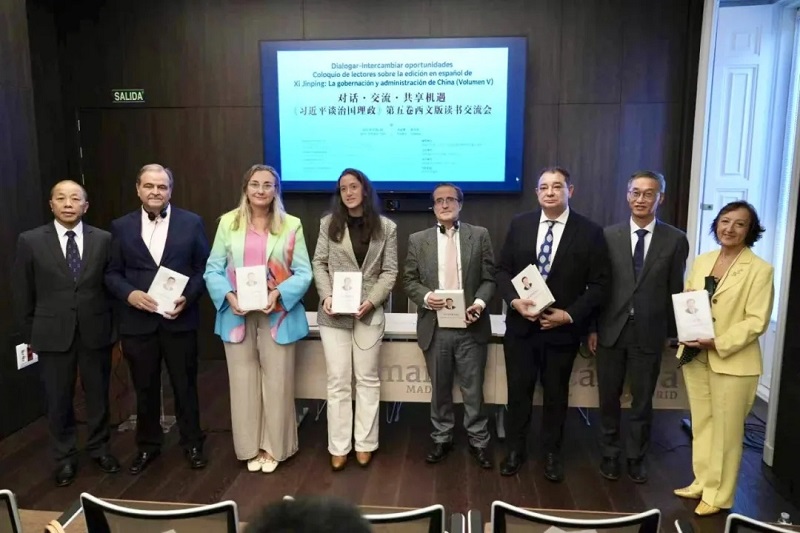
The book presentation.
At the end of the roundtable, the three mayors told the moderator, Eileen Jiang, president of the Spanish Association of Orienta-China Friends, that if she were to lead a delegation to Beijing at any time in the future, they would be ready to join her. This sentiment was echoed by the participants, indicating how quickly people from across borders could resonate with mutually beneficial ideas. The China stories shared by youth representatives and the objective narratives discussed by media professionals at the readers’ exchange created a meaningful connection between the Chinese and Spanish people in attendance.
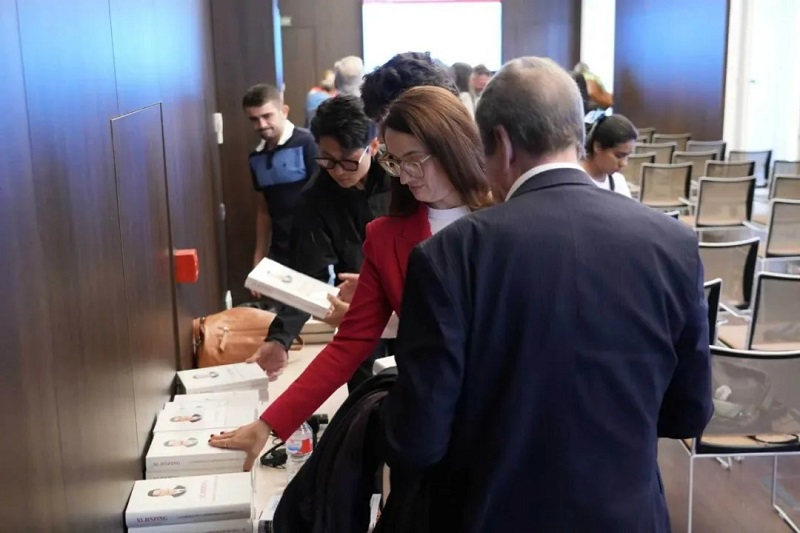
Spanish participants browse the Spanish edition of Volume V of Xi Jinping: The Governance of China at the event venue.
As dialogue among civilizations empowers shared progress, those once-sparsely-populated European towns are embracing the pulse of the times from a major Eastern country, and, through mutual learning, are writing a new chapter of mutual benefit, win-win outcomes and a shared future.