The 2026 China New Cultural and Creative Market & Trendy Toy Carnival offers a dynamic showcase of how tradition, creativity, and contemporary lifestyle are coming together in new forms.
A vibrant celebration of creativity and culture recently lit up Beijing, drawing crowds of visitors to experience the latest trends in China’s cultural and creative industries. At the event, tourists browsed through bustling cultural markets, watched performances of intangible cultural heritages, sampled local delicacies, and explored popular intellectual property (IP) -themed designer toys.
As the country’s first comprehensive market themed on culture and creativity, the 2026 China New Cultural and Creative Market & Trendy Toy Carnival took place at Chaoyang Park from May 15 to 24, 2026, offering a dynamic showcase of how tradition, creativity, and contemporary lifestyle are coming together in new forms.
The carnival featured high-quality cultural and creative products, intangible cultural heritages, original IPs, and digital technologies from 31 provinces, autonomous regions, and municipalities in China’s mainland, as well as the special administrative regions of Hong Kong and Macao. By combining a marketplace, trendy IP experiences, and leisure activities, the event created an open and immersive consumer space where visitors could explore, shop, and interact.
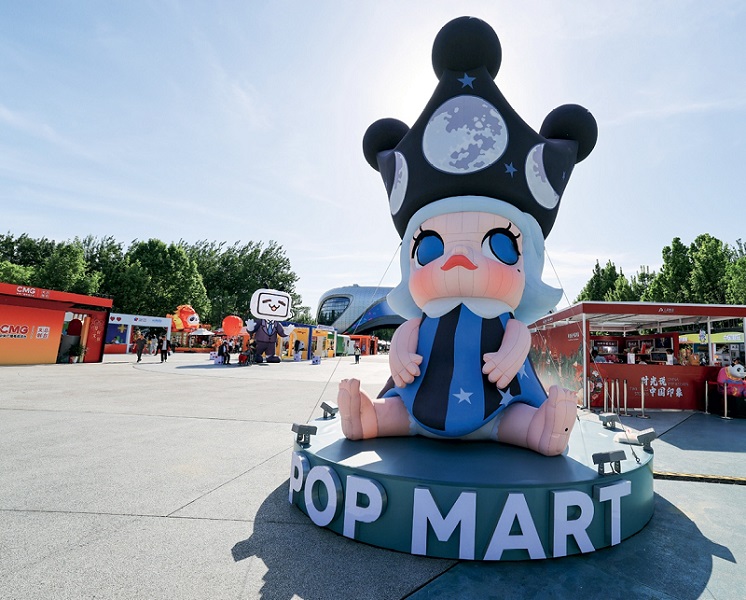
An art installation displayed by POP MART at the 2026 China New Cultural and Creative Market & Trendy Toy Carnival on May 18, 2026.
Popular Cultural and Creative Products
At the Chaoyang Museum of Urban Planning, one of the event’s main venues, visitors were greeted by a dazzling array of featured exhibits. There were products from across China that highlighted their distinctive regional cultures of origin, including intangible cultural heritage handicrafts, guochao (China-chic) blind boxes, and souvenirs inspired by traditional elements.
A long line of eager visitors formed at the entrance to the National Museum of China’s booth waiting to buy a refrigerator magnet. Since the opening of the exhibition “A Glimpse into the 6th-7th Century China: Discoveries at Li Jingxun’s Tomb” in April 2026, a series of cultural and creative products inspired by Li’s jewelry has become extremely popular. “This moth-shaped hairpin can be worn in your hair as jewelry or placed on your fridge as a fridge magnet, and the small moth can even be detached and worn as a brooch,” said Yuan Yanlong, a staff member at the booth. The magnets were released in limited quantities twice a day 90 each time and typically sold out within minutes.
The market also brought together many of the most popular cultural and creative products from other museums across the country. The National Library of China’s exam-blessing pendants and gilded bookplates were popular among students. The Dunhuang Academy’s Chinese-style skateboards and Silk Road Bluetooth speakers infused fashionable items with the charm of the desert. Other institutions, including Hebei Museum, Xinjiang Museum, and Nanjing Museum, also presented products inspired by famous cultural relics and local heritages.
At the Gansu Provincial Museum booth, the cartoon pendant based on the famous bronze galloping horse statue, a national treasure in the museum’s collection, was a major hit, with many visitors coming to the booth specifically to purchase it.
“All the must-have products from across the country are here,” said Li Xin, an enthusiast of cultural and creative merchandise, “You can collect all the museum-themed items you like by just visiting this one market.” After a full day of exploring the fair, she left with her arms full.
“Behind the popularity of these cultural and creative products lies people’s growing enthusiasm for traditional culture and their desire for fresh experiences,” said Liao Fei, head of cultural and creative products at the National Museum of China. He added that the ingenuity of these designs reflects the cultural significance of the relics themselves, allowing culture to enter people’s everyday life in creative new ways.
On May 21, 2026, diplomats and their spouses from countries including Portugal, Italy, Bosnia and Herzegovina, and Iceland, along with foreign representatives from fields such as trade, media, and education, visited the fair. Many were attracted to the cultural and creative displays. Sinisa Berjan, ambassador of Bosnia and Herzegovina to China, said he was delighted to see trendy products from across China. The variety of products allowed him to experience different facets of Chinese culture and see the creativity of the Chinese people.
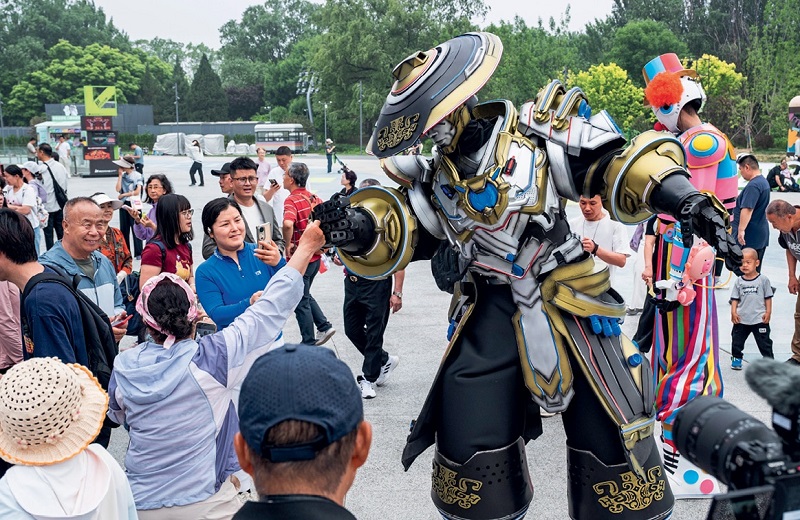
Performers dressed up as mecha and anime characters interact with visitors on May 15, 2026.
Interactive Intangible Cultural Heritages
In the intangible cultural heritage zone, 10 nationally recognized inheritors demonstrated their special masterful craftsmanship. In the outdoor area, there were 43 heritage projects that had their own booth, while more than 60 types of traditional foods creating a culinary feast for visitors.
Many visitors gathered at the booth showcasing Shui ethnic horse-tail embroidery. Song Shuixian, a nationally recognized inheritor of the craft, demonstrated the technique on site. “This embroidery technique uses horsehair as a key material and has been passed down for more than 1,000 years, embodying the unique culture of the Shui ethnic group,” Song said. She added that horse-tail embroidery has expanded into a variety of contemporary forms such as earrings, necklaces, and bag ornaments.
“We want people to see how remarkable China’s ancient carpet-weaving techniques are,” said Li Dongyang, an inheritor of traditional palace carpet weaving. With more than 30 years devoted to the craft, he patiently introduced visitors to the history and intricate patterns of traditional Chinese carpets. “More and more young people today are becoming interested in traditional craftsmanship and culture. These ancient techniques will certainly be better preserved and passed down.”
Visitors were able to observe many traditional skills up close, with every step of the process vividly presented, offering insight into the stories behind intangible cultural heritages. Performances such as the Jingxi Taiping Drum Dance and the Baizhifang Lion Dance further energized the atmosphere at the event.
Visiting diplomats also took part in hands-on experiences of these unique crafts. They learned three traditional skills: painting Lord Rabbit clay figurines, weaving palace carpets, and making Chinese medicine sachets, immersing themselves in the artistry and heritage of these time-honored traditions. “Through my experience today, the former distance I felt toward China’s intangible cultural heritage as an old tradition has disappeared, now I see them as a tangible, touchable, and shareable aesthetic of everyday life,” said Federico Antonelli, cultural counselor at the Italian embassy in China.
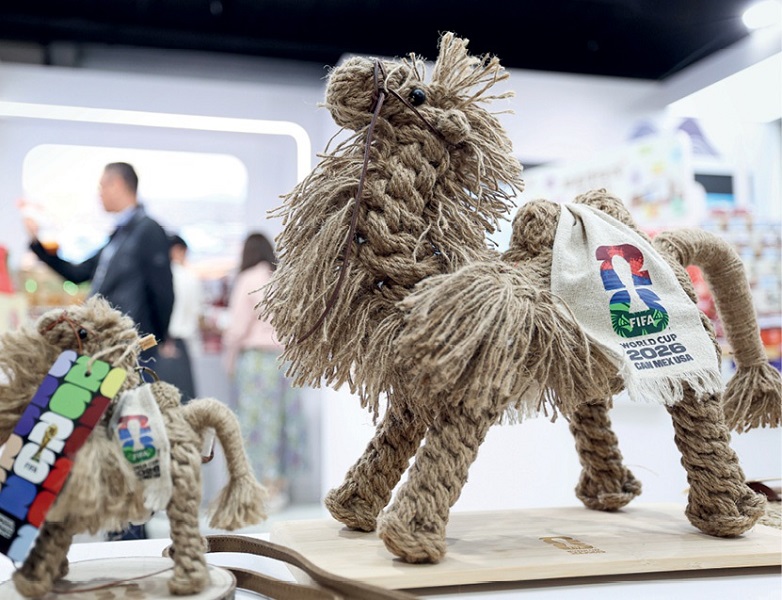
A camel craft made from hemp fiber is displayed at the Ningxia Hui Autonomous Region booth on May 15, 2026.
Diversified Business Formats
In addition to cultural products and performances, trendy toys also drew many young visitors. Brands such as POP MART, 52TOYS, and HERE brought their best-selling products and set up themed parks that highlighted the youthful energy of the designer toy culture.
A visitor surnamed Wu and each of his family members who came with him found their favorite toy at the market. His daughter had a great time at the upgraded POP LAND, a theme park created by POP MART. Wu himself stopped by the pop-up store for Black Myth: Wukong (a hit game inspired by the Chinese classic novel) and watched a parade of Chinese-style robots. He also picked up several finely crafted souvenirs. “We just couldn’t stop shopping here,” Wu said.
In the picnic area, aromas of different kinds of food filled the air. As lively music from the stage in the center of the lawn played in the background, young people relaxing on picnic blankets and inside tents shared food and snapped photos to remember the moment, turning the lawn into a vibrant cultural gathering.
At lunchtime, long lines formed in front of the Quanjude stall, the time-honored Beijing roasted duck restaurant. Its forearm-length super-skewered roast duck and roast duck pancakes were especially popular. “In the past, people thought a meal of roasted duck would take at least two hours to finish,” a Quanjude staff member said. “But as many visitors prefer to eat while strolling through the exhibition today, we developed the super-sized skewered roast duck.” The product has already become a viral hit. During the Labor Day holiday in May of this year, the company’s Qianmen store alone sold nearly 10,000 of the skewers.
Bringing together cultural and creative products, trendy designer toys, intangible cultural heritage craftsmanship, digital technology, classic cuisine, and riverside night tours, the event enriched visitors’ experiences while presenting traditional culture in a fresh and engaging way.
“In recent years, the business formats of China’s cultural and creative industries have continued to diversify. Cultural and creative products have gained widespread popularity, and young people have become the driving force behind the guochao consumption trend,” said Zhou Hanping, an official of the Industry Development Department of the Ministry of Culture and Tourism. She also noted that the event highlights the achievements of China’s cultural and creative industries and represents a valuable exploration of new cultural tourism consumption scenarios. By integrating diverse formats, she added, cities can create new cultural and tourism spaces that are open, immersive, participatory, and experiential throughout the year. Aligned with contemporary aesthetics and consumption trends, events like this can bring traditional culture to life and spark renewed enthusiasm for it among the public.
The article is based on reports from media outlets including Guangming Daily, China News Service, and Beijing Daily.