Once connected to a charging pile, an electric vehicle (EV) can not only draw power from the grid, but also feed surplus electricity back when needed, effectively doubling as a mobile “power bank.” This is not science fiction; it is reality unfolding in Xixian New Area, northwest China’s Shaanxi Province.
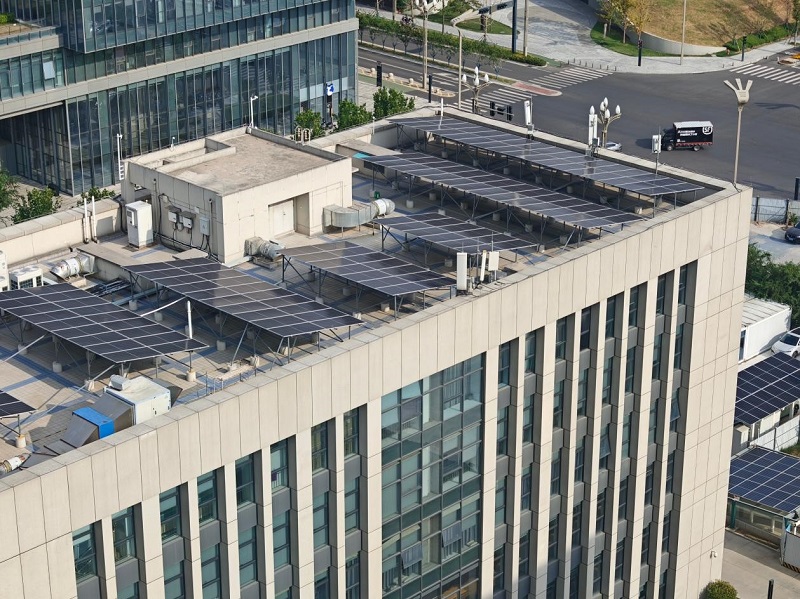
Part of the photovoltaic facilities at the Integrated Source-Grid-Load-Storage Demonstration Park of the State Grid’s Xixian New Area Power Supply Company.
The 15th Five-Year Plan for the development of this new energy system, for the first time, incorporates electric vehicle energy storage resources into the planning of a new power system. It calls for making full use of EV energy storage resources, exploring coordinated interactions among vehicles, charging piles, charging stations, and the power grid. These efforts are expected to promote smart and orderly charging across the board, and expand the large-scale deployment of Vehicle-to-Grid (V2G). By 2030, the V2G enabled aggregated adjustable charging and discharging capacity is projected to reach approximately 50,000 MW.
In 2025, the National Development and Reform Commission, together with three other government departments, announced the first batch of pilot projects for large-scale V2G applications, covering nine cities and 30 key projects. From policy guidance to engineering practice, V2G technology is rapidly progressing from R&D to commercial operation. Xixian New Area, located in the Guanzhong Plain and designated as one of the country’s first pilot areas for carbon peaking, provides an ideal testing ground for this transformation.
The State Grid’s Xixian New Area Power Supply Company has seized the opportunity of these pilot projects. Centered on a combination of distributed photovoltaics, energy storage, and V2G charging piles, its integrated source-grid-load-storage demonstration park has developed a smart microgrid system that integrates the consumption of green electricity, load regulation, and intelligent energy management. Within the system, V2G charging piles enable bidirectional energy flow between EVs and the grid, discharging power during peak hours to shave peak loads and charging during off-peak hours to fill the valley.
Electric vehicles have thus undergone a fundamental transformation in their role, becoming “mobile power banks” capable of feeding electricity back into the grid.
The demonstration park achieves 100 percent utilization of the green electricity generated by its photovoltaic facilities, with an estimated annual consumption of 120,000 kWh of green electricity and an annual reduction of approximately 117.6 tons of carbon emissions. The energy storage system employs a “two charges, two discharges” strategy, enabling approximately 140,000 kWh of peak shaving and valley filling each year, directly reducing energy costs by RMB 56,000. Furthermore, the park’s power supply reliability has been significantly improved. The dual power supply system, plus energy storage, provides safer and more stable electricity across the facility.
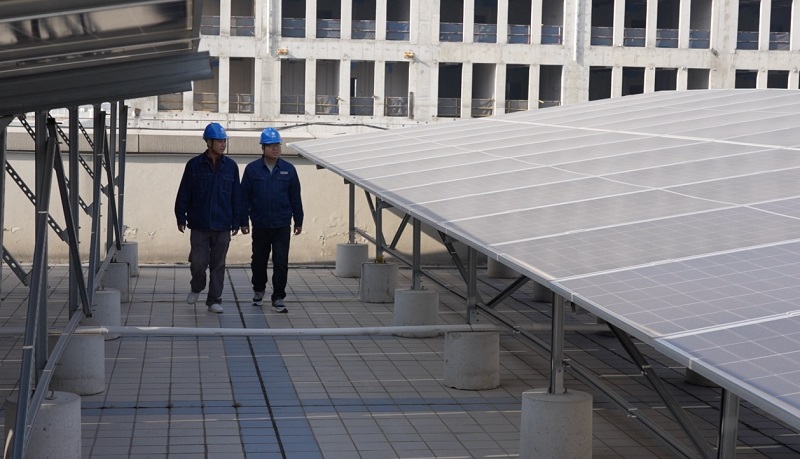
Power workers inspect photovoltaic panels at the demonstration park.
Even more noteworthy is the model’s potential for replication and wider application. The State Grid’s Xixian New Area Power Supply Company’s demonstration park can also serve as a resource node for a virtual power plant, enabling participation in broader electricity dispatch and grid interaction via the virtual power plant platform. To date, adjustable load resources from 59 enterprises in the New Area have been aggregated, forming a pool of more than 50 MW of adjustable load capacity.
The State Grid’s Shaanxi Electric Power is redefining the boundaries of energy services through a series of technological innovations. These include the transition from unidirectional electricity consumption to bidirectional interaction, and from dispersed resources to aggregated dispatch.
As EVs pivot from merely being a means of transportation to becoming mobile green energy units flowing through the power grid, a clean, efficient, and intelligent energy future is taking root and being pioneered in Xixian New Area. At the same time, this endeavor is also offering a Chinese solution to the development of new power systems worldwide.