Twenty years ago, Xi Jinping, then Party Secretary of Zhejiang Province, lauded Yiwu as having the magical ability of turning stone into gold. Over the few decades since the outset of China’s reform and opening-up, this county-level city in central Zhejiang has been transformed from a nondescript town to a world-renowned center of small commodities. Its growth not only exemplifies the success of China’s market economy but also serves as an important window for understanding China’s modernization drive, its approach to development, and the future of globalization.
Over the past two decades, Yiwu has followed a unique development path: carrying out market-oriented reforms in which the government provides necessary services; embracing global trade while remaining focused on local manufacturing; and encouraging individual success while pursuing shared development. This development model is a defining feature and key experience of Chinese modernization by promotion of both an efficient market and a well-functioning government.

International customers shop for Christmas products in Yiwu on July 6, 2026. Dong Ning
Efficient Market and Well-Functioning Government
Yiwu has a long commercial tradition despite its limited natural resources and scarce arable land. After China launched its reform and opening-up at the end of the 1970s, small private businesses in the region, such as those trading feathers for candies, took the lead in cultivating a robust modern market, integrating the city’s open-air markets to the world's largest distribution center for small commodities. Today, Yiwu brings together over 2.1 million types of commodities and sells them to more than 230 countries and regions around the world. This colossal scale is powered by a unique operational mode.
In Yiwu, the government plays the role of service provider and infrastructure builder, building roads and ports, improving logistics systems, optimizing the business environment, and updating regulatory models. In doing so, it removes obstacles and paves the way for market development. The government fully respects the private sector, introducing policies and taking measures that allow millions of small businesses to operate at low costs and trade with high efficiency.
This model, often summed up as “the people create the market, the government serves the market, and the market connects the world,” differs from those of government-dictated economy or capital-driven market monopoly. Its driving force comes from tens of thousands of small businesses that enter the market at an extremely low cost and complete transactions with exceptional efficiency. This model creates opportunities for ordinary people through institutional innovation, prevents the unchecked expansion of capital and market monopoly, and ensures that the dividends of development are shared by as many people as possible. This is precisely the core competitiveness of Yiwu.
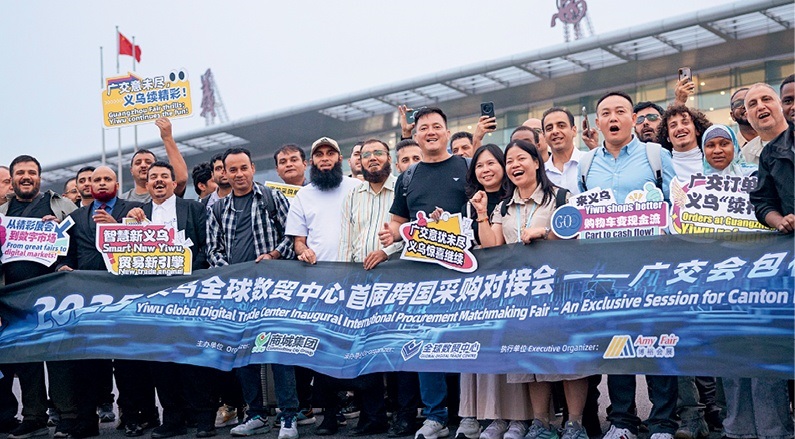
More than 100 purchasing agents from 26 countries and regions around the world arrive in Yiwu on October 27, 2025. With more than 65 percent of the group visiting the city for the first time, they will participate in multiple trading match-up activities held at the Global Digital Trade Center in Yiwu during the following days.
 People-Centered Globalization
For a long time, some Western economists and media outlets have attributed China’s development miracle simplistically to cheap labor or government subsidies. But Yiwu’s development shows that the real competitiveness of the Chinese economy lies in its strong capacity for mobilizing the market, coordinating industries, and running highly efficient supply chains.
For many European and African consumers, Yiwu is no stranger. Goods from this Chinese city can be found in street-side shops across Africa, wholesale markets in southern France, port warehouses in North Africa, and cross-border trade centers in Central and Eastern Europe. By boosting commodity trade, Yiwu contributes to the economy of developing countries, the development of millions of small and medium-sized enterprises worldwide, and the wellbeing and dreams of billions of ordinary families.
For Africa, Yiwu represents a replicable path to inclusive development. The continent has the world’s youngest population and a vast consumer market, yet it faces many challenges such as a weak industrial base and underdeveloped supply chains. Yiwu’s success shows that even without resource endowments, a region can still build global competitiveness by cultivating an open and efficient market ecosystem, reducing transaction costs, and unleashing grassroots vitality. In Yiwu, countless family workshops and micro-enterprises are engaged in foreign trade. This development model, centered on small and medium-sized enterprises, offers inspiring lessons for African countries.
For Europe, Yiwu is a prime example of economic resilience. Despite the rising trolling of de-risking and decoupling in certain parts of the world in recent years, Yiwu’s foreign trade has remained robust. The reason for this lies in the fact that its exports serve the most fundamental and extensive needs of ordinary consumers across the globe. It represents a livelihood-oriented globalization that serves ordinary families, small and medium-sized businesses, and entrepreneurs. No matter how the international landscape shifts, this globalization, rooted in the daily lives of ordinary people, will maintain a strong vitality.
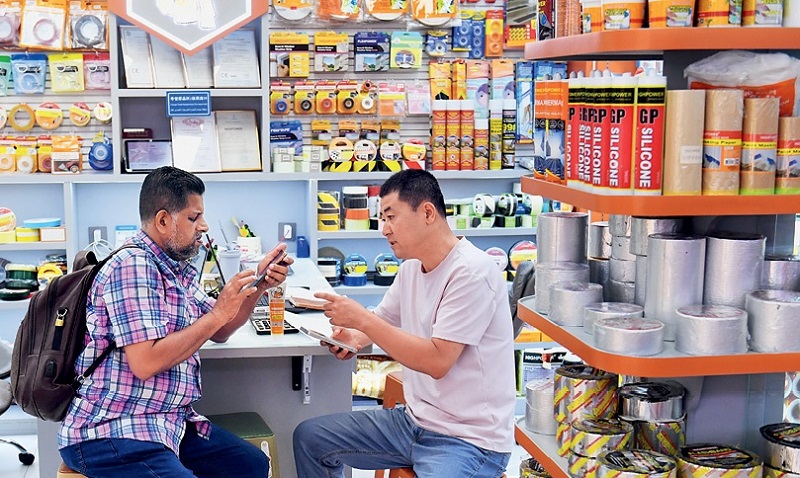
A foreign customer discusses details about exporting products with a local businessman in Yiwu on July 6, 2026. Dong Ning
Chinese Solutions
As globalization is undergoing profound shifts, Yiwu’s transformation has accelerated from traditional commodity trade to new business models such as digital trade, cross-border e-commerce, and overseas warehouses, extending and expanding its global connectivity and services. The ever-evolving Yiwu experience is injecting new certainty into globalization.
During this process, Yiwu has also become more open and inclusive. Today, people from more than 100 countries and regions live and work in the city, including over 15,000 foreign businesspeople who reside there permanently. Yiwu is not just a trade hub, but also a center for cultural exchange and a microcosm of a globalization featuring diversity and peaceful co-existence. At a time when protectionism is on the rise in many parts of the world, the philosophy of openness, cooperation, and mutual benefit that Yiwu embodies is in itself a significant contribution to the world.
As an important participant in South-South cooperation, Yiwu not only provides other developing countries with affordable, high-quality goods, but also serves as a vital demonstration of China’s experience in market-oriented development and industrialization. From street vending to a global hub, Yiwu demonstrates that there is no single template for achieving modernization. Countries can fully explore their own development paths based on their national conditions, and achieve prosperity through openness and cooperation.
When speaking at the 2026 Summer Davos Forum, Chinese Premier Li Qiang said that what China's technologies and products in emerging areas bring to the world are not shocks or threats, but opportunities and empowerment. Yiwu’s practice over the past couple of decades is a vindication of this observation. When Yiwu merchants use AI-powered multilingual tools to communicate with global buyers, when African youth return to their home countries to start businesses after gaining experience in Yiwu, and when the Yiwu-Xinjiang-Europe freight train sustains stable, efficient Asia-Europe supply chains, Yiwu showcases the very essence of the “China opportunity.”
This is the important lesson that Yiwu has offered to the world, and it is also the opportunity that Chinese modernization brings to global development. 
WANG WEN is dean of Chongyang Institute for Financial Studies, Renmin University of China; LIU YING is a research fellow at the institute.