At the 2026 China Yiwu Cultural and Tourism Products Trade Fair, Moroccan student Ben Gharbaout Hajar – known in Chinese as Xiao Yue – was busy promoting an upcoming project in Nigeria for Yiwu Cufei Technology Co., drawing a steady stream of visitors. This was part of her internship: under company policy, successful completion of the two-month internship would secure her a full-time position there, which specializes in China-Africa trade.
“Back in school, my teacher took us to similar exhibitions,” Xiao Yue recalled. “I noticed that many visitors showed strong interest. Such events are a great opportunity to acquire clients.”
The teacher she referred to is Xiong Aisha, an instructor of livestreaming courses at Yiwu Industrial and Commercial College. Known as “the university built on the market,” the college operates a comprehensive talent cultivation system rooted in Yiwu’s global trading practices. Every year, it draws waves of aspiring international entrepreneurs like Xiao Yue, attracting them to come, and inspiring them to stay.
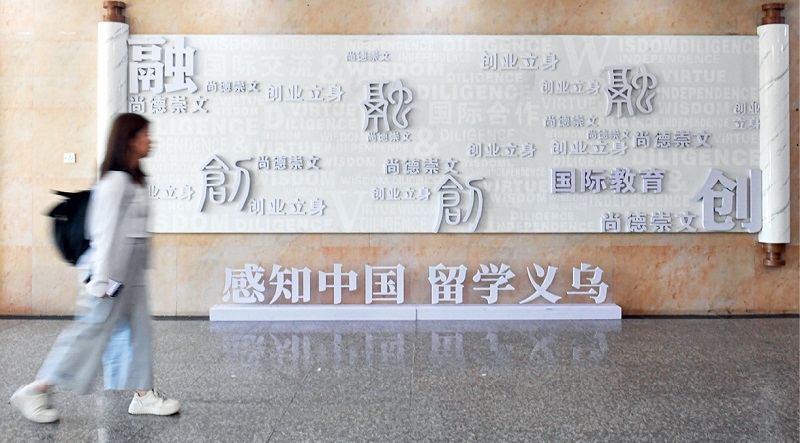
Livestreaming courses at Yiwu Industrial and Commercial College have attracted many international students to study in Yiwu. Dong Ning
From Language Training to Market Practice
“The college provides end-to-end incubation, guiding students from language learning all the way to hands-on entrepreneurship,” said Lü Jun, vice dean of the School of International Education at Yiwu Industrial and
Commercial College.
“New international students begin with Chinese language studies, along with modules on Chinese culture and business policies. They can then switch their visa status and register their own companies,” Lü explained. According to Lü, entrepreneurial education is embedded throughout the entire international student training system, aimed at fostering an entrepreneurial spirit to innovate and start businesses.
In March 2022, an international youth entrepreneurship incubation base was launched at the college, creating a “zero-barrier” pathway for foreign entrepreneurs. “We offer full-cycle support covering company registration, work permit applications, resource matching, and skills training,” Lü added. “These start-ups can register their addresses as our campus, and all services are provided free of charge.” To date, 47 international student-run enterprises have been registered at the base, generating a combined annual revenue of RMB 300 million in 2025.
“When potential partners see that my company is registered right here on campus, they immediately trust me,” said Kamalou-dine Adissa Akinocho, a student from Benin. Based in an office in the staff building, Adissa founded Dinei Import and Export Co., specializing in trade between China and Africa.
He exports hardware and general merchandise from Yiwu to African markets. “I have already established distribution channels in five African countries including Benin, the Republic of Congo, and Burundi.” Yiwu, with a mature commercial ecosystem and stable cross-border supply chains, serves as a vital bridge linking Chinese and African markets.
Since enrolling its first international students in 2007, Yiwu Industrial and Commercial College has trained more than 13,000 individuals from 113 countries. Its international entrepreneur park also serves dual functions: volunteer service and cultural exchange. The college aims to cultivate innovative talents with good ethical values and a global vision, according to Lü. In addition to regular digital commerce courses, students frequently visit wholesale markets, volunteer at trade fairs, and participate in cultural experience weeks each semester. “In business, never shortchange your customers,” Adissa said, a lesson he describes as the most important takeaway from his time at the college.
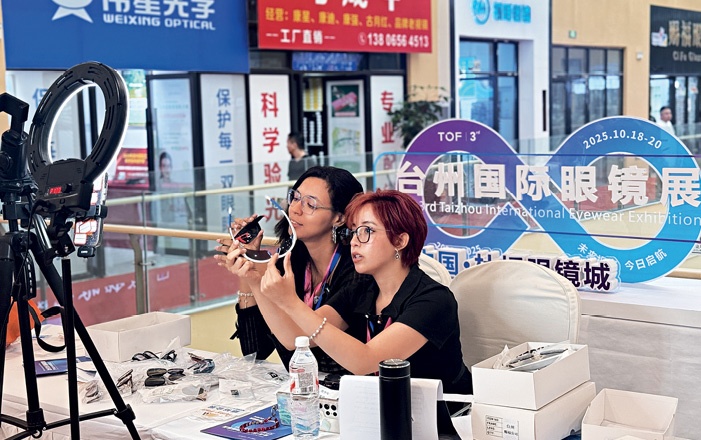
Moroccan student Ben Gharbaout Hajar (right) introduces products during a livestream. Courtesy of Yiwu Industrial and Commercial College
Classrooms in the Market
In recent years, Yiwu has witnessed explosive growth in cross-border e-commerce. In 2025, transaction volume reached RMB 168 billion, marking a year-on-year increase of 19.9 percent. That October, the launch of the Global Digital Trade Center – Yiwu’s sixth-generation market – ushered the city into a new era of digital trade, integrating livestreaming, digital platforms, cross-border e-commerce, and overseas warehouses. As local businesspeople describe it, “upstairs and downstairs are upstream and downstream; shopfronts double as livestreaming studios.”
Yiwu Industrial and Commercial College launched its cross-border e-commerce livestreaming course in September 2022. Inside the college’s livestreaming training base, shelves are stocked with a dazzling array of products. “We adopt a real-world industry-academia collaboration model,” said Xiong Aisha, one of the college’s first livestreaming instructors. “Partner enterprises provide accounts, products, and supply chains, which our students use for live broadcasts during class.” One of her standout students from Yemen routinely switches between Chinese, English, and Arabic during streams, achieving monthly sales of US $1,000-2,000.
Beyond “warehouse streaming” on campus, filming live broadcasts while walking through the marketplace is also a required part of the curriculum. At the Yiwu International Trade Market, which records some 680,000 visits by foreign buyers to its 80,000 booths every day, students showcase Yiwu’s goods to global audiences in Arabic, English, French, and other languages.
“Once students master the basics at the training base, they move on to livestream at the trade mart,” Xiong explained. “They treat the entire market as a livestreaming studio, guiding viewers stall by stall. Whenever an overseas customer shows interest in a product, they stop to introduce it on camera.” Xiong often leads mixed teams of Chinese and international students on these roaming sessions. “We’ve also set up a Brave Broadcasters Volunteer Team, which offers livestreaming training and proxy broadcasting services to small vendors in the trade market.”
Over the past three years, the college has cultivated more than 800 cross-border e-commerce livestreaming professionals with a global vision and multilingual capabilities. It has also delivered tailored livestreaming training programs for partners in South Africa, Nepal, and beyond. In 2024, the college even administered its Vocational Qualification Assessment for Cross-Border E-commerce Livestreaming in Morocco. Su Man, a lecturer at the School of Foreign Languages and International Trade, became the first faculty member dispatched to Morocco to support the initiative.
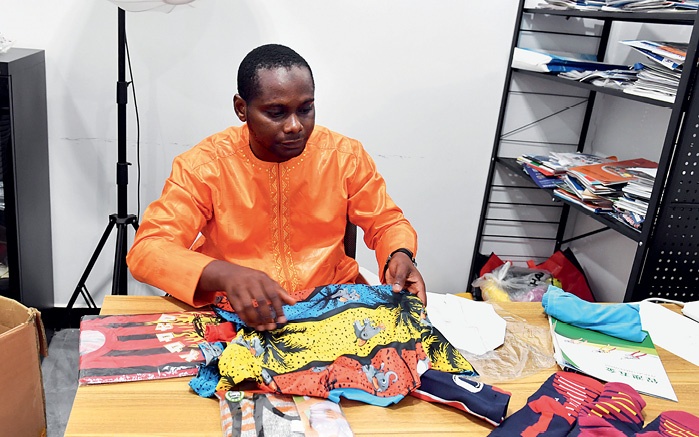
Adissa, from Benin, selects products on July 6, 2026. Dong Ning
From Yiwu to Morocco
Su Man’s journey to Morocco was part of the college’s broader mission to “go global.” In 2023, Yiwu Industrial and Commercial College established its first overseas branch – the Morocco-Yiwu Silk Road Institute, which adopts a “2+1” training model: students study in Morocco for two years before coming to Yiwu for a final year of hands-on business practice. This allows it to cultivate e-commerce talent tailored to Morocco’s needs.
“I spent three months there, primarily teaching Chinese language and international business courses,” recalled Su, who witnessed the program’s early growth firsthand. “As the inaugural cohort, we were all pioneers, and many had little idea about what lay ahead.” The college organized two summer study tours, bringing students to Yiwu to experience its dynamic marketplace. “After those visits, the students grew quite eager for their final year in China – some even arrived a full year ahead of schedule.”
Martis Nicolas Frank, a Senegalese student and a former classmate of Xiao Yue’s in Morocco, was one of those who could not wait. Before coming to China, he had less than 2,000 followers on TikTok. “I never expected that, shortly after arriving in Yiwu, my follower count would surpass 10,000,” he said. His daily glimpses into life in China quickly gained popularity. Inspired by Su Man’s lectures on Sourakhata Tirera, a prominent Senegalese entrepreneur who has built a successful career in Yiwu over the past two decades, Nicolas found his ambition reignited: “He is my role model. I want to become the second Sourakhata Tirera.”
“Each cohort follows a three-year cycle. This year marks the conclusion of our very first program, and all eight students majoring in international economics and trade, including Xiao Yue, have graduated,” said Fang Yifei, deputy director of the International Cooperation and Exchange Office at the International Education School. This September, the college welcomed both the second cohort of international economics and trade students and the inaugural class majoring in big data.
Today, Xiao Yue is pouring her energy into securing a permanent position at Cufei Technology. Nicolas, meanwhile, is following in the footsteps of his predecessors, injecting fresh vitality into China-Africa commerce. And Adissa looks forward to bringing African products to Yiwu and, and through the city, to the rest of China.
“Starting May 1 this year, China’s zero-tariff policy for African nations took effect. Many African traders hope to introduce more African goods into the Chinese market, and I am determined to expand my own trade footprint here,” Adissa said.