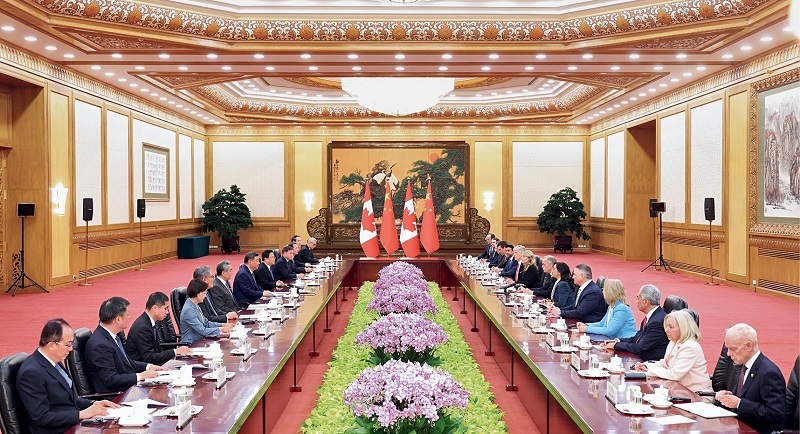
Since the start of 2026, Chinese President Xi Jinping has welcomed a succession of leaders from Western countries. From British Prime Minister Keir Starmer and Canadian Prime Minister Mark Carney to the leaders of Ireland and Finland, the unusually timed concentration of these visits has attracted much attention. More than routine diplomacy, it reflects a broader reassessment taking place among Western countries as they navigate an increasingly complex global environment.
In meetings with visiting leaders, Xi consistently emphasized dialogue, exchanges, and practical cooperation. As China is ushering in its 15th Five-Year Plan period (2026-2030), the country will continue to pursue high-quality development and high-standard opening-up, creating broad opportunities for mutually beneficial cooperation. At the same time, Xi highlighted the importance of upholding the United Nations-centered international system and an international order grounded in international law, placing bilateral engagement within a broader commitment to multilateralism and global stability.
Together, these messages set the tone for China’s engagement with Western countries at the outset of 2026. Cooperation, in this scenario, is not a short-term adjustment but part of a longer-term vision for economic development and global governance, in an era marked by uncertainty and transformation.
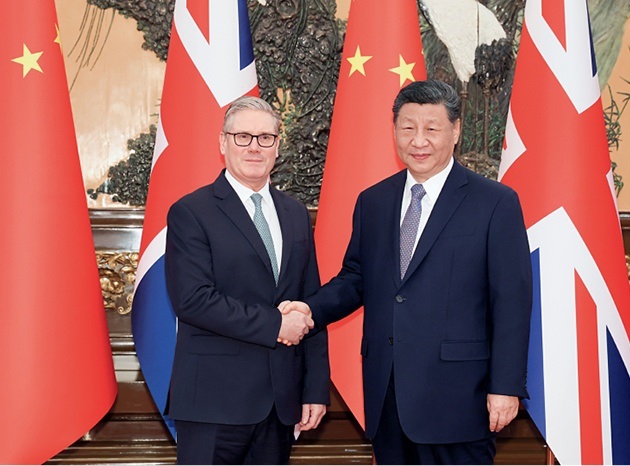
Chinese President Xi Jinping meets with British Prime Minister Keir Starmer at the Great Hall of the People in Beijing on January 29, 2026.
Looking to the East
The recent diplomatic surge by Western leaders reflects a broader strategic reassessment. For many, the certainty offered by engagement with China has become more attractive than the growing unpredictability of the United States.
Canadian Prime Minister Mark Carney’s arrival in China in January, was emblematic of this reassessment. It marked the first visit by a sitting Canadian prime minister in nearly a decade, a hiatus that itself underscores how much the geopolitical landscape has changed.
That visit did not appear in isolation but followed earlier efforts to stabilize ties. Back on October 31, 2025, Xi expressed China’s willingness to further improve bilateral relations when meeting with Carney on the sidelines of the APEC Economic Leaders’ Meeting in South Korea. This underscored that China and Canada should develop an objective and rational perception of each other and advance bilateral relations in light of the common and long-term interests of both countries.
This message was reinforced on January 16, 2026, when Xi described the APEC meeting as a turnaround of the relationship, one that placed bilateral relations on a new trajectory of positive development. He stressed that the steady growth of China-Canada relations serves the common interests of the two countries and contributes to peace, stability, development, and prosperity in the world.
Carney’s own remarks offered further insight into this diplomatic shift. Speaking at the 2026 World Economic Forum annual meeting in Davos, Carney gave a sharp critique of modern great-power politics. “More recently, great powers have begun using economic integration as weapons, tariffs as leverage, financial infrastructure as coercion, and supply chains as vulnerabilities to be exploited,” he said. It has been widely interpreted as a reference to U.S. hegemonism.
Such observations resonated strongly with Canada’s recent experience. Repeated threats by U.S. President Donald Trump to impose punitive tariffs on Canada, along with provocative rhetoric suggesting its incorporation as the “51st state,” have heightened the country’s strategic and economic vulnerability. Against this backdrop, Carney’s outreach to China is a pragmatic response to an increasingly unreliable partner, aimed at stabilizing Canada’s external environment.
This logic has been embraced by many. For middle-sized powers, engagement with China is increasingly understood as a form of strategic hedging, in a world where traditional alliances no longer reliably guarantee economic security or political stability.
British Prime Minister Sir Keir Starmer kicked off his China visit on January 28, 2026, the first one by a British leader in eight years, following Theresa May’s visit in 2018. The timing and symbolism of the visit suggested a renewed effort by London to realign its China policy in response to a rapidly changing global order.
During his meeting with Starmer on January 29, Xi underscored the changing international landscape influencing bilateral exchanges. He pointed out that unilateralism, protectionism, and power politics are running rampant, and the international order is under great strain. “International law can be truly effective only when all countries abide by it,” said Xi, adding that major countries in particular, should set an example, otherwise the world will revert to the law of the jungle.
Building on this assessment, Xi said that as supporters of multilateralism and free trade, China and the U.K. should advocate and practice true multilateralism, make the global governance system more just and equitable, and build an equal and orderly multipolar world and a universally beneficial and inclusive economic globalization.
Reflecting this broader shift, a recent article of The New York Times quoted Wang Yiwei, a professor of international relations at Renmin University of China, as saying that U.S. allies are increasingly seeking to diversify their risks by reducing excessive dependence on any single partner. “China’s might has won respect,” Wang said. “China’s stance has won respect.”
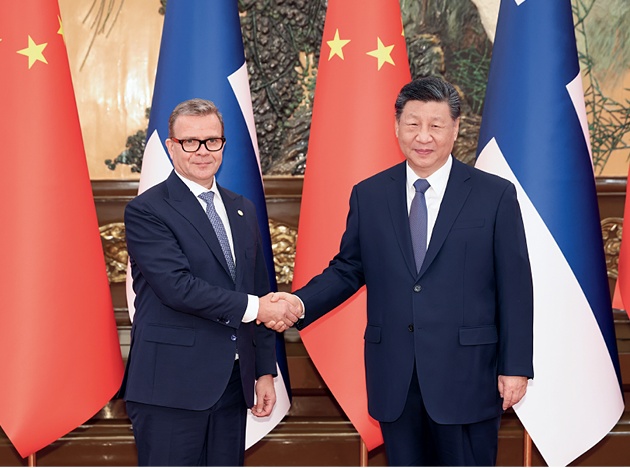
Chinese President Xi Jinping meets with Finnish Prime Minister Petteri Orpo at the Great Hall of the People in Beijing on January 27, 2026.
Seeking Cooperation
China’s pursuit of high-quality development, combined with the scale of its domestic market, has become a key source of attraction for Western leaders seeking economic stability and growth.
As Starmer told the British parliament, “China is the second biggest economy in the world. It’s our third biggest trading partner, supporting 370,000 British jobs, and it is an undeniable presence in global affairs. It would be impossible to safeguard our national interests without engaging with this geopolitical reality.” His remarks encapsulated a growing recognition in the West that engagement with China is less a matter of choice than of necessity.
It is therefore unsurprising that shared economic interests have underpinned many of the recent high-level visits. China, for its part, seeks openness for deeper and more structured cooperation. In his meeting with Starmer, Xi stressed that China–U.K. economic and trade ties are mutually beneficial in nature and that the two sides may expand win-win cooperation in the services sector including education, health, and finance. He also highlighted the potential for joint research and commercial application in frontier areas such as artificial intelligence, life sciences, new energy, and low-carbon technologies, framing economic collaboration as a pathway to shared development and prosperity.
This emphasis on complementarity and future-oriented cooperation has been echoed in China’s engagement with other Western countries. When meeting Irish Taoiseach (Prime Minister) Micheál Martin on January 5, 2026 in Beijing, Xi said China stands ready to work with Ireland to deepen economic and trade cooperation, seek greater synergy between development strategies in areas such as artificial intelligence, the digital economy, and pharmaceuticals and health, and encourage two-way investment. The objective, Xi noted, is to draw on each other’s strengths, share opportunities, and pursue common development.
Similarly, during his meeting with Finnish Prime Minister Petteri Orpo on January 27, 2026, Xi pointed to Finland’s global leadership in winter sports and China’s vast and growing base of participants. He called for the two countries to work more closely with each other to bolster ties in winter sports.
These visits have already produced tangible outcomes, emphasizing the practical dividends of renewed engagement. According to Carney, Canada will allow up to 49,000 Chinese electric vehicles into its market under a most-favored-nation tariff rate of 6.1 percent, while China is expected to lower levies on Canadian canola oil from 85 percent to 15 percent. Similarly, China–U.K. engagement has translated into concrete gains: the two sides reached £2.2 billion in export deals, secured around £2.3 billion in market-access wins, and attracted hundreds of millions of pounds in investment, with China cutting tariffs on British whisky from 10 percent to 5 percent, according to the press release of the U.K. government.
Beyond the figures, these outcomes indicate a broader pattern. Economic pragmatism that is anchored in market access, technological cooperation, and complementary strengths has emerged as a prominent feature in China’s engagement with Western countries. This pragmatism, in turn, supports a wider diplomatic reset driven less by ideology than by shared interests and mutual benefit.
It is in this context that Xi’s remarks to Carney during their January meeting take on particular significance. He said that the two countries should be partners that respect each other, pursue shared development, trust each other, and collaborate with each other.
These principles extend beyond the bilateral relationship. They reflect China’s broader expectations for engagement with Western countries: partnerships defined by mutual respect, practical cooperation, and a long-term perspective. In an increasingly uncertain world, China is presenting itself as a steady and constructive partner committed to stability, development, and shared prosperity.
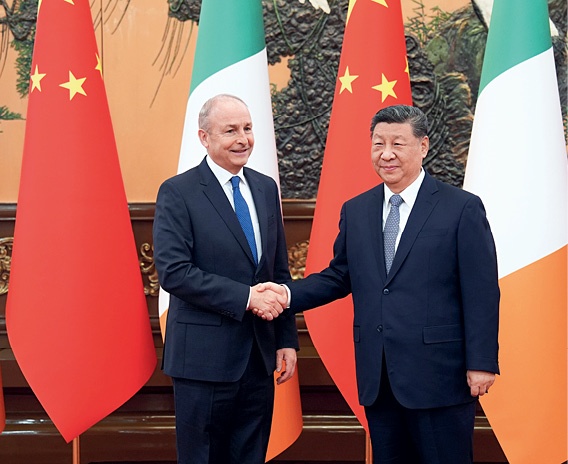
Chinese President Xi Jinping meets with Taoiseach of Ireland Micheál Martin at the Great Hall of the People in Beijing on January 5, 2026.