Senior government officials, technical experts, and policy researchers from 14 developing countries in Asia, Africa, Latin America, and Pacific Island countries gathered at Tsinghua University (THU), Beijing, on September 1-13, 2025 for in-depth study and exchange on “climate finance and low-carbon transformation.”
The South-South Cooperation 2025 Climate Finance Training Program, guided by the Department of Climate Change of China’s Ministry of Ecology and Environment, and organized by the Institute of Energy, Environment and Economy at THU, provided a broad platform for developing countries to jointly pursue green development. It has also become a strong testament to China’s efforts, through the Green Belt and Road Initiative, to collaboratively promote global climate governance and sustainable development.

Trainees of the South-South Cooperation 2025 Climate Finance Training Program visit the Dongguan Exhibition Center in Guangdong Province on September 9, 2025.

New Opportunities for Cooperation
Algeria is the largest country in Africa, with around 85 percent of its territory covered by the Sahara Desert, which endows the nation with abundant renewable energy resources. In recent years, Algeria has been actively developing green energy to achieve energy transition and sustainable development.
At the opening ceremony of the program, Laroussi Sofiane, deputy director of Department of Economic Research at the Algerian Ministry of Energy, Mines, and Renewable Energy, said that Algeria is committed to reducing greenhouse gas emissions by 7 percent by 2030 without external support, and by 22 percent if supported with funding and technology from developed countries. Currently, Algeria is undertaking large-scale construction of combined-cycle power plants to meet the growing demand for electricity, while accelerating the development of renewable energy sources, such as solar and wind power. It is planned that by 2030, renewable energy in Algeria will account for 40 percent of its electricity supply.
Algeria is the first Arab country to establish a comprehensive strategic partnership with China. Since joining the Belt and Road Initiative, the country has been strengthening exchanges and pragmatic cooperation with China.
“Through a brief training, I gained a comprehensive understanding of the significant achievements China has made in green technology. For example, China’s power generation system has undergone a notable transformation, with renewable energy sources such as photovoltaic power playing a crucial role. In addition, the green transformation of the automobile industry has also greatly reduced pollution emissions,” said a deputy department head of Algeria’s Ministry of Energy, Mines, and Renewable Energy surnamed Rafik, noting that China is an ideal partner for Algeria in promoting its energy transition.
According to Rafik, numerous Chinese companies have already gotten involved in energy project construction in Algeria. For example, Algeria plans to develop a 15-gigawatt renewable energy project by 2035, with Chinese companies selected to undertake the construction tasks of the first phase.
The project he mentioned is the 220MW Photovoltaic Power Plant project in Biskra, Algeria, undertaken by the STECOL Corporation North Africa. This is one of the first projects launched in Algeria to achieve the country’s 2035 new energy vision plan. This project is not only a landmark for the development of local clean energy, but also an important support for promoting the province’s green economic transformation. It will play a significant role in ensuring regional power supply, boosting local economic growth, creating jobs, and improving social welfare.
At the Algeria-China Business Forum held in April 2025, enterprises from both sides signed investment agreements totaling US $2 billion. Chinese companies, such as Sinopec, China Railway Construction, JAC Motors, Chery, and Geely, have planned investments in Algeria, and the potential for cooperation between the two countries in areas, such as automobile manufacturing and renewable energy, was further unleashed.
Dong Guangli, Chinese ambassador to Algeria, noted that currently, most photovoltaic equipment in Algeria comes from China, and that green energy is becoming a new area for bilateral cooperation.
Applying Knowledge in Practice
Chinese President Xi Jinping announced a plan to advance South-South cooperation in mitigating climate change in 2015. According to the plan, China will set up 10 pilot low-carbon industrial parks and start 100 climate mitigation and adaptation programs in other developing countries, and provide them with 1,000 training opportunities.
China has done more than what it promised. To date, more than 300 training sessions have been conducted, providing over 10,000 training opportunities for more than 120 developing countries.
A delegation from THU visited the Federal University of Ceará in Brazil at the end of 2024, and signed a memorandum of cooperation. Francisco Murilo, a professor at the Federal University of Ceará, has long been dedicated to research addressing climate change, with a particular focus on the development of sustainable fuels and low-carbon technologies. Taking this opportunity, he gained an in-depth understanding of THU’s innovative achievements in this field and submitted an application in 2025, becoming one of the participants in this training program.
This visit to THU was extremely rewarding for Murilo. The combination of cutting-edge theories and practical case studies has given him a deeper understanding of global energy transition strategies, China’s carbon market mechanisms, and the concrete practices of achieving carbon neutrality.
After returning to Brazil, Murilo plans to integrate the knowledge he has acquired into the projects and activities he is involved in, such as projects focusing on renewable energy integration, hydrogen production, and carbon capture technologies.
Caroline Cabral, an industrial development expert at the National Service for Industrial Training (SENAI) in Brazil, is eager to apply what she learned at the program as soon as possible. She plans to integrate knowledge of green finance and technology roadmaps into SENAI’s strategic planning, and conduct internal training workshops to disseminate China’s core concepts on climate finance and policy design. This aims to better align with national sustainable development goals and attract green investment. These insights will also directly support her doctoral research on sustainable aviation fuels and life cycle assessment.
Cabral has long been deeply involved in key areas for Brazil’s future development, including the bioeconomy, energy transition, and industrial decarbonization, and is responsible for guiding the technological strategy of 28 SENAI innovation institutes across 13 Brazilian states. She stated that during this training program, the intellectual resonance and collaborative spirit demonstrated among participants from 14 countries in the Global South, as well as the in-depth exchanges with senior experts, were unforgettable, providing her with practical insights and actionable guidance.
To date, the Institute for Energy, Environment, and Economy at THU has hosted five specialized seminars on climate investment and financing, attended by approximately 140 professionals in related fields. This has established a global dialogue and cooperation network in the fields of climate change and investment and financing, covering 39 countries. Some participants, upon returning to their home countries, have taken the lead in formulating national climate investment and financing strategies, emerging as key forces in promoting South-South cooperation in global climate governance.
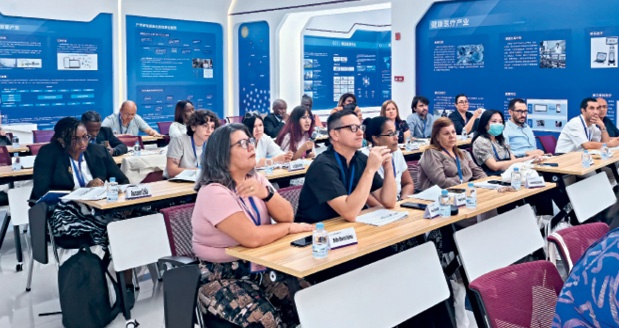
Trainees of the South-South Cooperation 2025 Climate Finance Training Program attend a lecture on the practical application of scientific and technological achievements at the Guangdong Qingda Innovation Research Institute on September 7, 2025.
Fulfilling Promises through Action
The 30th Conference of the Parties (COP30) to the United Nations Framework Convention on Climate Change was held in Belém, Brazil in November 2025. This city, located at the heart of the Amazon rainforest, carries the global expectation for ecological protection and lends profound symbolic significance to the conference.
China’s commitment to keeping its promises gives the international community great reassurance. Ana Toni, CEO of COP30, spoke highly of China’s role in the multilateral framework of global climate governance. She believes that in terms of climate governance, the key right now is to turn promises into action. Brazil and China each have their strengths in technology and resources, and she hopes the two countries can complement each other and work together in areas such as climate governance and green energy.
Murilo also appreciates the exchange and collaboration between China and Brazil. He specifically mentioned that China has demonstrated a leading role in the application of renewable energy, the development of new energy vehicles, and large-scale investment in clean technologies. Currently, the two countries have engaged in practical cooperation in areas such as renewable energy, sustainable agricultural development, and biofuel research. This helps promote knowledge sharing and technological advancement, thereby accelerating the energy transition process for both sides and further consolidating the two countries’ key roles in global climate governance.
Meanwhile, Cabral lauded China’s confidence and determination. She pointed out that China’s policies are ambitious, strategically visionary, and implemented on a large-scale through concrete actions, demonstrating a firm commitment to green transformation. China provides a compelling reference for how governments can guide large-scale investment and drive technological innovation through clear policy signals and industrial planning, she said. She added that although there are still significant challenges in balancing economic growth and carbon reduction, China’s practice proves that with strong determination, driving the development of a low-carbon economy through policy is entirely feasible.
According to Cabral, China has increased its investment in Brazil’s renewable energy sector in recent years, including manufacture of solar panels and electric vehicles, as well as promoted energy transmission and power generation by merger and acquisition. These projects have become an important source of support for Brazil in achieving the climate goals of the Paris Agreement.
Cabral looks forward to all parties turning their commitments into concrete actions, particularly making substantial progress in financial mechanisms needed to support developing countries.
As the host of COP30, Brazil should seize this unique opportunity to speak for countries in the Global South and advocate for a fair and inclusive path to green transition based on each nation’s circumstances, Cabral said.