A Beijing hutong-based bookstore is drawing people back into the quiet, engaging world of reading.
It was a freezing December night in 2023 when Zhao Chen received an urgent call from one of his employees: several neighbors had assembled at his recently opened bookstore, convinced it was to blame for a prolonged water outage in the area. Located in a shared courtyard with six households in a hutong, Dongcheng District, Beijing, the bookstore became the focus of suspicion because its water supply remained unaffected.
Zhao rushed across the city to the scene to calm his neighbors down and called in a professional repair team. As it turned out, the cause of the problem was not the bookstore, but an aging damaged pipe buried in the alleyway. By choosing not to castigate his neighbors and rather resolve the issue overnight, he was able to win their trust.
Inadvertently, this incident helped the bookstore build stronger connections with hutong residents. For example, the windows on the west side are recessed inward toward the bookstore, allowing residents to place everyday items on the windowsill from the other side. Additionally, the bookstore opened a steamed buns shop at its entrance, hiring retired locals from the neighborhood. In return, residents help keep an eye on the bookstore, like receiving deliveries of it.
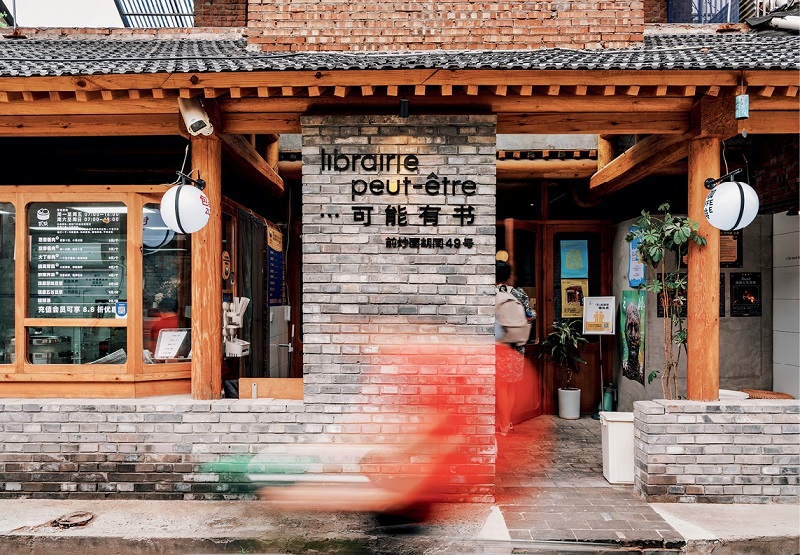
The main entrance of the Possibly Books’ branch in Qianchaomian Hutong.
A Carefully Curated Reading Space
On the outside, the bookstore, known as Possibly Books, blends into the rhythm of hutong life. Inside, it offers a comprehensive reading space shaped by thoughtful design and subtle human interaction, providing alternative possibilities for a bookstore.
Rescued stray cats roam around the space, often playfully acting as furry social bridges. As Zhao told China Today, when a cat jumps onto a table, it can become an “anchor” for the room, prompting brief, quiet interactions among visitors without disturbing the overall atmosphere.
The bookshelf design is another unique feature. Instead of displaying books on shelves in the conventional spine-out manner, the front cover of each book is fully displayed. Zhao believes that book designs reflect a significant level of artistic effort and should be seen rather than hidden. Each section of the shelves are arranged like a small exhibition, often accompanied by handwritten notes and delicate decorations, making browsing an interesting and engaging experience.
This curatorial approach also extends to the bookstore’s exhibitions. Regularly updated, these book-related events infuse the space with ongoing vitality; to date, more than 30 exhibitions have been held. A notable example is the exhibition inspired by the illustrated book A Small, Small World, which depicts everyday life scenes. The display featured the original drawings of the book alongside brief textual excerpts, fostering an intimate and relatable ambiance. On weekends, the author attended the exhibition in person, sketching personalized portraits for visitors, a gesture that deepened the sense of connection. This exhibition not only attracted significant attention but also became the bookstore’s first to turn a profit, showing how thoughtfully designed cultural events can resonate with readers while supporting sustainable operations.
However, running such a store comes with its own challenges. One of the most persistent difficulties, according to Zhao, is maintaining a quiet environment. Unlike typical commercial venues, a bookstore emphasizes silence as an essential part of the reading experience, requiring staff to frequently remind visitors to lower their voices, especially during the early months after opening. This process of “educating customers,” as Zhao puts it, can be mentally taxing but is necessary to preserve the atmosphere the bookstore aims to nurture.
Over time, these efforts have proven worthwhile. For example, on one occasion, a customer accidentally spilled coffee onto a power outlet, causing a small part of the bookstore to lose power. Rather than casting blame, Zhao calmed her down and even offered a replacement drink, acknowledging that the bookstore’s layout also shared some responsibility. Touched by this response, the customer began to regularly come every Sunday morning to make purchases as a gesture of support. For Zhao, such moments reflect a deeper form of mutual respect between the bookstore and its readers that goes beyond transactions and highlights the emotional connection.
Rooted in Community
As the business grows, the bookstore has opened its first branch in Huilongguan on the outskirts of Beijing. Each location is carefully tailored to its surroundings, reflecting Zhao’s belief that a bookstore should organically integratge into the community it inhabits.
The hutong branch attracts a diverse mix of local residents and tourists. Situated near historical sites, it has become a popular stop along “city walk” routes, drawing visitors who come to browse books, attend exhibitions, or simply soak in the atmosphere. This has resulted in a high proportion of first-time patrons.
In contrast, the Huilongguan branch caters to a more settled, community-based audience, largely consisting of employees from nearby tech companies. Here, the rhythm is more regular: many customers come daily to read, work, or study. To serve them better, the branch offers long-term seating and membership options.
Through different models, Zhao demonstrates how each bookstore actively shapes its operation by responding to the people it serves.
The Drive Behind Reading
The decision to open these bookstores was not made on a whim. Zhao’s connection to reading began at around the age of eight, starting with magazine stories and gradually expanding to classical Chinese literature. Over time, reading has defined not only his interests but also his way of understanding the world.
In 2016, Zhao became involved in a community-based cultural initiative, co-founding a public cultural space in a traditional courtyard in Beijing. There, he and his team organized a wide range of cultural activities, including the Peking Party, where local residents dressed in vintage attire for markets and performances, along with a program that paired young people with seniors to exchange daily life experiences.
These years of experimentation in public cultural service provided Zhao with hands-on experience and a network of artists, writers, and cultural practitioners. More importantly, they prompted him to reexamine the sustainability of cultural spaces.
As government funding for such initiatives diminished, Zhao and his partners began exploring a model that could balance cultural value with financial viability. This ultimately led to the founding of Possibly Books in 2023.
Currently, Possibly Books maintains financial equilibrium, with income and expenses in steady balance. According to Zhao, book sales contribute around 40 percent to 45 percent of total income, which is relatively high for an independent bookstore, while the rest comes from beverages, cultural products, and related services.
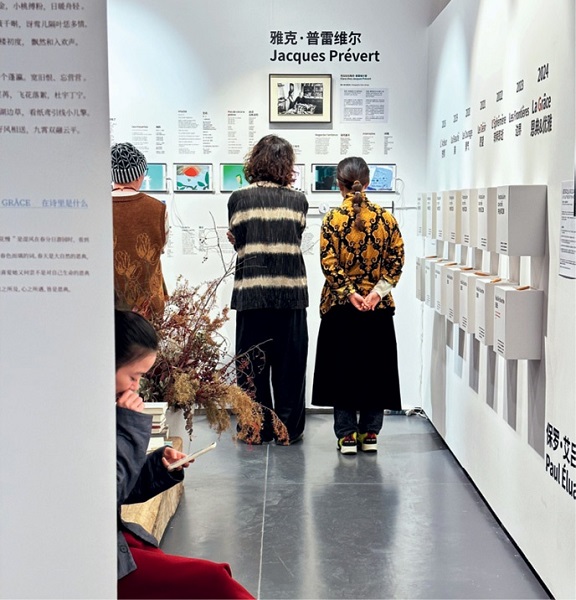
An exhibition on poetry is co-organized by Possibly Books and the French Embassy in China in celebration of the 60th anniversary of the establishment of diplomatic relations between China and France in March 2024. Photos courtesy of Zhao Chen
A Space to Unwind
For Zhao, reading is also a way to reconnect with himself, a return to the bookworm he once was at the library, free from the pressures of daily life and business. This need is widely shared. “Nowadays, people take on various roles in society and face huge pressures,” Zhao said. What many seek is a “third space,” somewhere between home and work, where they can slow down, read, and simply relax.
This philosophy guides the bookstore’s curation, which emphasizes quality over quantity. Rather than chasing bestsellers or market trends, their selection leans toward literature, humanities, and art – books that invite slow and reflective reading. Each title is chosen to align with the store’s overall atmosphere, contributing to a cohesive and contemplative atmosphere.
This approach also resonates with broader changes in consumer behavior. Zhao believes that after a decade dominated by e-commerce and fast-paced digital consumption, many people have begun to feel a sense of fatigue with purely online experiences. Consumers, especially younger, well-educated groups, are increasingly drawn to offline spaces that offer tactility, ambiance, and emotional value. They are increasingly willing to pay not just for products, but for how a place makes them feel.
This shift has also reshaped the landscape of physical bookstores. Traditional bookstores that rely mainly on selling books are gradually fading, while those with distinctive features are gaining ground. Some prioritize spacious study areas, while others explore niche themes such as culinary literature. In this sense, bookstores are evolving into hybrid cultural spaces.
Zhao’s experiment is part of this broader trend. Today, Beijing is home to over 2100 physical bookstores, with more than 0.94 bookstores per 10,000 residents, the highest in terms of both number and density nationwide. With the State Council’s Regulations on National Reading Promotion taking effect in February 2026, the sector is poised for further growth.
In many ways, Possibly Books extends the role that reading has played in Zhao’s own life. By translating his personal relationship with books into a physical space, he offers others the same connection and meaning that reading has long given him. It was the very same connection he fostered on that freezing December night.