In Wuhu City, 57 underutilized spaces have been reborn as vibrant community study rooms, creating a 15-minute reading circle that has welcomed 18 million visitors and reshaped public cultural service for modern urban life.
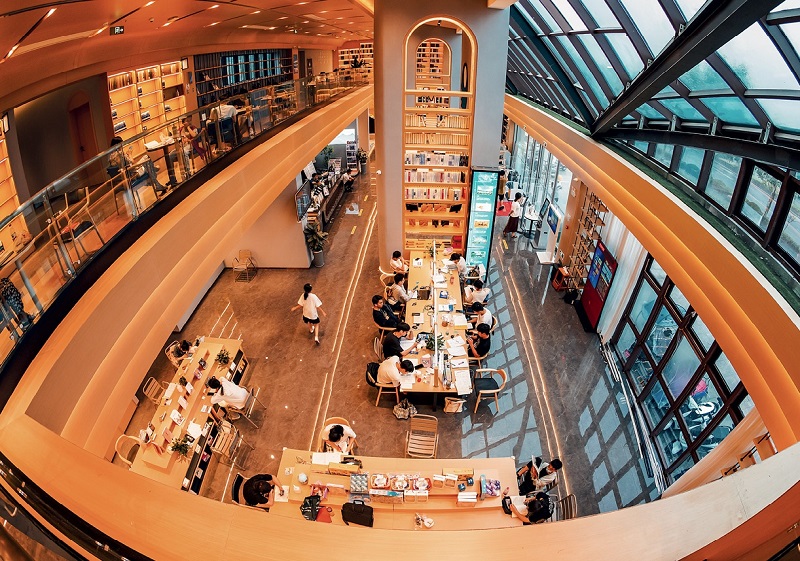
Among the “Wuhu Study Rooms,” the Jiangwan Academy is known as the “most beautiful book house.” Lyu Yunfei
Nestled deep within the green expanse of Shenshan Park in Wuhu, Anhui Province, Chizhu Academy stands as an elegant two-story glass building. Sunlight streams through its thin curtain walls, casting dappled tree shadows onto book pages. Converted from a disused park facility, this academy spans nearly 1,000 square meters and houses more than 30,000 books. Its expansive glass panels seamlessly blend the natural scenery with reading space, causing visitors to often remark that here, with “a book in your hands and a view of nature before your eyes,” time seems to slow down. The academy is part of an initiative to expand peaceful private study, cultural and reading spaces.
Since the launch of the initiative in 2021, known as “Wuhu Study Rooms,” the city has established 57 such public reading spaces, logging over 18 million visits, 3.8 million book loans, and 24,000 cultural events. By the green hills and clear waters of Shenshan Park, amid river breeze of Binjiang Park, or against the grey bricks and dark tiles of Wuhu’s ancient town, these study rooms are scattered across parks, historic towns, villages, and communities, creating a convenient 15-minute reading circle network.
But why would a prefecture-level city invest so heavily in such spaces and how do they integrate into the daily lives of locals? To explore these questions, China Today spoke to Chen Xiuzheng, director of the Wuhu Municipal Library.
Creating a 15-Minute Reading Circle
“The decision to build Wuhu Study Rooms was driven by two main considerations,” Chen explained. “First, to respond to the state’s call for accelerating the development of a modern public cultural service system and meeting the public demand for a 15-minute reading circle. Second, to address citizen’s growing cultural needs, solving the ‘last mile’ problem in public cultural services.”
The goal, Chen noted, is clear: to build convenient, efficient, and welcoming new reading spaces that cover both urban and rural areas, achieving a transformation from “book-based reading” to “cultural experiences.” He emphasized a key principle: “We avoid large-scale demolition and new construction. All Study Rooms are renovated from existing structures. What we revive are idle assets; what we create are quality spaces.” To date, Wuhu has repurposed 41,000 square meters of underutilized space for these facilities, gradually awakening dormant corners of the city.
Chen listed several of these space transformations. Zixian Book Club in Aili Village, Yandun Town, Nanling County, was rebuilt from a former primary school. Viewed from above, it resembles a white cloud floating among the mountains, “preserving rural memories while injecting modern reading and leisure functions.” Yuexiang Book Bar in Jiujiang District, formerly a Vanke City sales center, now features local tech products such as the HIT Robot and JMGO laser projectors, becoming a cross-section of “culture plus technology.” Zhanchuan Bookstore in Wuhu’s ancient town preserves Hui-style architecture with its grey bricks and dark tiles, serving both as a reading space and a window into the region’s ancient memories.
The 15-minute reading circle represents the principle of spatial equity.
Chen revealed that in planning and layout, Wuhu Study Rooms balance “even coverage” with “featured guidance.” In the central urban area, the focus is on “filling gaps,” utilizing idle community buildings to root these facilities in densely populated neighborhoods. In counties and villages, the emphasis is on “extending radiation,” with facilities built at county seats and model villages to activate county-wide reading environments. At scenic nodes such as Shenshan Park, Binjiang Park, Shili Jiangwan, Zhongjiang Park, and Wuhu Ancient Town, the priority is “enhancing quality,” integrating landscape resources with reading spaces to create reading retreats in parks.
Every site undergoes rigorous evaluation, including transportation accessibility, population density, surrounding amenities, and historical-cultural heritage. “We hope these spaces become not just reading venues, but an integral part of citizens’ daily lives,” Chen said.
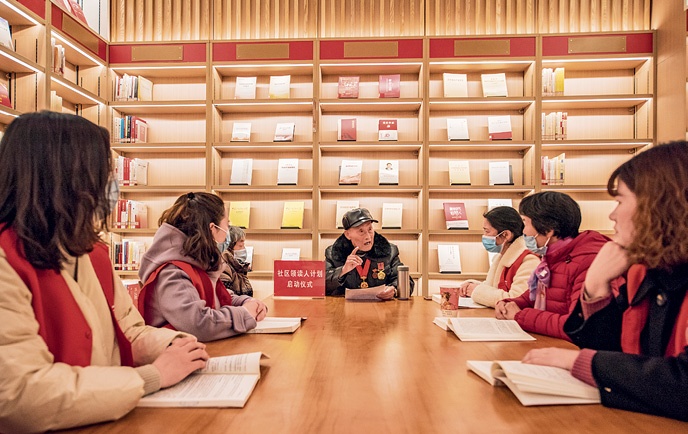
An octogenarian leads a community reading activity held at the Longting Book House. Xiao Benxiang
 Giving Each Study Room a Soul
With 57 such facilities, how does the city avoid cookie-cutter uniformity?
“We adhere to the principle of individuality and functional diversity. Under a unified brand, each Study Room is designed according to local culture,” Chen said. For example, entering Longting Academy in Fanchang District, one encounters the millennium-old porcelain heritage of Fanchang Kiln; at Jiangmuchong Bookstore in Nanling County, the profound weight of bronze culture greets visitors; and at Yungu Study Hall, the rhythms of Tang poetry flow. There are also Qingyijiang Academy, with its red revolutionary themes and Xianfeng Book Garden, with its Party building focus. “Wuhu Study Rooms are not simple copies; each truly has its own character.” Chen told China Today. “We have also set up special sections in these Study Rooms for exhibiting local documents, such as ‘Wuhu Memories’ and ‘Jinghu Impressions,’ to preserve the city’s historical memory.”
Among the 18 million visits, young people constitute the main users. Each facility therefore includes a children’s reading area, offering after-school activities such as picture book sharing, science lectures, and creative handicrafts. Senior citizens are equally well served, with all facilities providing senior listening devices, reading glasses, dedicated newspaper and periodical sections, and spacious, comfortable seating.
The “Reading Wuhu” program has evolved into a citywide reading brand. “The original intention was to tell Wuhu stories and serve citywide reading,” Chen said. He envisions this brand will closely integrate reading promotion with the inheritance of local culture. For example, the City Memory Forum explores Wuhu’s history and culture through lenses such as “City Memory,” “Two Rivers Culture,” “Jiangcheng Cuisine,” and “Urban Architecture.” It has hosted 89 lectures, attracting over 20,000 onsite participants. Additionally, the “Jiuzi School” program reaches primary and secondary schools and rural areas, benefiting 200,000 students. Meanwhile, the Municipal Bureau of Culture and Tourism has partnered with the Federation of Literary and Art Circles, the Communist Youth League, local chronicles offices, and universities to invite writers and artists to these spaces, blending reading with Wuhu’s distinctive resources and cultural elements.
Diverse Operations, Digital Empowerment
“Wuhu Study Rooms embody the philosophy that ‘the people’s city is built by the people,’” Chen said. Operating entities include government-invested platform companies, state-owned cultural-tourism enterprises, and private cultural companies. “The advantage lies in stimulating market vitality and improving operational efficiency,” Chen said. For example, industry professionals such as those from Anhui Xinhua Media have brought managerial expertise. The private bookstore Kuiyue Study operates on a membership system and has independently developed the Kuiyue Chinese Reading Club service, generating an annual revenue of RMB 580,000, thereby enhancing its self-sustaining capacity.
In terms of functions, they focus on free reading, complemented by cultural displays, cultural activities, and value-added services such as cultural products and light food and beverages. This composite functionality gives each facility its unique “soul.”
Cross-sector models such as culture + tourism, culture + sports, and culture + technology have also been introduced. The Zixian Book Club not only offers reading services but has also built a capsule hostel, becoming a tourist destination that effectively stimulates tourism and agricultural product sales in surrounding areas. Yuexiang Book Bar promotes “culture + sports” services, renovating a sports function room and bringing in professional institutions. Its annual revenue now approaches RMB 350,000. In April this year, Wuhu sponsored the Study Room Coffee Month, blending the fragrance of books with the aroma of coffee. This event drove sales of coffee, tea drinks, and baked goods to exceed RMB 300,000. “It guarantees that we can provide economic support for the long-term operation of these reading facilities,” Chen said.
How are 57 facilities managed uniformly? According to Chen, the “six unifications” model is used: unified brand and logo, planning, construction standards, book allocation, information management, and assessment and evaluation. The municipal library allocates books based on each facility’s floor size and uses a unified logistics system to enable citywide borrowing and returning. People can borrow and return books at any Study Room with just their ID cards.
The digital system brings many other conveniences: the Wuhu Study Room Business Management System monitors real-time data such as visitor numbers and book circulation; the Wuhu Public Reading Space Smart Map provides voice explanations, smart navigation, and route recommendations; self-service borrowing and returning machines, and big data analysis platforms, offer services such as categorized search and book recommendations. More than half of these Study Rooms remain open until 8 p.m. or 9 p.m., with over 10 equipped with 24-hour self-service borrowing and returning devices. Today, “night reading” has become a new cultural trend in Wuhu.
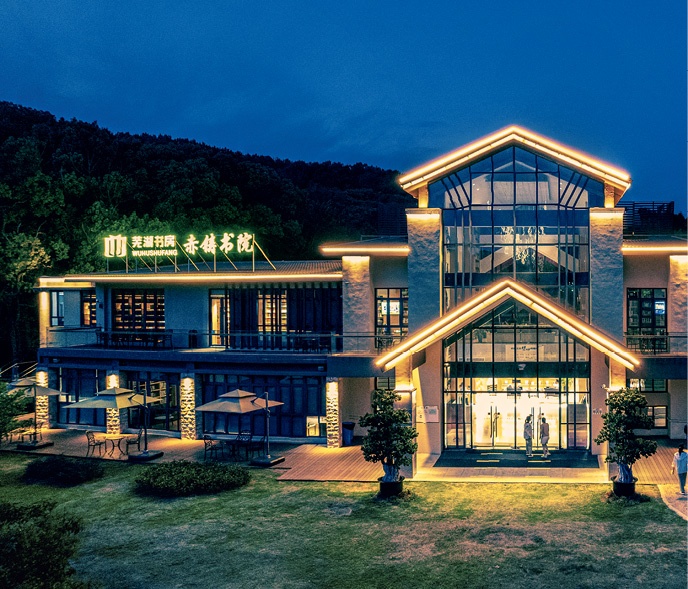
Wuhu citizens read at the Chizhu Academy after work. Du Benqin
Citywide Reading Promoters
Chen said that Wuhu has established a team of 100 “citywide reading promoters,” mostly local cultural scholars, writers, and teachers, who carry out various activities regularly to enhance the professionalism and influence of reading events.
An even greater assistance comes from volunteers. “These young people transform Study Rooms into social practice bases and children’s second classrooms,” Chen said. For example, the School of History at Anhui Normal University has created a volunteer service project called “Ink Charm Through Time, A City of Books,” organizing over 2,100 volunteers who have served local residents in more than 60,000 visits.
“The Youth Volunteer Small Classroom, co-established by Baima Dongtian Academy and the School of History at Anhui Normal University, provides free services for left-behind children and was selected as one of Anhui Province’s Top 10 Reading Promotion Activities in 2023,” Chen said. This was the only Wuhu Study Room to receive that honor.
Regarding reader feedback, multichannel collection mechanisms have been established, including making big data analysis to understand reader preferences, and placing suggestion books at each facility to facilitate dialogue between readers and staff.
Chen told China Today, “Many readers are busy office workers, but they often come to these spaces after work to read for a while, partly to broaden their knowledge, and partly to give their minds a break.”
“When night falls, the lights that come on in these Study Rooms warm the hearts of every book-loving Wuhu resident,” Chen said. “This is our greatest motivation to keep going.”
Looking ahead, Chen said that focusing on “high quality, deep integration, and wide coverage,” Wuhu Study Rooms will continue extending into more residential areas, rural villages, and idle social housing. There will be themed facilities on opera, poetry, iron painting, and more. Efforts will be strengthened to explore digital resources and promote successful rural service models, allowing the charm of books to blend with the peaceful ambience of nature.